
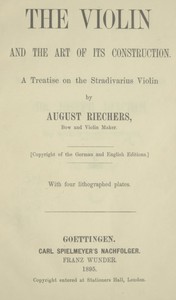
The violin and the art of its construction: a treatise on the Stradivarius…
This isn't a novel with a plot in the traditional sense, but it has a clear and compelling story. August Riechers sets out with one goal: to understand the genius of Antonio Stradivari. The book is his detailed report from the front lines of that investigation. He starts by breaking down the anatomy of a violin, piece by piece—the belly, the back, the scroll, the sound holes. He talks about the importance of wood selection and aging. Then, he gets into the real heart of the matter: the precise geometry, the arching of the plates, and the legendary varnish. Riechers compares Stradivari's work to that of other famous makers, pointing out the subtle differences that he believes create that legendary, singing tone. The 'story' is his journey from observation to understanding, building a logical case for how a master craftsman turned wood and glue into something that feels alive.
Why You Should Read It
What makes this old technical treatise so gripping is Riechers's voice. You can feel his respect bordering on reverence for Stradivari, but also his intense curiosity as a fellow craftsman. He’s not just writing a textbook; he’s trying to reverse-engineer a miracle. Reading it, you get a profound appreciation for the fact that great art is also great science. Every curve has a purpose. Every millimeter matters. It demystifies the Stradivarius legend not by magic, but by showing the incredible depth of skill and thought that went into it. It makes you listen to music differently.
Final Verdict
This book is a niche gem, but a brilliant one. It's perfect for musicians, makers, woodworkers, or anyone fascinated by the intersection of art and precision engineering. If you love shows about how things are made or documentaries about historical mysteries, you'll find a kindred spirit in August Riechers. A word of caution: it gets technical. This isn't casual bedtime reading. But if you're willing to engage with it, you'll be rewarded with a unique look inside the mind of a master trying to learn from the greatest master of all. It's a specialized, insightful, and surprisingly human look at perfection.
This book is widely considered to be in the public domain. Knowledge should be free and accessible.
Elizabeth Martinez
2 months agoMy professor recommended this, and I see why.
Lucas Lee
2 years agoGreat digital experience compared to other versions.
David Ramirez
1 month agoRead this on my tablet, looks great.









George Thompson
3 months agoI took detailed notes while reading through the chapters and the way it handles controversial points with balance is quite professional. The insights gained here are worth every minute of reading.