
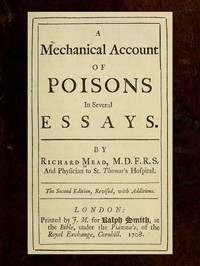
A Mechanical Account of Poisons in Several Essays by Richard Mead
Published in 1702, this isn't a novel with a plot, but the story it tells is gripping in its own way. It's the story of an idea fighting to be born.
The Story
Richard Mead, a young and ambitious physician, presents a series of essays examining different poisons. He starts with the most feared ones of his day: viper venom and the 'virus' from rabid dogs. He describes their effects in gruesome detail, then gets to work. He dissects poisoned animals, tries to isolate the poisonous substance, and tests how it spreads through the body. He argues that these poisons aren't mystical essences but material particles with specific shapes and properties that physically interfere with the body's machinery—blocking blood flow, corroding tissues, or overstimulating nerves. He even applies this 'mechanical' logic to contagious diseases, suggesting they spread through tiny, harmful particles in the air, a radical idea at the time.
Why You Should Read It
What hooked me wasn't that Mead was always right (he wasn't), but his mindset. You can feel his frustration with old, vague explanations. He's determined to find tangible causes. When he describes injecting venom into dogs or applying it to wounds, it's not just for shock value; he's systematically trying to crack a code. His writing mixes careful observation with the bold confidence of someone who believes he's found a new key to understanding nature. Reading him argue his case is like watching a detective piece together a theory without any of the modern tools we take for granted. It's a raw look at the scientific process in its early, messy, and often brutal days.
Final Verdict
This book is perfect for history buffs and science enthusiasts who enjoy seeing how ideas evolve. If you like stories about intellectual pioneers or are curious about the strange and often wrong paths medicine has taken, you'll find this captivating. It's not a light read—the language is 18th-century and the subject is heavy—but it's incredibly rewarding. You're not just reading about poisons; you're witnessing a pivotal shift in how humans explained the things that harmed them. Just be prepared for some graphic descriptions that haven't lost their sting after 300 years.
This publication is available for unrestricted use. Feel free to use it for personal or commercial purposes.
Jackson Jackson
1 year agoThis is one of those stories where it provides a comprehensive overview perfect for everyone. Worth every second.
Mary Torres
7 months agoAfter hearing about this author multiple times, it manages to explain difficult concepts in plain English. I learned so much from this.
Nancy White
5 months agoRecommended.
Lucas Gonzalez
1 year agoAfter hearing about this author multiple times, the author's voice is distinct and makes complex topics easy to digest. A true masterpiece.




Susan Rodriguez
1 year agoAfter finishing this book, the emotional weight of the story is balanced perfectly. One of the best books I've read this year.