About 98 minutes
Songs of love and empire — Inside the Classic
Adventure Picaresque Fiction
22,463 recorded words. 6 minutes difference from this book's estimate.
View Gutenberg source #50162
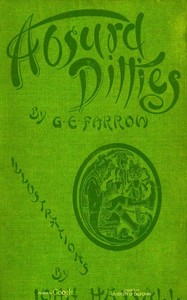
This digital edition of Absurd Ditties — Context and Discussion is described by source-level measurements including 23,832 words, 1 hr 44 min estimated reading time, and 50 detected text sections.
The text analysis averages about 15.9 words per sentence, while the detected sections provide another way to judge how the source is divided.
Project Gutenberg metadata also associates the work with “English wit and humor,” connecting these edition facts with the source record’s subject description.
Explore this collection
These alternatives are selected using recorded categories and estimated reading time.
About 98 minutes
Adventure Picaresque Fiction
22,463 recorded words. 6 minutes difference from this book's estimate.
View Gutenberg source #50162About 79 minutes
Adventure Picaresque Fiction
18,013 recorded words. 25 minutes difference from this book's estimate.
View Gutenberg source #37085About 74 minutes
Adventure Picaresque Fiction
16,951 recorded words. 30 minutes difference from this book's estimate.
View Gutenberg source #47842Search stored excerpts and compare books → Choose by your preferences →
Choices use stored catalog measurements. Estimates vary with reading speed. A shared category is a catalog label, not a claim that two books have the same argument or literary quality.
Search reads excerpt text stored with this catalog and links to its associated Gutenberg record. The connection is stored in the site database; this tool does not recheck that every excerpt is word-for-word identical to that external record. Excerpt search does not cover every chapter and does not verify historical publication dates.
Catalog snapshot checked: 2026-09-26. Coverage: 90 public books, 90 available source excerpts.
Calculated from edition completeness, EPUB availability, text structure and catalogue metadata. Not a user rating.
Total of 100 points, scaled to a 2.5-5.0 range. Editions with an empty description or a missing EPUB file are not scored.
Public-domain source text
The source text is kept in the dedicated reader, separate from this catalogue record and its commentary.
G. E. Farrow's Absurd Ditties (1903) presents sixty-five comic poems, each introduced with the formulaic heading 'That of...'—a structural device that immediately signals the work's playful, cataloguing impulse. The poems move briskly through a rogues' gallery of characters: a judge lamenting a lack of crime, a doctor prescribing sulphur fumes on the Underground, a Fairy Grandmother confronting a Company Promoter. John Hassall's 'Pictorial Absurdities' complement the verse's visual humour.
The collection's architecture is deceptively simple. Each poem operates as a self-contained anecdote, yet recurring patterns—such as the sudden intrusion of the fantastical into mundane settings (a fairy in Throgmorton Street, a skeleton that speaks) and the use of direct address to the reader—create a cumulative effect. Farrow's metre is predominantly anapestic, lending a jaunty, sing-song rhythm that undercuts even the most dire situations.
The title of every poem begins with 'That of' followed by a character or type: 'That of Mr. Justice Dear,' 'That of the Underground “Sulphur Cure,”' 'That of the Fairy Grandmother and the Company Promoter.' This repetitive structure does more than organise the contents; it establishes a mock-serious, almost bureaucratic tone. The reader is invited to treat each absurd figure as a case study or a specimen. The formula also allows Farrow to pivot abruptly between social spheres—from a judge to a pork-butcher to a geisha—without transition, emphasising the arbitrary nature of the collection's taxonomy.
The phrase 'That of' echoes legal or documentary language, a choice that becomes ironic when applied to a 'Hooligan and the Philanthropist' or a 'Deceased Fly.' This tension between form and content is central to the book's humour. The poems themselves often begin in medias res, with a character exclaiming or reflecting, as when Justice Dear opens with ''Tis really very, very queer!'—a line that could serve as an epigraph for the entire volume.
One of the most vividly realised poems, 'That of the Underground “Sulphur Cure,”' takes place on the London Underground, a setting that recurs elsewhere in the collection. The speaker encounters a 'strange old party' who conducts a therapy session on the train, forcing passengers to inhale the sulphurous air of the tunnels. The poem's structure mirrors the journey: stanzas are punctuated by station names ('At Gower Street I chanced to meet'), and the rhythm mimics the clatter of the carriage.
Farrow uses the Underground as a microcosm of modern urban life—crowded, noisy, and slightly toxic. The 'doctor' character, Mr. Chadder, treats his patients by having them 'inhale' and 'swallow' the foul air, a satirical inversion of health fads. The poem ends with a wry nod to electrification: 'Down here there'll be no smoke,' said he, / 'When run by electricity.' This blend of topical reference (the early 1900s saw the Tube's expansion) and absurd logic is typical of Farrow's method.
The poems systematically skewer a range of professions and social roles: judges, solicitors, company promoters, pork-butchers, poets, and cannibals. The satire is rarely vicious; instead, Farrow relies on exposing the gap between a character's self-image and reality. In 'That of the Fairy Grandmother and the Company Promoter,' the financier Septimus Sharpe is visited by a fairy who offers to fill his coffers—a fantasy that punctures the pretensions of the business world. The fairy's appearance 'in a costume unusually airy' in a Throgmorton Street office literalises the notion of a 'fairy godmother' for capitalism.
Other poems target more diffuse targets: 'That of the Hooligan and the Philanthropist' contrasts rowdy behaviour with do-gooding, while 'That of the Socialist and the Earl' stages a class confrontation. The collection's range is broad, but Farrow consistently favours the underdog or the eccentric over the powerful. Even the 'Retired Pork-Butcher and the Spook' receives a sympathetic hearing.
John Hassall's illustrations are integral to the book's effect, as the subtitle 'With Pictorial Absurdities' suggests. Hassall, known for his poster art and comic drawings, provides images that amplify the poems' grotesque and whimsical elements. The illustrations often depict characters in exaggerated poses—a judge in a towering wig, a doctor with a stethoscope on the Underground—that mirror the verse's hyperbole.
The collaboration between text and image is close: the poems frequently describe scenes that the illustrations realise, such as the 'strange old party' tearing his hair on the platform. Hassall's style, with its bold lines and flat colours, suits the poems' broad humour. The illustrations also serve a structural function, breaking up the text and providing visual punchlines. In a collection where the poems are of similar length and form, the illustrations offer variety and emphasis, guiding the reader's eye to key moments of absurdity.
Absurd Ditties rewards reading in sequence, as the cumulative effect of its formulaic titles and recurring motifs—the Underground, the fairy intruder, the pompous professional—builds a coherent comic world. Farrow's verse is best appreciated aloud, where its anapestic rhythms and internal rhymes come to the fore. The poems are short enough to be sampled, but the collection's architecture—its careful arrangement of types and its satirical through-lines—repays sustained attention. Hassall's illustrations are an essential complement, not mere decoration.
Some poems stay like old friends, don’t they? That silly collection of ditties left me smiling days later, much like the quiet ache in Songs of love and empire — Songs of love and empire — Inside the Classic. Different worlds, yet both caught something true about longing and laughter, and I still feel them hovering nearby.
Save your reaction, strongest insight, and memorable passage.