About 36 minutes
Cricket Songs — Reading Notes
Adventure Picaresque Fiction
8,140 recorded words. 2 minutes difference from this book's estimate.
View Gutenberg source #47354
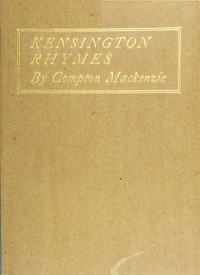
The catalog record for Kensington Rhymes — Themes and Context provides practical reading context through 8,576 words, 38 min estimated reading time, and 2 detected text sections.
The text analysis averages about 22.8 words per sentence, while the detected sections provide another way to judge how the source is divided.
Project Gutenberg metadata also associates the work with “Children's poetry, English,” connecting these edition facts with the source record’s subject description.
Explore this collection
These alternatives are selected using recorded categories and estimated reading time.
About 36 minutes
Adventure Picaresque Fiction
8,140 recorded words. 2 minutes difference from this book's estimate.
View Gutenberg source #47354About 33 minutes
Adventure Picaresque Fiction
7,585 recorded words. 5 minutes difference from this book's estimate.
View Gutenberg source #35452About 29 minutes
Adventure Picaresque Fiction
6,538 recorded words. 9 minutes difference from this book's estimate.
View Gutenberg source #32445Search stored excerpts and compare books → Choose by your preferences →
Choices use stored catalog measurements. Estimates vary with reading speed. A shared category is a catalog label, not a claim that two books have the same argument or literary quality.
Search reads excerpt text stored with this catalog and links to its associated Gutenberg record. The connection is stored in the site database; this tool does not recheck that every excerpt is word-for-word identical to that external record. Excerpt search does not cover every chapter and does not verify historical publication dates.
Catalog snapshot checked: 2026-09-26. Coverage: 90 public books, 90 available source excerpts.
Calculated from edition completeness, EPUB availability, text structure and catalogue metadata. Not a user rating.
Total of 100 points, scaled to a 2.5-5.0 range. Editions with an empty description or a missing EPUB file are not scored.
Public-domain source text
The source text is kept in the dedicated reader, separate from this catalogue record and its commentary.
Compton Mackenzie's Kensington Rhymes (1912) presents a child's-eye view of Edwardian London, where the domestic landscape is charged with both comfort and menace. The opening poem, 'Our House,' catalogues rooms with a mixture of familiarity and unease: the kitchen 'ticks too loud at night' and is 'a horrid place,' while the library 'smells like new boots' and is 'a woolly room.' These sensory details ground the collection in a specific, tactile world.
The poems move between the regulated spaces of the square and dancing class and the wilder territories of imagination. In 'Treasure Trove,' a foggy street becomes a pirate fleet, and a baked potato transforms into Captain Kidd's treasure. This tension between the orderly and the fantastical runs through the collection, as the child narrator navigates rules, rituals, and the private dramas of play.
Mackenzie's child narrator maps the house with a precision that reveals both attachment and anxiety. The staircase has 'a thousand rods / That rattle if you kick,' and the landing is 'a dismal place' where 'the door-knobs twinkle horribly.' These details create a world where the familiar is slightly off-kilter. The cellar is 'quite black with coal,' and the cat goes 'scratching there,' hinting at unseen activity. Even the bathroom is 'a trickling room, / And always smells of paint.'
This attention to sensory detail extends to the square, which is 'really most select' and excludes 'infectious children, dogs and cats.' The social order is internalized: the child knows that 'people from the flats' are not allowed. Yet within this regulated space, sweethearts are chosen, and pebbles and sticks are offered as gifts. The poems capture the way children inhabit adult spaces, finding both security and strangeness in the routines of home.
In 'Treasure Trove,' a foggy walk home becomes a pirate adventure. The lamp-posts 'sailed like a wicked pirate fleet,' and the pavement 'smelt of tar and salt.' The child narrator becomes 'an English midshipman,' and a baked potato is 'just exactly Captain Kidd.' This imaginative leap is typical of the collection: the mundane is constantly reimagined. A bullfinch in a lighted window becomes a parrot in a far-off creek; the parlour-maid at Twenty-two is transformed into 'black-eyed Susan.'
The poems often hinge on such moments of perceptual shift, where the boundary between reality and fantasy blurs. In 'Don Quixote,' the child identifies with the knight because 'he saw queer things, he heard queer sounds / Though he was more than nine.' The child's bedroom becomes a landscape of adventure, with 'the hilly counterpane' serving as a plain for 'strange little knights-at-arms.' Mackenzie captures the way children use imagination to assert control over their environment, turning the ordinary into the extraordinary.
The collection is rich with observations of Edwardian social rituals. 'The Dancing Class' depicts a weekly event where children are 'watched' walking through the rain. 'My Sister at a Party' and 'Kissing Games' hint at the coded behaviors of childhood courtship. In 'Our Square,' the child narrator has a sweetheart who wears 'a dress of crackling white' and 'a shiny sash of pink or blue.' The rituals are observed with a mixture of earnestness and bemusement.
Mackenzie also notes the hierarchies of the street: the 'German Band,' the 'Pavement Artist,' the 'Fortunate Coalmen,' and 'Poor Lavender Girls.' These figures are seen from a child's vantage point, often with sympathy or curiosity. In 'A Visit to My Aunt,' the aunt's house is 'as quiet as a mouse,' and the garden is 'like a secret corner in / A sort of nightmare park.' The child is relieved to return home 'into the shining lamps / And comfortable sound of streets.' The poems consistently balance the allure of the unfamiliar with the comfort of the known.
Readers approaching Kensington Rhymes will find a collection that rewards attention to its small, precise details. The poems are best read as a sequence, where the child's voice accumulates a coherent world. Notice how Mackenzie uses rhyme and meter to echo the rhythms of nursery rhymes while subverting them with moments of genuine strangeness. The illustrations by J. R. Monsell, though not reproduced here, complement the text's blend of charm and unease. This is a book that invites rereading, each poem revealing new layers of observation.
I’ve often shelved Compton Mackenzie’s Kensington Rhymes near the fog-swathed piers of childhood, where rain becomes a sea. Years later, I found The Dream of Gerontius — Reading Notes beside it, and understood both books share a quiet inward gaze—one turning streets to tide, the other turning death to a passage, each tenderly sure of its own strange weather.
A brief reflection can help important ideas stay with you longer.