
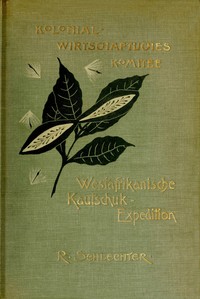
Westafrikanische Kautschuk-Expedition by Rudolf Schlechter et al.
Published in 1911, this book is the official scientific report of a German expedition to Cameroon from 1905 to 1906. Led by botanist Rudolf Schlechter, the team's stated goal was to explore the region's plant life, with a special focus on finding new sources of rubber ('Kautschuk'). The narrative is structured as a travelogue, detailing their journey from the coast into the interior, the landscapes they crossed, and the countless plant species they collected and documented.
The Story
On the surface, it's a straightforward account of exploration. The team moves from village to village, sets up camps, and meticulously records botanical data. They face the expected challenges: difficult terrain, logistical headaches, and tropical illnesses. However, the story beneath the surface is far more complex. The expedition was funded and operating within the framework of German colonial rule in Kamerun. As they travel, they are constant witnesses to the brutal reality of the colonial rubber economy. The report, while focused on science, can't help but note the depopulated villages, the evidence of violence, and the sheer human cost of the rubber quotas imposed on local people. The mission's scientific purpose becomes deeply entangled with the economic and political forces reshaping the region.
Why You Should Read It
This book is fascinating because of what it is and what it implies. As a primary source, it's a direct window into a pivotal moment. Schlechter was a brilliant botanist, and his descriptions of the ecosystem are valuable. But the real power comes from reading it critically. You see the disconnect between the neutral, observational tone of science and the horrific context. You get a sense of the expedition members being caught in a system larger than themselves, documenting paradise while operating in a hell of their own nation's making. It makes you question every explorer narrative you've ever heard. It's not an adventure story; it's a witness statement.
Final Verdict
This is a challenging but essential read for anyone interested in the real history of colonialism, not the sanitized version. It's perfect for readers of history and science who don't mind doing a bit of reading between the lines. If you enjoyed books like King Leopold's Ghost but want to see the mechanics of that era from a ground-level, scientific perspective, this report is a unique and sobering document. Be warned: it's not a light narrative. It's a technical report that reveals a human tragedy, and that contrast is what makes it so unforgettable.
This masterpiece is free from copyright limitations. Thank you for supporting open literature.
Paul Martin
1 year agoComparing this to other titles in the same genre, the author manages to bridge the gap between theory and practice effectively. A rare gem in a sea of mediocre content.
James Sanchez
2 months agoThe layout is very easy on the eyes.

Michael Johnson
8 months agoThis is now a staple reference in my professional collection.