1

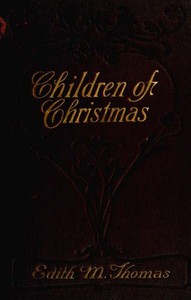
Children of Christmas, and Others — Text and Context
(6 User reviews)
812
Project Gutenberg
2012
Not confirmed
American poetry; Christmas -- Poetry
Readers of public-domain and historical texts
Project Gutenberg digital edition
en
Edition facts
Words
20,294
Reading time
89 min
Text sections
5
Before opening Children of Christmas, and Others — Text and Context, the edition data offers a quick orientation: 20,294 words, 1 hr 29 min estimated reading time, and 5 detected text sections.
The text analysis averages about 21.8 words per sentence, while the detected sections provide another way to judge how the source is divided.
Project Gutenberg metadata also associates the work with “American poetry,” connecting these edition facts with the source record’s subject description.
Source:
Project Gutenberg record #40598
Edith M. Thomas's 1907 poetry collection pairs Christmas-themed verses with poems about children, nature, and folklore, using precise diction and varied voices to explore innocence, loss, and the natural world.
Editorial Edition Score
4.6/5
★★★★★
★★★★★
Calculated from edition completeness, EPUB availability, text structure and catalogue metadata. Not a user rating.
How this score is calculated
- Description quality20 pts
- Title & short description10 pts
- Source metadata20 pts
- Text length15 pts
- Chapters / structure15 pts
- EPUB file integrity20 pts
Total of 100 points, scaled to a 2.5-5.0 range. Editions with an empty description or a missing EPUB file are not scored.
Edition quality
Read the Text
She had no license, and, when fined, The fine she could not meet."
"My mamma's good. Please, let her go." The judge looked down and smiled; "So well you've pleaded, she shall be Your Christmas Present, child."
"Now take this paper, little one, It sets your mother free. She should be very proud of you; Go, tell her so, from me."
With doll in arms away she went, And soon the prison gained; And when her mother clasped her close, The happy child explained:
"A kind, good man like Santa Claus, With hair as white as snow, He let you out because--because I asked him too, you know!"
When Poebe brought the wood and coal; To lay the fire, what did she see But Baby--dropped upon one knee And peering up the chimney-hole!
She never turned her little head, With all its curly, yellow hair: I asked, "What are you doing there?" "Me look for Santa Taus!" she said.
REFRESHMENTS FOR SANTA CLAUS
"It may be late and stormy and cold When Santa Claus reaches our street; And Santa, you know, is very old, So I'll leave him something to eat."
"And what do you think he would like, dear heart," "Something nice and sweet," she said; "Jelly and jam, and a cranberry tart, And a _teenty_ piece of bread!"
So there on the sideboard is Santa's feast, Which her own small hands have spread; Jelly and jam,--three kinds at least, And a tart--but _where is the bread_?"
HOW THE CHRISTMAS TREE WAS BROUGHT TO NOME
Night of the winter--winter and night in the city of Nome, There where the many are dwelling, but no man yet has a home! Desolate league upon league, ice-pack and tundra and hill; And the dark of the year when the gold-hunter's rocker and dredge are still!
By the fire that is no man's hearth,--by the fire more precious than gold,-- They are passing the time as they may, encompassed by storm and by cold: And their talk is of pay-streak and bedrock, of claim by seashore or creek, Of the brigantine fast in the ice-pack this many and many a week; Wraiths of the mist and the snow encumber her canvas and deck,-- And the Eskimos swear that a crew out of ghostland are crowding the wreck!
Thus, in the indolent dark of the year, in the city of Nome, They were passing the time as they might, but ever their thoughts turned home. Said the Man from the East, "In God's country now (where we'd all like to be), You may bet your life there's a big boom on for the Christmas Tree; And we'd have one here, but there isn't a shrub as high as my hand, Nor the smell of spruce, for a hundred miles, in all this land!"
Then the Man from the South arose: "I allow, if the Tree could be found, I'd 'tend to the fruit myself, and stand ye a treat all round!" "Done!" said the Man from the West (the youngest of all was he). "I'll lose my claim in the ruby sand--or I'll find the Tree!"
The restless Aurora is waving her banners wide through the dome, And the Man from the West is off, while yet they are sleeping in Nome! Off, ere the low-browed dawn, with Eskimo, sledge, and team: He is leaving the tundra behind, he is climbing the source of the stream! On, beyond Sinrock--on, while the miles and the dim hours glide-- On, toward the evergreen belt that darkens the mountain side! 'Tis a hundred miles or more; but his team is strong, is swift, And brief are his slumbers at night, in the lee of the feathery drift!
There were watchful eyes, there were anxious hearts in the city of Nome; And they cheered with a will when the Man from the West with his prize came home! And they cheered again for the Christmas Tree that was brought from far, Chained to his sledge, like a king of old to the conqueror's car!
Said the Man from the South, "I'll 'tend to the fruit that grows on the Tree!" Said the Man from the East, "Leave the Christmas dinner and trimmings to me!"
Said the Holly to the Mistletoe: "Of this holy-tide what canst know,-- Thou a pagan--thou Of the leafless bough? My leaves are green, my scarlet berries shine At thought of things divine!"
To the Holly spake the Mistletoe: "Matters not, my leafless boughs but show Berries pale as pearl-- Ask yon boy and girl! If human mirth and love be not some sign Of share in things divine!"
THE FIREBRAND (_Northern Ohio, Christmas Eve, 1804_)
Edith M. Thomas's Children of Christmas, and Others (1907) opens with a cradle song that immediately establishes a distinctive voice: the speaker addresses a winter-born child with the line 'Happy thou, a winter comer,' a compact inversion that signals Thomas's willingness to reshape syntax for metrical effect. Throughout the collection, she moves between simple nursery rhythms and more complex, sometimes archaic diction—'Nowel,' 'cherub faces'—that gives the Christmas poems a liturgical gravity. The book is divided into three sections: 'Children of Christmas,' 'Other Children,' and 'Some of Their Friends,' the last turning to birds, animals, and natural phenomena. Thomas's verse is notable for its shifting perspectives: she writes from the point of view of a giant's daughter, a homesick soldier, a Cossack mother, and even a cat, often using dialogue or direct address to create intimacy.
Diction and the Christmas Voice
Thomas's Christmas poems employ a deliberately varied lexicon. In 'Cradle Song,' she uses the archaic 'Nowel' alongside the colloquial 'cherub faces,' blending sacred and domestic registers. The poem 'How Many' (partially excerpted) uses a question-and-answer structure that mimics a child's curiosity, while 'A Christmas Spy' adopts a conspiratorial tone. The most striking example of diction is in 'The Giant's Daughter,' where the giant child exclaims 'Live toys are best—I'll have no other!'—a line that juxtaposes childish enthusiasm with the absurd scale of the narrative. Thomas also uses repetition for emphasis: in 'The Homesick Soldier,' the refrain 'What do my darlings so far away?' is answered by the quail, the river, and the stars, each reply building a cumulative emotional effect. The vocabulary is often concrete and sensory: 'scatter the dew,' 'small bare feet,' 'mimic fleets adrift.'
Dialogue and Dramatic Monologue
Many poems in the collection are built around direct speech or dramatic monologue. 'The Cossack Mother' is a first-person lament: 'My little one will die to-night / (Then break, my heart, oh, break!).' The parenthetical aside creates a double voice—the mother's outward statement and her inward anguish. In 'The Giant's Daughter,' the narrative is framed as a fable ('says my fable'), and the dialogue between the giant child and her mother is rendered in simple, almost proverbial lines: 'Go, take the plowman back, my child, / To fields beside the blue Rhine water.' Thomas also uses question-and-answer patterns, as in 'The Homesick Soldier,' where the soldier's queries are answered by natural elements. 'Erotion and the Dove' is a monologue from a child who has died, speaking from heaven: 'I was too young, they said (I was not seven).' The parenthetical again adds a layer of innocence and precision.
Description and the Natural World
Thomas's descriptive passages are economical but vivid. In 'The Homesick Soldier,' the setting is established in three lines: 'The soldier woke at the quail's first note, / At dawn, on the grassy couch where he lay.' The 'grassy couch' is both literal and suggestive of the soldier's vulnerability. In 'The Cossack Mother,' the sky is described as 'smoky clouds' that 'blot the sunset sky,' a detail that ties the personal tragedy to a larger battlefield. The poem 'The Blossom-Child' uses a repetitive, incantatory structure—'The flowers, the haunted flowers of May'—to evoke a sense of haunting beauty. Thomas often personifies natural elements: the river 'runs through the fields of home,' the stars 'shine on the fields of home.' In 'The Giant's Daughter,' the scale of description shifts dramatically: the giant child's discovery of a plowman is rendered with comic disproportion—'The great trees trembled, miles around, / The rocks gave back a sound like thunder.'
Structure and Metrical Patterns
Thomas employs a variety of metrical forms, from the simple quatrains of 'Cradle Song' (abab) to the more complex rondeau-like repetition in 'The Blossom-Child,' where the line 'The flowers—the haunted flowers of May' recurs as a refrain. The poem 'How Many' uses a question-and-answer structure that builds anticipation. 'The Homesick Soldier' is organized around three stanzas, each corresponding to a time of day (dawn, march, twilight) and a natural interlocutor (quail, river, stars). This tripartite structure gives the poem a ritualistic quality. 'The Cossack Mother' uses a regular ballad meter (alternating tetrameter and trimeter) but breaks the pattern with the parenthetical 'Then break, my heart, oh, break!'—a metrical interruption that mirrors emotional disruption. Thomas also uses enjambment sparingly but effectively: in 'Erotion and the Dove,' the line 'But they were wrong, for when I came to heaven' carries the reader into the next line, emphasizing the child's arrival.
Readers approaching Children of Christmas, and Others should attend to the way Thomas modulates voice from poem to poem: the same poet who writes a lullaby for the Christ child also ventriloquizes a giant's daughter, a dying soldier, and a bereaved mother. Her diction is never merely decorative; it serves to establish character and emotional register. The collection rewards attention to its structural patterns—repetition, refrain, question-and-answer—and to the way Thomas uses the natural world as both setting and interlocutor. These poems are best read aloud, where their rhythms and shifts in tone become most apparent.
There’s something tender in how Edith Thomas holds both the child’s wonder and the ache of what fades, each poem a small room with its own weather. Reading her makes me think of that older, stranger voice in Satan Absolved: A Victorian Mystery — Reading Notes — how even a cosmic argument can feel, at odd moments, like a lullaby for grown-ups who’ve forgotten the tune.
Dylan Thompson
2 weeks agoAvery Scott
2 weeks agoSophia Davis
4 weeks agoOlivia Young
1 month ago-

Cody Rogers - 1 month ago
The collection is uneven, with only a couple of genuinely memorable stories. The prose is overwrought, and the plots often rely on clichés. The Christmas stories try too hard to be sentimental, resulting in forced emotion. As a whole, it feels dated and lacks the freshness that would appeal to modern readers. Disappointing. -
Linda Burke - 2 weeks ago
'Children Of Christmas And Others' offers a charming mix of festive and non-festive stories. The Christmas tales are heartwarming, but some of the 'others' feel out of place and less engaging. The writing is solid with a nostalgic tone, though a few stories could have been trimmed for better impact. Overall, a pleasant read. -
Sandra Roberts - 2 weeks ago
A beautiful collection of Christmas stories that capture the magic and warmth of the holiday season. Each tale is unique, yet they all share a common thread of hope and humanity. The author's prose is lyrical and evocative, making it perfect for cozy evenings by the fire. A timeless addition to any Christmas library.
Reader reflection
Before you leave, reflect on the book
Use these questions to collect your thoughts before moving on.
Your progress
0
/
10
2
Was reading this book enjoyable?
3
Is this a title you would suggest to others?
4
How easy was the book to follow?
5
How clear did the writing feel?
6
Did the book deliver what you hoped for?
7
Did it raise ideas you would like to talk about?
8
Was the book moving at the right speed?
9
In one sentence, what did you learn?
10

Madison Jones
1 month ago