About 27 minutes
Splores of a Halloween, Twenty Years Ago — A Closer Reading
Science Fiction Utopias
6,002 recorded words. 4 minutes difference from this book's estimate.
View Gutenberg source #34780
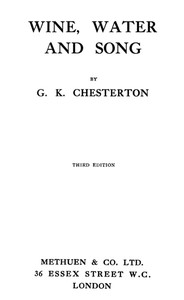
Before opening Wine, Water, and Song — Key Ideas to Explore, the edition data offers a quick orientation: 7,043 words, 31 min estimated reading time, and 1 detected text section.
The text analysis averages about 26.8 words per sentence, while the detected sections provide another way to judge how the source is divided.
Project Gutenberg metadata also associates the work with “English poetry,” connecting these edition facts with the source record’s subject description.
Explore this collection
These alternatives are selected using recorded categories and estimated reading time.
About 27 minutes
Science Fiction Utopias
6,002 recorded words. 4 minutes difference from this book's estimate.
View Gutenberg source #34780About 27 minutes
Science Fiction Utopias
6,201 recorded words. 4 minutes difference from this book's estimate.
View Gutenberg source #53002About 37 minutes
Science Fiction Utopias
8,472 recorded words. 6 minutes difference from this book's estimate.
View Gutenberg source #37214Search stored excerpts and compare books → Choose by your preferences →
Choices use stored catalog measurements. Estimates vary with reading speed. A shared category is a catalog label, not a claim that two books have the same argument or literary quality.
Search reads excerpt text stored with this catalog and links to its associated Gutenberg record. The connection is stored in the site database; this tool does not recheck that every excerpt is word-for-word identical to that external record. Excerpt search does not cover every chapter and does not verify historical publication dates.
Catalog snapshot checked: 2026-09-26. Coverage: 90 public books, 90 available source excerpts.
Calculated from edition completeness, EPUB availability, text structure and catalogue metadata. Not a user rating.
Total of 100 points, scaled to a 2.5-5.0 range. Editions with an empty description or a missing EPUB file are not scored.
Public-domain source text
The source text is kept in the dedicated reader, separate from this catalogue record and its commentary.
The first poem, 'The Englishman,' immediately establishes a pattern of playful, combative nationalism. St. George is presented not as a saintly ascetic but as a man who 'drank a pint of English ale / Out of an English flagon.' The stanza structure—three lines of narrative followed by a punchy, rhymed couplet—recurs throughout the collection, giving each poem a ballad-like momentum. Chesterton’s voice is unmistakable: he uses food and drink as moral symbols, equating ale with freedom and beans with constraint. Readers should watch for how this opening poem sets up a binary (ale vs. cakes, bacon vs. beans) that the later poems expand into a full-blown comic war between robust indulgence and timid reform.
'Wine and Water' takes the biblical flood and turns it into a joke about Noah’s priorities. The refrain—'I don't care where the water goes if it doesn't get into the wine'—is repeated with variations, each time after an increasingly absurd description of the deluge. The cataract of heaven is 'blinding off the brink,' washing stars away 'as suds go down a sink.' Chesterton’s hyperbole serves a serious point: the poem ends with a 'great big black teetotaller' sent as a rod, and the final lines lament that 'you can't get wine' because water has triumphed. This poem is the collection’s theological center, using Noah as a figure of sensible hedonism. Notice how the rhyme scheme—long, rolling couplets that mimic the flood’s momentum—contrasts with the clipped, bitter final stanza.
Several poems target specific types of hypocrisy. 'The Song against Grocers' attacks merchants who sell 'tea and coffee' and 'butter and eggs' while pretending to be honest; Chesterton calls them 'the poisoners of England.' 'The Song of Quoodle' is a dog’s lament that humans have lost their sense of smell, a metaphor for losing instinctual joy. 'The Logical Vegetarian' satirizes a man who 'eats his dinner with a fork' and 'cannot eat his dinner with a fork'—a paradox that mocks rigid dietary rules. These poems share a structure: a series of hypotheticals ('If I had been a Heathen…') that contrast the speaker’s imagined freedom with the vegetarian’s dreary life. The recurring word 'Heathen' is used ironically, as the speaker implies that true paganism is more honest than modern piety.
'The Rolling English Road' is one of Chesterton’s best-known poems, celebrating the drunken, winding roads of England that 'go rolling all alone.' The poem’s meter mimics a lurching walk, with lines like 'Before the Roman came to Rye or out to Severn strode.' 'The Song of the Oak' personifies the oak tree as a symbol of English endurance, contrasting it with 'the foreign tree' that 'grows in a foreign land.' Both poems use natural imagery to argue for a native, organic tradition against imported ideas. The oak is 'the tree that grows in the good green wood,' and the road is 'the road that goes to heaven.' These poems are less satirical than the earlier ones, offering a positive vision of Englishness rooted in landscape and history.
The collection’s final poems sharpen the moral paradoxes. 'The Song of Right and Wrong' declares that 'feast on wine or fast on water, / And your honour shall stand sure,' but then attacks tea, cocoa, and soda water as corrupt. The logic is deliberately perverse: it is not the substance but the attitude that matters. 'Who Goes Home?' shifts to a darker tone, with a refrain that echoes a parliamentary call but answers it with blood and battle. The poem ends with a 'voice valedictory' asking 'Who is for Victory? / Who is for Liberty? / Who goes home?' This ambiguity—home as death, home as England, home as a pub—leaves the reader with a riddle. Throughout, Chesterton uses simple rhyme schemes to deliver complex arguments, often turning a stanza on its head with a final line that contradicts the preceding ones.
Readers approaching this collection for the first time should pay attention to the tension between the rollicking surface and the serious undercurrent. Chesterton’s poems are not mere drinking songs; they are arguments about freedom, tradition, and the dangers of reform. The recurring figures of Noah, St. George, and the 'Heathen' serve as touchstones for a worldview that values joy over utility. The poems reward rereading, as the paradoxes often reveal deeper layers on second encounter.
I keep thinking about how Chesterton’s ale-soaked verses celebrate the stubborn joy of simple things, the way St. George’s quiet valor outshines noise. That same gentle firmness lives in The Holy Isle: A Legend of Bardsey Abbey — A Reader’s Guide, where faith feels like water finding its way through stone. Some books sit with you like an old friend’s hand on your shoulder.
Answer a few questions and save a private reflection on this device.