About 69 minutes
Songs of Sea and Sail — Context and Discussion
Adventure Picaresque Fiction
15,812 recorded words. 2 minutes difference from this book's estimate.
View Gutenberg source #43739
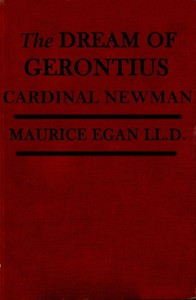
The catalog record for The Dream of Gerontius — Reading Notes provides practical reading context through 16,265 words, 1 hr 11 min estimated reading time, and 9 detected text sections.
The text analysis averages about 20.3 words per sentence, while the detected sections provide another way to judge how the source is divided.
Project Gutenberg metadata also associates the work with “Christian poetry, English -- 19th century,” connecting these edition facts with the source record’s subject description.
Explore this collection
These alternatives are selected using recorded categories and estimated reading time.
About 69 minutes
Adventure Picaresque Fiction
15,812 recorded words. 2 minutes difference from this book's estimate.
View Gutenberg source #43739About 74 minutes
Adventure Picaresque Fiction
16,951 recorded words. 3 minutes difference from this book's estimate.
View Gutenberg source #47842About 79 minutes
Adventure Picaresque Fiction
18,013 recorded words. 8 minutes difference from this book's estimate.
View Gutenberg source #37085Search stored excerpts and compare books → Choose by your preferences →
Choices use stored catalog measurements. Estimates vary with reading speed. A shared category is a catalog label, not a claim that two books have the same argument or literary quality.
Search reads excerpt text stored with this catalog and links to its associated Gutenberg record. The connection is stored in the site database; this tool does not recheck that every excerpt is word-for-word identical to that external record. Excerpt search does not cover every chapter and does not verify historical publication dates.
Catalog snapshot checked: 2026-09-26. Coverage: 90 public books, 90 available source excerpts.
Calculated from edition completeness, EPUB availability, text structure and catalogue metadata. Not a user rating.
Total of 100 points, scaled to a 2.5-5.0 range. Editions with an empty description or a missing EPUB file are not scored.
Public-domain source text
The source text is kept in the dedicated reader, separate from this catalogue record and its commentary.
John Henry Newman's The Dream of Gerontius is cataloged under 'Christian poetry, English -- 19th century' and 'Adventure & Picaresque Fiction,' yet the excerpts reveal a work that is neither adventurous in plot nor picaresque in tone. Instead, the poem unfolds as a dramatic monologue of a disembodied soul, Gerontius, moving through judgment and purgation. The catalog's adventure label likely refers to the soul's perilous journey, but the text's structure—alternating between the Soul's anxious questions and an Angel's theological explanations—resembles a Socratic dialogue more than a narrative of external events.
The excerpts emphasize the Soul's deprivation of sight: 'All has been darkness since I left the earth' and 'I see not those false spirits.' The Soul retains hearing, taste, and touch, but lacks 'that princely sense / Which binds ideas in one.' This sensory hierarchy is central to the poem's epistemology. The Angel explains that the Soul lives 'in a world of signs and types,' not direct perception. This metaphysical conceit—that the disembodied soul experiences reality through mediated 'lower measures of perception'—is a precise theological argument, not an adventure trope. The catalog's 'Adventure' category seems to misrepresent the poem's introspective, doctrinal focus.
The demons speak in a distinctive, irregular meter with short lines and exclamations ('Ha! ha!'), contrasting sharply with the Angel's measured blank verse. Their speeches are vituperative and mocking, targeting saints as 'psalm-droners' and 'crawling knaves.' This theatrical quality—almost operatic in its alternation of voices—gives the poem a dramatic structure. The demons' arguments are not physical threats but rhetorical assaults, questioning the motives of virtue: 'He'll slave for hire; / Ha! ha! / And does but aspire / To the heaven above / With sordid aim, / And not from love.' This focus on spiritual combat through language aligns more with theological debate than picaresque adventure.
The Angel functions less as a guide through peril and more as a theological interpreter. When the Soul fears judgment, the Angel explains the nature of demons: 'in thy trial-state / Thou hadst a traitor nestling close at home'—referring to the body's senses. The Angel's speeches are didactic, clarifying the Soul's condition rather than advancing a plot. For instance, the Angel describes demons as 'caged within their bars,' pacing 'to and fro'—a static image of confinement. This static, explanatory role contradicts the 'Adventure' cataloging; the poem's movement is inward, toward understanding, not outward toward action.
Readers approaching The Dream of Gerontius should set aside expectations of adventure or picaresque narrative. The poem rewards attention to its theological structure, the interplay of voices, and the precise imagery of sensory deprivation. Newman's work is a meditation on the soul's state after death, rendered through dramatic dialogue and doctrinal exposition. The catalog subjects, while not entirely inaccurate, fail to capture the poem's contemplative and liturgical character.
I remember sitting with Newman's poem on a quiet Sunday, feeling the soul's terror and trust unwind together. It stirred something of my father's last weeks. Then I thought of Blottentots, and How to Make Them — Text and Context, which once gave me the same odd comfort — that making something clumsy and small can be its own kind of prayer.
Save your reaction, strongest insight, and memorable passage.