About 23 minutes
The Gold Horns — Context and Discussion
Adventure Picaresque Fiction
5,239 recorded words. 2 minutes difference from this book's estimate.
View Gutenberg source #29124
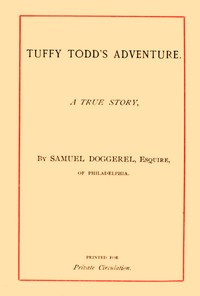
Before opening Tuffy Todd's Adventure: A True Story — Reading Companion, the edition data offers a quick orientation: 5,673 words, 25 min estimated reading time, and 1 detected text section.
The text analysis averages about 24.7 words per sentence, while the detected sections provide another way to judge how the source is divided.
Project Gutenberg metadata also associates the work with “Dogs -- Poetry,” connecting these edition facts with the source record’s subject description.
Explore this collection
These alternatives are selected using recorded categories and estimated reading time.
About 23 minutes
Adventure Picaresque Fiction
5,239 recorded words. 2 minutes difference from this book's estimate.
View Gutenberg source #29124About 29 minutes
Adventure Picaresque Fiction
6,538 recorded words. 4 minutes difference from this book's estimate.
View Gutenberg source #32445About 20 minutes
Adventure Picaresque Fiction
4,441 recorded words. 5 minutes difference from this book's estimate.
View Gutenberg source #44898Search stored excerpts and compare books → Choose by your preferences →
Choices use stored catalog measurements. Estimates vary with reading speed. A shared category is a catalog label, not a claim that two books have the same argument or literary quality.
Search reads excerpt text stored with this catalog and links to its associated Gutenberg record. The connection is stored in the site database; this tool does not recheck that every excerpt is word-for-word identical to that external record. Excerpt search does not cover every chapter and does not verify historical publication dates.
Catalog snapshot checked: 2026-09-26. Coverage: 90 public books, 90 available source excerpts.
Calculated from edition completeness, EPUB availability, text structure and catalogue metadata. Not a user rating.
Total of 100 points, scaled to a 2.5-5.0 range. Editions with an empty description or a missing EPUB file are not scored.
Public-domain source text
The source text is kept in the dedicated reader, separate from this catalogue record and its commentary.
Lewis D. Harlow, writing under the pseudonym Samuel Doggerel, presents Tuffy Todd as a dog of contradictions: “round as a mole” yet a “valiant guard,” indifferent to most caresses yet utterly devoted to his master. The poem, originally printed for private circulation in 1886, was composed for the guests of Todd’s Hillside Home in the Catskills, where the incident it recounts actually occurred. Harlow’s introductory note explains that the verses first appeared in the Dry Brook Evening Mail, a local paper, and were meant to amuse an audience already familiar with the facts.
Tuffy’s behavior is defined by stark preferences. He is “to people so polite” that one might think he never barks, yet he reserves his loudest bark for “traveler late in midnight dark” and confronts tramps with fearless aggression. His affection is almost exclusively directed at Master Orrin Todd, whom he “worships as household god.” When Todd leaves, Tuffy lies “sad and desolate,” unmoved by other sights or sounds, until the call “Ho! Orrin’s come!” sends him flying. This selective devotion is reinforced by the poem’s structure: the first half catalogues Tuffy’s general traits, while the second narrows to his relationship with Todd, emphasizing that his “eccentric” ways are only fully displayed in that bond.
The poem is written in rhymed couplets of iambic tetrameter, a form that lends itself to light, comic verse. Harlow leans into the mock-heroic by calling Tuffy a “hound” for the sake of rhyme, though he is a small, white house-dog. The narrator’s tone is playful and self-aware, as when he describes Tuffy’s “kind expressive face” with “every feature full of grace.” The moral appended at the end—warning that “not all is gold with golden gleam”—shifts abruptly from anecdote to didacticism, a common Victorian convention. The poem’s brevity (under 6,000 words) and its origin as occasional verse for a private audience suggest it was meant to be read aloud, with the rhyming couplets aiding memorability.
The Catskill Mountain setting is evoked through details like “strangers climbing up the hill” and “the porch—a sunny place.” The poem’s dedication to Mr. and Mrs. Orrin Todd, “in grateful memory of the happy hours spent at Hillside Home,” frames it as a souvenir of a specific time and place. Harlow’s pseudonym, Samuel Doggerel, signals a self-deprecating awareness of the verses’ modest literary ambitions. The work was printed for private circulation, not public sale, and the copyright is held by George Barrie, a Philadelphia publisher. This context explains why the poem assumes familiarity with Tuffy’s personality and the household routines; an outside reader must infer the dynamics from the text alone.
Readers encountering Tuffy Todd’s Adventure today will find a compact example of late-nineteenth-century occasional verse, preserved by its local origins and the charm of its subject. The poem rewards attention to its shifts in register—from affectionate description to comic exaggeration to moralizing—and to the way it constructs a dog’s character through selective detail. Harlow’s choice to frame the story as “a true story” invites us to consider how fact and embellishment intertwine in this Catskill souvenir.
Tuffy’s faithful devotion made me think of another kind of quiet steadfastness—the patient music of a poet who spent a lifetime with words, the same unhurried loyalty in a different key. There’s a Poetical Works of Robert Bridges volume I’ve kept nearby for years, its pages worn exactly where I return most often. Something about that dog’s simple, wholehearted watching stays with me. The Poetical Works of Robert Bridges, Excluding the Eight Dramas — Key Ideas to Explore feels like an old acquaintance, one I’m glad to have met.
A brief reflection can help important ideas stay with you longer.