About 547 minutes
The Poetical Works of William Wordsworth — Volume 8 (of 8) — Context and Discussion
Adventure Picaresque Fiction
125,803 recorded words. 367 minutes difference from this book's estimate.
View Gutenberg source #52836
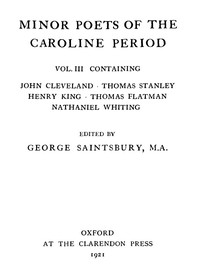
The source record for Minor Poets of the Caroline Period, Vol. III — Context and Discussion measures this digital text at 210,147 words, 15 hr 14 min estimated reading time, and 36 detected text sections.
The text analysis averages about 19.8 words per sentence, while the detected sections provide another way to judge how the source is divided.
Project Gutenberg metadata also associates the work with “English poetry -- Early modern, 1500-1700,” connecting these edition facts with the source record’s subject description.
Explore this collection
These alternatives are selected using recorded categories and estimated reading time.
About 547 minutes
Adventure Picaresque Fiction
125,803 recorded words. 367 minutes difference from this book's estimate.
View Gutenberg source #52836About 443 minutes
Adventure Picaresque Fiction
101,749 recorded words. 471 minutes difference from this book's estimate.
View Gutenberg source #37804About 223 minutes
Adventure Picaresque Fiction
51,214 recorded words. 691 minutes difference from this book's estimate.
View Gutenberg source #37452Search stored excerpts and compare books → Choose by your preferences →
Choices use stored catalog measurements. Estimates vary with reading speed. A shared category is a catalog label, not a claim that two books have the same argument or literary quality.
Search reads excerpt text stored with this catalog and links to its associated Gutenberg record. The connection is stored in the site database; this tool does not recheck that every excerpt is word-for-word identical to that external record. Excerpt search does not cover every chapter and does not verify historical publication dates.
Catalog snapshot checked: 2026-09-26. Coverage: 90 public books, 90 available source excerpts.
Calculated from edition completeness, EPUB availability, text structure and catalogue metadata. Not a user rating.
Total of 100 points, scaled to a 2.5-5.0 range. Editions with an empty description or a missing EPUB file are not scored.
Public-domain source text
The source text is kept in the dedicated reader, separate from this catalogue record and its commentary.
George Saintsbury's edition of Minor Poets of the Caroline Period, Vol. III presents a carefully curated selection of seventeenth-century verse, with John Cleveland's political satires occupying a prominent position. The editor's prefatory note reveals a laborious process of textual recovery, relying on bromide rotographs from the Bodleian Library to access rare printed sources. This volume invites attention to the interplay between editorial intervention and the original poets' voices, particularly in Cleveland's densely allusive and metrically irregular lines.
John Cleveland's verse in this collection moves at a relentless pace, driven by compressed syntax and abrupt shifts in tone. In the excerpt from his political poem, lines such as “You had other plots, your busy hate / Plied all advantage on His fallen state” demonstrate a swift, accusatory rhythm that mirrors the urgency of civil conflict. The poet frequently employs enjambment to propel the reader forward, as in “Till on pretence of safety Cromwell's wile / Had juggl'd Him into the Fatal Isle.” This technique creates a breathless momentum, appropriate for a narrator who presents himself as exposing hidden conspiracies. Cleveland's vocabulary is deliberately harsh—words like “jailor,” “murderous,” and “fatal” accumulate to reinforce a sense of imminent danger. The meter, often iambic pentameter, is disrupted by irregular stresses that mimic the disorder of the events described. Saintsbury's textual notes, which record variant readings, occasionally smooth these irregularities, but the underlying volatility remains a defining feature of Cleveland's style.
George Saintsbury's editorial presence is felt throughout the volume, not only in the prefatory note but also in the apparatus of footnotes and variant lists. His language is characteristically self-deprecating and precise; he describes the volume as “an unconscionable time in being born” and acknowledges the difficulty of sourcing materials. This personal tone contrasts with the formal presentation of the poems themselves. Saintsbury's notes often gloss historical references or explain obscure allusions, yet he refrains from extensive literary commentary, allowing the poets to speak directly. The placement of line notes immediately after each poem encourages a back-and-forth reading experience, where the reader can consult textual variants without losing the thread of the verse. This structure subtly alters the pace of reading, introducing pauses that invite reflection on the choices made by both poet and editor. The editor's humility—his admission that “no efforts of mine, unless I had been able to reside in Oxford or London, would have much hastened the completion”—grounds the scholarly apparatus in a human narrative of labor and limitation.
The volume's arrangement creates a varied reading tempo, moving from Cleveland's aggressive satires to the more meditative lyrics of Thomas Stanley and Henry King. Stanley's verse, represented by shorter, more regular stanzas, offers a respite from Cleveland's density. King's poetry, often elegiac, employs a slower, more deliberate rhythm, as seen in his famous “Exequy” (though not excerpted here). The inclusion of Thomas Flatman and Nathaniel Whiting further diversifies the pace: Flatman's occasional poems tend toward conversational ease, while Whiting's allegorical narratives sustain a steady narrative flow. Saintsbury's editorial choices—such as grouping poems by author and providing separate introductions—allow readers to adjust their expectations with each section. The footnotes, which vary in length and frequency, also affect pacing; some poems are heavily annotated, while others receive minimal commentary. This uneven distribution mirrors the uneven survival and study of these poets, reminding readers that the volume is as much a record of editorial labor as a collection of verse.
Readers approaching this volume should attend to the interplay between the poets' original rhythms and Saintsbury's editorial interventions. The footnotes and variant lists are not mere supplements but integral to understanding how these texts have been transmitted. For those interested in the politics of form, Cleveland's satires reward close attention to their metrical irregularities, while the quieter passages of Stanley and King offer contrast. The volume as a whole demonstrates that pace—whether of verse or of scholarly recovery—shapes our encounter with literary history.
Saintsbury’s notes on Cleveland feel like a long, patient walk through overgrown paths—each marginal remark a small lantern. That same unhurried intimacy lives in Songs of love and empire — Inside the Classic, where the cadence of old verse seems to slow time itself. I keep returning to how quietly both hold their mysteries.
Build a private reading journal entry for this title.