About 443 minutes
The Poetical Works of Robert Bridges, Excluding the Eight Dramas — Key Ideas to Explore
Adventure Picaresque Fiction
101,749 recorded words. 104 minutes difference from this book's estimate.
View Gutenberg source #37804
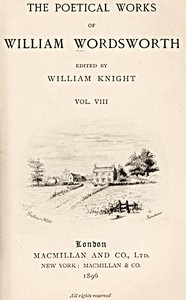
The catalog record for The Poetical Works of William Wordsworth — Volume 8 (of 8) — Context and Discussion provides practical reading context through 125,803 words, 9 hr 7 min estimated reading time, and 27 detected text sections.
The text analysis averages about 18.9 words per sentence, while the detected sections provide another way to judge how the source is divided.
Project Gutenberg metadata also associates the work with “English poetry -- 19th century,” connecting these edition facts with the source record’s subject description.
Explore this collection
These alternatives are selected using recorded categories and estimated reading time.
About 443 minutes
Adventure Picaresque Fiction
101,749 recorded words. 104 minutes difference from this book's estimate.
View Gutenberg source #37804About 223 minutes
Adventure Picaresque Fiction
51,214 recorded words. 324 minutes difference from this book's estimate.
View Gutenberg source #37452About 208 minutes
Adventure Picaresque Fiction
47,637 recorded words. 339 minutes difference from this book's estimate.
View Gutenberg source #55458Search stored excerpts and compare books → Choose by your preferences →
Choices use stored catalog measurements. Estimates vary with reading speed. A shared category is a catalog label, not a claim that two books have the same argument or literary quality.
Search reads excerpt text stored with this catalog and links to its associated Gutenberg record. The connection is stored in the site database; this tool does not recheck that every excerpt is word-for-word identical to that external record. Excerpt search does not cover every chapter and does not verify historical publication dates.
Catalog snapshot checked: 2026-09-26. Coverage: 90 public books, 90 available source excerpts.
Calculated from edition completeness, EPUB availability, text structure and catalogue metadata. Not a user rating.
Total of 100 points, scaled to a 2.5-5.0 range. Editions with an empty description or a missing EPUB file are not scored.
Public-domain source text
The source text is kept in the dedicated reader, separate from this catalogue record and its commentary.
This volume presents Wordsworth's poetry from 1834 to 1847, as edited by William Knight in 1896. It includes the complete 'Memorials of a Tour in Italy, 1837,' a sequence of 26 poems that record the poet's responses to Italian landscapes, artworks, and historical sites. The volume also contains the first print publication of 'Home at Grasmere,' a canto from Wordsworth's unpublished autobiographical poem The Recluse, which Knight prints from the original manuscript with notes by Gordon Wordsworth. Knight's editorial apparatus—footnotes, cross-references, and headnotes—provides a scholarly framework that situates these late poems within Wordsworth's broader oeuvre.
Knight's edition is notable for its editorial transparency. In the headnote to 'Home at Grasmere,' he explains that the poem was 'kept back by him during his lifetime' and that its posthumous publication was 'omitted by his representatives—with what must be regarded as true critical insight.' He acknowledges the poem's uneven quality, noting that 'certain passages are very inferior, but there are others that posterity must cherish.' This candid assessment is paired with detailed textual notes: Knight records that the manuscript heading is 'THE RECLUSE. BOOK FIRST, PART FIRST. HOME AT GRASMERE' and that the text 'has been carefully compared with the original MS. by Mr. Gordon Wordsworth.' Such remarks give the reader a clear sense of the editorial decisions behind the printed text.
The 'Memorials of a Tour in Italy, 1837' showcase Wordsworth's later poetic manner—meditative, allusive, and often anchored in specific locales. In 'Musings near Aquapendente,' the speaker reflects on the landscape with a characteristic blend of sensory detail and moral reflection. Knight's footnotes frequently cross-reference other poems in the Wordsworth canon, such as comparing a line in 'To the Moon' (p. 15) with an 'Evening Voluntary' of 1846. These annotations reveal how Wordsworth's later work reworks earlier themes and images. The sequence also includes sonnets on historical subjects, such as 'At Rome—Regrets—in Allusion to Niebuhr and other Modern Historians,' which engage with contemporary historiography. The poems are not travelogue but a poet's grappling with the weight of the past.
'Home at Grasmere' offers a rare glimpse into Wordsworth's unfinished magnum opus. The poem opens with a schoolboy's first view of the valley—'Once to the verge of yon steep barrier came / A roving school-boy'—and the speaker later identifies himself as 'that same young and happy being.' The passage moves from a boy's fantasy of 'unfettered liberty' to a mature recognition of the valley as 'a haunt / Of pure affections.' Knight notes that internal evidence—'the numerous allusions to Dorothy, and the reference to John Wordsworth'—dates the poem to shortly after Wordsworth's arrival at Grasmere and before his marriage. The fragment thus serves as a companion to The Prelude, offering a more localized, domestic counterpart to that poem's epic scope.
The volume includes a series of sonnets on the punishment of death, written in 1839, which engage with legal and moral questions. The first, 'Suggested by the View of Lancaster Castle,' uses the castle as a symbol of judicial authority. Knight's edition places these sonnets alongside occasional poems on contemporary events, such as 'At Bologna, in Remembrance of the late Insurrections, 1837.' These works show Wordsworth turning his sonnet form to public subjects, a practice he had maintained since the early 1800s. The editorial notes do not provide historical context for these events, leaving the reader to infer the political background from the poems themselves.
Readers approaching this volume should be aware that it is a scholarly edition, not a reading text. Knight's footnotes and headnotes are integral to understanding the poems' composition history and textual variants. The inclusion of 'Home at Grasmere' makes this volume essential for those interested in Wordsworth's autobiographical project, while the Italian poems offer a late-career perspective on a poet who had long meditated on nature and memory. The volume rewards careful attention to both the poems and the editorial apparatus that frames them.
Sometimes I think of Wordsworth, late in life, turning toward memory’s quiet shelter, and it puts me in mind of another homemade comfort — the patient little volume Blottentots, and How to Make Them — Text and Context. Both are crafts of gathering small, ordinary things until they become a kind of home. No grand noise, just the soft persistence of making and remembering.
Answer a few questions and save a private reflection on this device.