1

The Dream of Gerontius — Reading Notes
(7 User reviews)
953
Project Gutenberg
2015
Not confirmed
Christian poetry, English -- 19th century
Readers of public-domain and historical texts
Project Gutenberg digital edition
en
Edition facts
Words
16,265
Reading time
71 min
Text sections
9
The catalog record for The Dream of Gerontius — Reading Notes provides practical reading context through 16,265 words, 1 hr 11 min estimated reading time, and 9 detected text sections.
The text analysis averages about 20.3 words per sentence, while the detected sections provide another way to judge how the source is divided.
Project Gutenberg metadata also associates the work with “Christian poetry, English -- 19th century,” connecting these edition facts with the source record’s subject description.
Source:
Project Gutenberg record #48927
An editorial note on Newman's poem, examining how the catalog subjects 'Christian poetry' and 'Adventure & Picaresque Fiction' relate to the actual text, which presents a soul's journey after death through dramatic dialogue and theological meditation.
Editorial Edition Score
4.6/5
★★★★★
★★★★★
Calculated from edition completeness, EPUB availability, text structure and catalogue metadata. Not a user rating.
How this score is calculated
- Description quality20 pts
- Title & short description10 pts
- Source metadata20 pts
- Text length15 pts
- Chapters / structure15 pts
- EPUB file integrity20 pts
Total of 100 points, scaled to a 2.5-5.0 range. Editions with an empty description or a missing EPUB file are not scored.
Edition quality
Read the Text
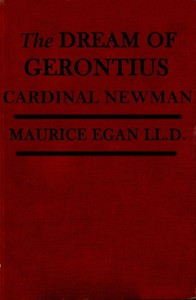
THE DREAM OF GERONTIUS
_WITH INTRODUCTION AND NOTES_ BY MAURICE FRANCIS EGAN, A.M., LL.D.
_Professor of English Language and Literature in the Catholic University of America, Washington, D. C._
LONGMANS, GREEN, AND CO. FOURTH AVENUE & 30TH STREET, NEW YORK LONDON, BOMBAY AND CALCUTTA 1910
LONGMANS, GREEN, AND CO.
_All rights reserved_
First edition, September 30, 1903; Reprinted, with additions, September, 1904; August, 1908; February, 1910.
FRATRI DESIDERATISSIMO
ORATORII S.P.N. PRESBYTERO
CUJUS ANIMA IN REFRIGERIUM
As a rule, when Cardinal Newman's poetry is mentioned, people think of "The Pillar of the Cloud," better known as "Lead, Kindly Light." This lyric is only one of the many beautiful poems written by an author whose fame as a writer of the finest modern prose in the English language has eclipsed his reputation as a poet. Nevertheless, he wrote a very great poem, "The Dream of Gerontius"--a poem which the intellectual world admires more and more every year, and which yields its best only after careful study and consideration. It has been described as a metrical meditation on death. It is more than that; it is the realization by means of a loving heart and a poetic imagination of the state of a just soul after death,--Gerontius typifying not the soul of a particular person imagined by Cardinal Newman, but your soul, my soul, any soul which may be fortunate enough to satisfy the judging and merciful God. No poet has ever presented the condition of the soul, as made known by the theology of the Catholic Church, so forcibly and appealingly as Cardinal Newman. The poem is filled with intense white light, and the soul on earth sees itself as it will be at the moment before its death; as it will be when, strengthened by the last sacraments and upborne by the prayers of its friends, it approaches the bar of judgment. Separated from the body until the day of the Resurrection, when it shall be united to that glorified body, it is not sundered by death from the love of those who have loved it on earth. Gerontius about to be judged feels that he must fail
"And drop from out the universal frame Into that shapeless, scopeless, blank abyss, That utter nothingness"
from which the soul came, and, in its depths of fear, it pleads silently that its friends in Christ may pray for it. The dread of annihilation is upon it; it fears "the great deep"[1] to which it goes. And, in the agony of its rending from the beloved body, it thinks--for it can no longer speak--of the horror of nothingness. All its physical supports are gone. Its eyes are darkening and glazing; its feet motionless and cold; its arms and hands rigid. To those in the sick-room the body once so beautiful,
"from the graced decorum of the hair Ev'n to the tingling sweet Soles of the simple, earth-confiding feet,"[2]
is now white as white marble and as lifeless. But the soul is not dead, though the earthly parts of the body appear to be, and it hears the prayers of the Church for the dying as the supreme moment of its departure from the body is at hand. Some of these prayers, translated from the Latin, the author puts into the mouths of the assistants. They have all the refreshing strength that the Church gives; they represent the supplication of millions of devout souls bound to this dying brother in the communion of saints. The soul gains new strength from these prayers; it arouses itself; sees God through the ruin of the world, and wills to be wholly His. The assistants by the bedside redouble their supplications in the sacred words of the Litany for the Dying, which Cardinal Newman again interprets in English verse, though the Litany is in the Latin tongue. Again, the soul gains strength for a moment, and calls, in the universal speech of the Church, for strength, and that, "out of the depths,"[3] the holy God might save it. Then it uses its will to believe, and within itself asserts the creed of the Church, which is musically interpreted by the poet:
"Firmly I believe and truly God is Three, and God is One, And I next acknowledge duly Manhood taken by the Son."
The moment of agony, the moment of the realization of the soul that it is alone, bereft of its support, is terrible but short. In the "Inferno" of Dante, with all its objective horrors, there are no lines so terrible as these, which show the spirit naked, wild with horror and dismay:
"And worse and worse, Some bodily form of ill Floats on the wind, with many a loathsome curse Tainting the hallowed air, and laughs and flaps Its hideous wings."
John Henry Newman's The Dream of Gerontius is cataloged under 'Christian poetry, English -- 19th century' and 'Adventure & Picaresque Fiction,' yet the excerpts reveal a work that is neither adventurous in plot nor picaresque in tone. Instead, the poem unfolds as a dramatic monologue of a disembodied soul, Gerontius, moving through judgment and purgation. The catalog's adventure label likely refers to the soul's perilous journey, but the text's structure—alternating between the Soul's anxious questions and an Angel's theological explanations—resembles a Socratic dialogue more than a narrative of external events.
The Soul's Sensory Limitation
The excerpts emphasize the Soul's deprivation of sight: 'All has been darkness since I left the earth' and 'I see not those false spirits.' The Soul retains hearing, taste, and touch, but lacks 'that princely sense / Which binds ideas in one.' This sensory hierarchy is central to the poem's epistemology. The Angel explains that the Soul lives 'in a world of signs and types,' not direct perception. This metaphysical conceit—that the disembodied soul experiences reality through mediated 'lower measures of perception'—is a precise theological argument, not an adventure trope. The catalog's 'Adventure' category seems to misrepresent the poem's introspective, doctrinal focus.
Demonic Rhetoric and Theatricality
The demons speak in a distinctive, irregular meter with short lines and exclamations ('Ha! ha!'), contrasting sharply with the Angel's measured blank verse. Their speeches are vituperative and mocking, targeting saints as 'psalm-droners' and 'crawling knaves.' This theatrical quality—almost operatic in its alternation of voices—gives the poem a dramatic structure. The demons' arguments are not physical threats but rhetorical assaults, questioning the motives of virtue: 'He'll slave for hire; / Ha! ha! / And does but aspire / To the heaven above / With sordid aim, / And not from love.' This focus on spiritual combat through language aligns more with theological debate than picaresque adventure.
The Angel's Role as Interpreter
The Angel functions less as a guide through peril and more as a theological interpreter. When the Soul fears judgment, the Angel explains the nature of demons: 'in thy trial-state / Thou hadst a traitor nestling close at home'—referring to the body's senses. The Angel's speeches are didactic, clarifying the Soul's condition rather than advancing a plot. For instance, the Angel describes demons as 'caged within their bars,' pacing 'to and fro'—a static image of confinement. This static, explanatory role contradicts the 'Adventure' cataloging; the poem's movement is inward, toward understanding, not outward toward action.
Readers approaching The Dream of Gerontius should set aside expectations of adventure or picaresque narrative. The poem rewards attention to its theological structure, the interplay of voices, and the precise imagery of sensory deprivation. Newman's work is a meditation on the soul's state after death, rendered through dramatic dialogue and doctrinal exposition. The catalog subjects, while not entirely inaccurate, fail to capture the poem's contemplative and liturgical character.
I remember sitting with Newman's poem on a quiet Sunday, feeling the soul's terror and trust unwind together. It stirred something of my father's last weeks. Then I thought of Blottentots, and How to Make Them — Text and Context, which once gave me the same odd comfort — that making something clumsy and small can be its own kind of prayer.
Sofia Davis
1 month ago-

Joshua Harris - 4 weeks ago
Cardinal Newman's 'The Dream of Gerontius' is a profound and moving poetic masterpiece. The journey of the soul after death, from judgment to purification, is rendered with exquisite language and deep spiritual insight. The vivid imagery of the angelic hosts and the demons is haunting, and the emotional depth is unmatched. A timeless work that resonates with anyone seeking meaning in the afterlife. Highly recommended for its theological richness and poetic beauty. -
April Jenkins - 2 weeks ago
While 'The Dream of Gerontius' is celebrated, I found it tedious and overhyped. The narrative is slow, and the theological arguments are dated, making it hard to engage with modern sensibilities. The poetry is sometimes purple and overwrought, and the characters are more symbols than relatable figures. If you're not deeply invested in Catholic doctrine, this may be a chore to get through. There are better spiritual poems out there. -
Colleen Scott - 1 week ago
This poetic work offers a serious and introspective look at the afterlife, with beautiful language and strong religious themes. However, the dense theological content and archaic style might not appeal to all readers. Those with an interest in Victorian spirituality or Newman's work will find it rewarding, but others may struggle with the pacing and complexity. A meaningful piece of literature, though not for casual reading.
Reader reflection
How will you remember this book?
Save your reaction, strongest insight, and memorable passage.
Your progress
0
/
10
2
How did the book work for you overall?
3
How likely are you to recommend this book?
4
How easy was the book to follow?
5
Did any part of the book stay with you emotionally?
6
How clear did the writing feel?
7
How distinctive were its ideas or approach?
8
What did you appreciate most?
9
What did this book teach you most?
10









Charlotte Martinez
1 month ago