1

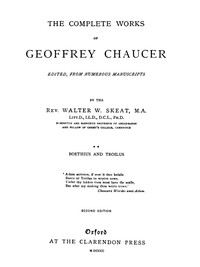
Chaucer's Works, Volume 2 — Boethius and Troilus — A Reader’s Guide
(6 User reviews)
1251
Project Gutenberg
2014
Not confirmed
English poetry -- Middle English, 1100-1500
Readers of public-domain and historical texts
Project Gutenberg digital edition
en
Edition facts
Words
214,323
Reading time
932 min
Text sections
50
Before opening Chaucer's Works, Volume 2 — Boethius and Troilus — A Reader’s Guide, the edition data offers a quick orientation: 214,323 words, 15 hr 32 min estimated reading time, and 50 detected text sections.
The text analysis averages about 17.3 words per sentence, while the detected sections provide another way to judge how the source is divided.
Project Gutenberg metadata also associates the work with “English poetry -- Middle English, 1100-1500,” connecting these edition facts with the source record’s subject description.
Source:
Project Gutenberg record #44833
This editorial note examines how the opening of Chaucer's Boece and Troilus and Criseyde, along with later excerpts, shapes a first reading, focusing on the interplay between philosophical prose and narrative verse, the editor's scholarly apparatus, and Criseyde's internal debate.
Editorial Edition Score
4.9/5
★★★★★
★★★★★
Calculated from edition completeness, EPUB availability, text structure and catalogue metadata. Not a user rating.
How this score is calculated
- Description quality20 pts
- Title & short description10 pts
- Source metadata20 pts
- Text length15 pts
- Chapters / structure15 pts
- EPUB file integrity20 pts
Total of 100 points, scaled to a 2.5-5.0 range. Editions with an empty description or a missing EPUB file are not scored.
Edition quality
Read the Text
gifts; experience had satisfied him of their real value[4]; he had enjoyed them without guilt; he might resign them without a sigh, and calmly disdain the impotent malice of his enemies, who had left him happiness, since they had left him virtue[5]. From the earth, Boethius ascended to heaven in search of the SUPREME GOOD[6], explored the metaphysical labyrinth of chance and destiny[7], of prescience and freewill, of time and eternity, and generously attempted to reconcile the perfect attributes of the Deity with the apparent disorders of his moral and physical government[8]. Such topics of consolation, so obvious, so vague, or so abstruse, are ineffectual to subdue the feelings of human nature. Yet the sense of misfortune may be diverted by the labour of thought; and the sage who could artfully combine, in the same work, the various riches of philosophy, poetry, and eloquence, must already have possessed the intrepid calmness which he affected to seek. Suspense, the worst of evils, was at length determined by the ministers of death, who executed, and perhaps exceeded, the inhuman mandate of Theodoric. A strong cord was fastened round the head of Boethius, and forcibly tightened till his eyes almost started from their sockets; and some mercy may be discovered in the milder torture of beating him with clubs till he expired. But his genius survived to diffuse a ray of knowledge over the darkest ages of the Latin world; the writings of the philosopher were translated by the most glorious of the English Kings, and the third emperor of the name of Otho removed to a more honourable tomb the bones of a catholic saint, who, from his Arian persecutors, had acquired the honours of martyrdom and the fame of miracles. In the last hours of Boethius, he derived some comfort from the safety of his two sons, of his wife, and of his father-in-law, the venerable Symmachus. But the grief of Symmachus was indiscreet, and perhaps disrespectful; he had presumed to lament, he might dare to revenge, the death of an injured friend. He was dragged in chains from Rome to the palace of Ravenna; and the suspicions of Theodoric could only be appeased by the blood of an innocent and aged senator.'
This deed of injustice brought small profit to its perpetrator; for we read that Theodoric's own death took place shortly afterwards; and that, on his death-bed, 'he expressed in broken murmurs to his physician Elpidius, his deep repentance for the murders of Boethius and Symmachus.'
§ 4. For further details, I beg leave to refer the reader to the essay on 'Boethius' by H. F. Stewart, published by W. Blackwood and Sons, Edinburgh and London, in 1891. We are chiefly concerned here with the 'Consolation of Philosophy,' a work which enjoyed great popularity in the middle ages, and first influenced Chaucer indirectly, through the use of it made by Jean de Meun in the poem entitled Le Roman de la Rose, as well as directly, at a later period, through his own translation of it. Indeed, I have little doubt that Chaucer's attention was drawn to it when, somewhat early in life, he first perused with diligence that remarkable poem; and that it was from the following passage that he probably drew the inference that it might be well for him to translate the whole work:--
'Ce puet l'en bien des clers enquerre Qui _Boëce de Confort_ lisent, Et les sentences qui là gisent, _Dont grans biens as gens laiz feroit Qui bien le lor translateroit_' (ll. 5052-6).
I.e. in modern English:--'This can be easily ascertained from the learned men who read Boece on the Consolation of Philosophy, and the opinions which are found therein; as to which, any one _who would well translate it for them_ would confer much benefit on the unlearned folk':--a pretty strong hint[9]!
The volume pairs Chaucer's prose translation of Boethius's Consolation of Philosophy with his narrative poem Troilus and Criseyde, a juxtaposition that immediately signals thematic resonance. The editor, Walter W. Skeat, provides extensive introductions, manuscript notes, and a glossary, framing the texts as objects of philological study. For a first reader, the opening pages of Boethius—a dialogue between the narrator and Lady Philosophy—establish a contemplative, argumentative mode, while the first book of Troilus plunges into the Trojan war and the protagonist's unrequited love. The contrast in form and tone invites comparison between philosophical consolation and poetic tragedy.
Skeat's Scholarly Frame
Skeat's introduction occupies nearly fifty pages, detailing the date, sources, manuscripts, and textual history of each work. For Boethius, he traces Chaucer's translation method, noting mistakes and borrowings from Jean de Meun. For Troilus, he discusses Boccaccio's Filostrato as the primary source and the mysterious 'Lollius.' A first reader may find this apparatus daunting, but it offers a transparent view of how the text was constructed. Skeat's notes, placed after the poems, gloss Middle English words and cite parallel passages. The frontispiece—a facsimile of a manuscript page—reinforces the volume's status as a critical edition.
Boethius: Prose and Poetry in Dialogue
The Consolation alternates between prose sections (the narrator's complaints and Philosophy's arguments) and metrical poems (the narrator's songs). In Book I, the narrator laments his exile in verse, then Philosophy responds in prose, diagnosing his sickness as forgetfulness of true good. This rhythm creates a pedagogical drama: the reader follows the narrator's gradual reorientation from worldly grief to philosophical understanding. Chaucer's prose is direct, often literal, but occasionally awkward—Skeat notes several mistranslations. The metra (verse sections) employ rhyme and meter, offering a lyrical counterpoint. A first reader might attend to how the form itself enacts the movement from emotion to reason.
Troilus: Criseyde's Deliberation
In the excerpt from Book II (stanzas 102–115), Criseyde weighs whether to love Troilus. Her soliloquy reveals a shrewd, self-aware mind: she considers his worth, her own freedom, and the risks of scandal. The passage is structured as a series of conditional arguments ('Now set a cas...'), punctuated by proverbial wisdom ('In every thing, I woot, ther lyth mesure'). The simile of the March cloud (lines 765–770) dramatizes her shifting emotions. Chaucer gives her a voice that is both rational and vulnerable, making her decision feel like a genuine moral dilemma. A first reader should note how this interiority contrasts with the more external action of Book I.
The Cloud and the Sun: Imagery of Uncertainty
Recurring imagery of light and shadow links the two texts. In Boethius, Philosophy promises to dispel the 'clouds' of error; in Troilus, Criseyde's 'cloudy thought' overspreads her 'brighte thoughtes.' The March sun that 'chaungeth ofte tyme his face' mirrors the instability of love. These images are not merely decorative—they structure the reader's experience of uncertainty. In Boethius, the movement is toward clarity; in Troilus, the cloud may never fully lift. A first reader attuned to this pattern will see how Chaucer adapts Boethian consolation to a narrative where happiness is fleeting.
Reading these works together, a first-time reader benefits from Skeat's notes but should not let them overshadow the texts themselves. The Consolation rewards slow, patient reading, while Troilus demands attention to character and voice. The volume's structure—philosophy first, then poetry—suggests a progression, but the excerpts show that both works grapple with fortune, free will, and human suffering. Let the texts speak; the apparatus is a guide, not a substitute.
Some evenings, I still recall how Chaucer’s Boece murmurs against Criseyde’s wavering, prose and verse trading the same anxious breath. That measured struggle finds a quieter echo in The Hound of Heaven — Text and Context, where a soul’s flight and pursuit feel less like doctrine than a held sigh. Two books, keeping each other company on my shelf.
-

Christopher Williams - 1 month ago
This second volume of Chaucer's works is a scholarly masterpiece, offering both 'Boethius' and 'Troilus' with meticulous editing and helpful annotations. The translation of Boethius is clear and faithful, while 'Troilus and Criseyde' shines with Chaucer's poetic genius. The notes are invaluable, providing context that enriches the reading experience. As a student of medieval literature, I found this edition indispensable. A must-have for any serious reader of Chaucer. -
Tracy Ross - 2 weeks ago
A well-put-together edition of Chaucer's works, including the philosophical 'Boethius' and the tragic romance 'Troilus'. The textual notes are helpful, and the glossary aids in understanding archaic terms. However, the formatting is a bit dense, and the lack of a modern translation for some parts might be challenging for casual readers. Still, it's a valuable resource for students and enthusiasts. -
Rachel Petty - 1 week ago
Chaucer's Works Volume 2 is a letdown in terms of accessibility. The Middle English text is presented without a facing-page translation, making it difficult for non-scholars to appreciate the poetry. The footnotes are academic and sparse. The inclusion of 'Boethius' feels out of place and dry, and 'Troilus' is hard to follow. This edition is only for the most dedicated medievalists; others should look for a more reader-friendly version.
Reader reflection
How will you remember this book?
Save your reaction, strongest insight, and memorable passage.
Your progress
0
/
10
2
How did the book work for you overall?
3
How likely are you to recommend this book?
4
Did the language feel accessible?
5
Was the book what you thought it would be?
6
Would you read this book again?
7
How strongly did the book affect you emotionally?
8
Would you like to discuss this book with someone?
9
What is the main idea you are taking away?
10








Charlotte Wright
1 month ago