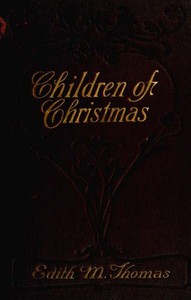
Edith M. Thomas's Children of Christmas, and Others (1907) opens with a cradle song that immediately establishes a distinctive voice: the speaker addresses a winter-born child with the line 'Happy thou, a winter comer,' a compact inversion that signals Thomas's willingness to reshape syntax for metrical effect. Throughout the collection, she moves between simple nursery rhythms and more complex, sometimes archaic diction—'Nowel,' 'cherub faces'—that gives the Christmas poems a liturgical gravity. The book is divided into three sections: 'Children of Christmas,' 'Other Children,' and 'Some of Their Friends,' the last turning to birds, animals, and natural phenomena. Thomas's verse is notable for its shifting perspectives: she writes from the point of view of a giant's daughter, a homesick soldier, a Cossack mother, and even a cat, often using dialogue or direct address to create intimacy.
Diction and the Christmas Voice
Thomas's Christmas poems employ a deliberately varied lexicon. In 'Cradle Song,' she uses the archaic 'Nowel' alongside the colloquial 'cherub faces,' blending sacred and domestic registers. The poem 'How Many' (partially excerpted) uses a question-and-answer structure that mimics a child's curiosity, while 'A Christmas Spy' adopts a conspiratorial tone. The most striking example of diction is in 'The Giant's Daughter,' where the giant child exclaims 'Live toys are best—I'll have no other!'—a line that juxtaposes childish enthusiasm with the absurd scale of the narrative. Thomas also uses repetition for emphasis: in 'The Homesick Soldier,' the refrain 'What do my darlings so far away?' is answered by the quail, the river, and the stars, each reply building a cumulative emotional effect. The vocabulary is often concrete and sensory: 'scatter the dew,' 'small bare feet,' 'mimic fleets adrift.'
Dialogue and Dramatic Monologue
Many poems in the collection are built around direct speech or dramatic monologue. 'The Cossack Mother' is a first-person lament: 'My little one will die to-night / (Then break, my heart, oh, break!).' The parenthetical aside creates a double voice—the mother's outward statement and her inward anguish. In 'The Giant's Daughter,' the narrative is framed as a fable ('says my fable'), and the dialogue between the giant child and her mother is rendered in simple, almost proverbial lines: 'Go, take the plowman back, my child, / To fields beside the blue Rhine water.' Thomas also uses question-and-answer patterns, as in 'The Homesick Soldier,' where the soldier's queries are answered by natural elements. 'Erotion and the Dove' is a monologue from a child who has died, speaking from heaven: 'I was too young, they said (I was not seven).' The parenthetical again adds a layer of innocence and precision.
Description and the Natural World
Thomas's descriptive passages are economical but vivid. In 'The Homesick Soldier,' the setting is established in three lines: 'The soldier woke at the quail's first note, / At dawn, on the grassy couch where he lay.' The 'grassy couch' is both literal and suggestive of the soldier's vulnerability. In 'The Cossack Mother,' the sky is described as 'smoky clouds' that 'blot the sunset sky,' a detail that ties the personal tragedy to a larger battlefield. The poem 'The Blossom-Child' uses a repetitive, incantatory structure—'The flowers, the haunted flowers of May'—to evoke a sense of haunting beauty. Thomas often personifies natural elements: the river 'runs through the fields of home,' the stars 'shine on the fields of home.' In 'The Giant's Daughter,' the scale of description shifts dramatically: the giant child's discovery of a plowman is rendered with comic disproportion—'The great trees trembled, miles around, / The rocks gave back a sound like thunder.'
Structure and Metrical Patterns
Thomas employs a variety of metrical forms, from the simple quatrains of 'Cradle Song' (abab) to the more complex rondeau-like repetition in 'The Blossom-Child,' where the line 'The flowers—the haunted flowers of May' recurs as a refrain. The poem 'How Many' uses a question-and-answer structure that builds anticipation. 'The Homesick Soldier' is organized around three stanzas, each corresponding to a time of day (dawn, march, twilight) and a natural interlocutor (quail, river, stars). This tripartite structure gives the poem a ritualistic quality. 'The Cossack Mother' uses a regular ballad meter (alternating tetrameter and trimeter) but breaks the pattern with the parenthetical 'Then break, my heart, oh, break!'—a metrical interruption that mirrors emotional disruption. Thomas also uses enjambment sparingly but effectively: in 'Erotion and the Dove,' the line 'But they were wrong, for when I came to heaven' carries the reader into the next line, emphasizing the child's arrival.
Readers approaching Children of Christmas, and Others should attend to the way Thomas modulates voice from poem to poem: the same poet who writes a lullaby for the Christ child also ventriloquizes a giant's daughter, a dying soldier, and a bereaved mother. Her diction is never merely decorative; it serves to establish character and emotional register. The collection rewards attention to its structural patterns—repetition, refrain, question-and-answer—and to the way Thomas uses the natural world as both setting and interlocutor. These poems are best read aloud, where their rhythms and shifts in tone become most apparent.
There’s something tender in how Edith Thomas holds both the child’s wonder and the ache of what fades, each poem a small room with its own weather. Reading her makes me think of that older, stranger voice in Satan Absolved: A Victorian Mystery — Reading Notes — how even a cosmic argument can feel, at odd moments, like a lullaby for grown-ups who’ve forgotten the tune.