About 89 minutes
Children of Christmas, and Others — Text and Context
Science Fiction Utopias
20,294 recorded words. 6 minutes difference from this book's estimate.
View Gutenberg source #40598
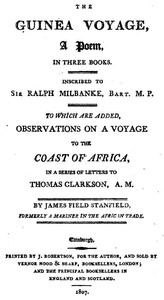
The Guinea Voyage: A Poem in Three Books To Which Are Added Observations on a Voyage to the Coast of Africa — Key Ideas to Explore can be approached with a clearer sense of reading commitment from its source measurements: 18,911 words, 1 hr 23 min estimated reading time, and 11 detected text sections.
The text analysis averages about 26.5 words per sentence, while the detected sections provide another way to judge how the source is divided.
Project Gutenberg metadata also associates the work with “Slave trade -- Poetry,” connecting these edition facts with the source record’s subject description.
Explore this collection
These alternatives are selected using recorded categories and estimated reading time.
About 89 minutes
Science Fiction Utopias
20,294 recorded words. 6 minutes difference from this book's estimate.
View Gutenberg source #40598About 75 minutes
Science Fiction Utopias
17,051 recorded words. 8 minutes difference from this book's estimate.
View Gutenberg source #41077About 69 minutes
Science Fiction Utopias
15,837 recorded words. 14 minutes difference from this book's estimate.
View Gutenberg source #30391Search stored excerpts and compare books → Choose by your preferences →
Choices use stored catalog measurements. Estimates vary with reading speed. A shared category is a catalog label, not a claim that two books have the same argument or literary quality.
Search reads excerpt text stored with this catalog and links to its associated Gutenberg record. The connection is stored in the site database; this tool does not recheck that every excerpt is word-for-word identical to that external record. Excerpt search does not cover every chapter and does not verify historical publication dates.
Catalog snapshot checked: 2026-09-26. Coverage: 90 public books, 90 available source excerpts.
Calculated from edition completeness, EPUB availability, text structure and catalogue metadata. Not a user rating.
Total of 100 points, scaled to a 2.5-5.0 range. Editions with an empty description or a missing EPUB file are not scored.
Public-domain source text
The source text is kept in the dedicated reader, separate from this catalogue record and its commentary.
James Field Stanfield's The Guinea Voyage pairs a three-book poem with prose letters addressed to abolitionist Thomas Clarkson. The work is unusual in its dual form: the verse offers a moral and emotional indictment of the slave trade, while the appended letters provide factual, affidavit-backed testimony from Stanfield's own experience as a mariner. The preface explains that the prose originally was meant to accompany the poem as 'proofs and explanations,' but was published separately to strengthen the abolitionist cause. This edition restores the two together, creating a layered document that shifts between poetic lament and forensic report.
Stanfield presents himself not as a distant commentator but as a former insider. He writes from the position of 'a mariner in the African trade,' and his preface states that he twice gave personal evidence before Parliament. The prose letters are grounded in specific, verifiable details: he names Liverpool as the only port he sailed from, describes the exact method of debt entrapment in 'public houses, under the influence, and in the pay of the merchants,' and recounts the fate of two crews—thirty-two men or more on his own vessel, plus a replacement crew—of whom only the captain, the carpenter, and himself returned to England. This statistical claim is offered as a concrete example of the trade's human cost.
The letters detail a systematic process for recruiting sailors. Stanfield describes how public houses use 'festivity and music,' prostitution, and intoxication to lure seamen into debt. Once a sailor owes enough, a Guinea ship is offered; if he refuses, imprisonment follows, making him unemployable on other vessels. Stanfield calls these houses 'infamous dens' and notes that merchants, clerks, and captains 'prowl about without intermission' during an outfit. The language is precise and accusatory, contrasting the sailors' 'unsuspecting, thoughtless, dissipated propensity' with the calculated exploitation by the trade's agents. This section of the letters functions as a procedural exposé, showing how the trade manufactured its own workforce.
A recurring theme in the letters is the erasure of the crew. Stanfield observes that sailors on Guinea voyages seldom inform their families of their destination, partly because the voyage is 'held in so much dishonour and contempt.' After his own return to Liverpool, inquiries were made for only four men out of two crews. He managed their accounts and asserts that not one of the first crew (officers excepted) had sent word of their destination. This silence, he argues, deprives the public of 'an impartial channel of information' and allows the trade to continue veiled. The poem, by contrast, gives voice to the suffering that the prose documents—a deliberate pairing of emotional outcry with the cold record of lives lost without trace.
Readers approaching The Guinea Voyage should attend to the tension between its two halves. The poem employs the conventions of eighteenth-century moral verse, while the letters adopt the plain style of a legal brief. Stanfield himself notes in the preface that the prose was intended to 'bring the work down, in some measure to the level of plain, prosaic comprehension.' Together, they form a hybrid work that insists on the authority of personal witness even as it reaches for the permanence of art.
Reading Stanfield’s account, I kept thinking how certain truths only settle in when someone dares to write them down plainly. That’s what lingered for me, the weight of a voice that refuses to look away. The other night, I found myself reaching for Splores of a Halloween, Twenty Years Ago — A Closer Reading and felt that same quiet ache, remembering how memory can hold both the light and the shadow of a single evening.
Your answers remain private and are stored only in this browser.