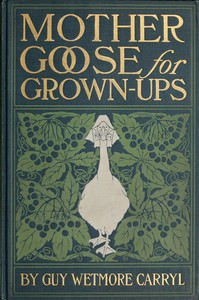
Mother Goose for Grown-ups — Story, Setting & Ideas

(2 User reviews)   537
Carryl, Guy Wetmore, 1873-1904, Newell, Peter, 1862-1924 [Illustrator], Verbeek, Gustave, 1867-1937 [Illustrator] Project Gutenberg 2015 Not confirmed
American poetry; Mother Goose -- Parodies, imitations, etc. Readers of public-domain and historical texts
Project Gutenberg digital edition en

Edition facts

Words 10,036
Reading time 44 min
Text sections 2

For Mother Goose for Grown-ups — Story, Setting & Ideas, the stored edition analysis reports 10,036 words, 44 min estimated reading time, and 2 detected text sections.

The text analysis averages about 22.4 words per sentence, while the detected sections provide another way to judge how the source is divided.

Project Gutenberg metadata also associates the work with “American poetry,” connecting these edition facts with the source record’s subject description.

Guy Wetmore Carryl's 1900 collection parodies Mother Goose rhymes with elaborate, polysyllabic verse, ironic morals, and absurdly inflated diction. Each poem reimagines a nursery character—Jack, Jill, Miss Muffet, Humpty Dumpty—in a mock-heroic style, often ending with a sardonic lesson. The excerpts reveal a pattern of deflating childish innocence through sophisticated wordplay and comic violence.
Share
Editorial Edition Score 4.5/5

Calculated from edition completeness, EPUB availability, text structure and catalogue metadata. Not a user rating.

How this score is calculated
  • Description quality20 pts
  • Title & short description10 pts
  • Source metadata20 pts
  • Text length15 pts
  • Chapters / structure15 pts
  • EPUB file integrity20 pts

Total of 100 points, scaled to a 2.5-5.0 range. Editions with an empty description or a missing EPUB file are not scored.

Edition quality

Read the Text

Never was African leopardess Crosser than Little Bow Peep: Quite apathetic, impassible People described her as: "That Wayward, contentious, irascible, Testy, cantankerous brat!"

Yet, as she dozed in a grotto-like Sort of a kind of a nook, She was so charmingly Watteau-like, What with her sheep and her crook; "She is a dryad or nymph," any Casual passer would think. Poets pronounced her a symphony, All in the palest of pink.

Thus it was not enigmatical, That the young shepherd who first Found her asleep, in ecstatical Sighs of felicity burst: Such was his sudden beatitude That, as he gazed at her so, Daphnis gave vent to this platitude: "My! Ain't she elegant though!"

Roused from some dream of Arcadia, Little Bow Peep with a start Answered him: "I ain't afraid o' yer! P'raps you imagine you're smart!" Daphnis protested impulsively, Blushing as red as a rose; All was in vain. She convulsively Punched the young man in the nose!

All of it's true, every word of it! I was not present to peep, But if you ask how I heard of it, Please to remember the sheep. There is no need of excuse. You will See how such scandals occur: If you recall Mother Goose, you will Know what tail-bearers they were!

MORAL: This pair irreclaimable Might have made Seraphim weep, But who can pick the most blamable? _Both saw a little beau peep!_

THE COMMENDABLE CASTIGATION

She was one of those creatures Whose features Are hard beyond any reclaim; And she loved in a hovel To grovel, And she hadn't a cent to her name. She owned neither gallants Nor talents; She borrowed extensively, too, From all of her dozens Of cousins, And never refunded a _sou_: Yet all they said in abuse of her Was: "She is prouder than Lucifer!" (That, I must say, without meaning to blame, Is always the way with that kind of a dame!)

There never was jolli- Er colley Than Old Mother Hubbard had found, Though cheaply she bought him, She'd taught him To follow her meekly around: But though she would lick him And kick him, It never had any effect; He always was howling And growling, But goodness! What could you expect? Colleys were never to flourish meant 'Less they had plenty of nourishment, All that he had were the feathers she'd pluck Off an occasional chicken or duck.

The colley was barred in The garden, He howled and he wailed and he whined. The neighbors indignant, Malignant Petitions unanimous signed. "The nuisance grows nightly," Politely They wrote. "It's an odious hound, And either you'll fill him, Or kill him, Or else he must go to the pound. For if this howling infernally Is to continue nocturnally-- Pardon us, ma'am, if we seem to be curt-- Somebody's apt to get horribly hurt!"

Mother Hubbard cried loudly And proudly: "Lands sakes! but you give yourselves airs! I'll take the law to you And sue you." The neighbors responded: "Who cares? We none of us care if The sheriff Lock every man jack of us up; We won't be repining At fining So long as we're rid of the pup!" They then proceeded to mount a sign, Bearing this ominous countersign: "FREEMEN! THE MOMENT HAS COME TO PROTEST AND OLD MOTHER HUBBARD DELENDUM EST!"

They marched to her gateway, And straightway They trampled all over her lawn; Most rudely they harried And carried Her round on a rail until dawn. They marred her, and jarred her, And tarred her And feathered her, just as they should, Of speech they bereft her, And left her With: "_Now_ do you think you'll be good!"

THE MORAL'S a charmingly pleasing one. While we would deprecate teasing one, Still, when a dame has politeness rebuffed, She certainly ought to be collared and cuffed.

THE DISCOURAGING DISCOVERY

A knack almost incredible for dealing with an edible Jack Horner's elder sister was acknowledged to display; She labored hard and zealously, but always guarded jealously The secrets of the dishes she invented every day. She'd take some indigestible, unpopular comestible, And to its better nature would so tenderly appeal That Jack invoked a benison upon a haunch of venison, When really she was serving him a little leg of veal!

Jack said she was a miracle. The word was not satirical, For daily climbing upward, she excelled herself at last: The acme of facility, the zenith of ability Was what she gave her brother for his Christmas Day repast. He dined that evening eagerly and anything but meagerly, And when he'd had his salad and his quart of Extra Dry, With sisterly benignity, and just a touch of dignity, She placed upon the table an unutterable pie!

Guy Wetmore Carryl's Mother Goose for Grown-ups (1900) takes the familiar nursery rhymes and inflates them into mock-heroic poems stuffed with polysyllabic wit. The opening poem, “The Admirable Assertiveness of Jilted Jack,” immediately signals the method: Jack’s tongue is “sharp as any ax,” and his sighs “were fit to kill.” Carryl does not simply update the rhymes; he reimagines them as miniature satires, complete with elaborate vocabulary and ironic morals. The collection’s table of contents, with titles like “The Blatant Brutality of Little Bow Peep” and “The Gastronomic Guile of Simple Simon,” promises a systematic deflation of childhood innocence.

Mock-Heroic Diction and Comic Violence

Carryl’s signature move is to dress nursery characters in the language of epic poetry. In “The Preposterous Performance of an Old Lady of Banbury,” the old lady’s fall is compared to a “red Italian sunset” beside a “Beardsley poster” and the “aurora borealis.” The absurd simile is typical: Carryl piles on cultural references to heighten the ridiculousness. Violence is frequent but cartoonish. In “The Quixotic Quest of Three Blind Mice,” the farmer’s wife “sought them” with a knife, but the poem’s tone remains arch. The moral of “The Commendable Castigation of Old Mother Hubbard” (not fully excerpted) likely follows suit. Carryl’s rhymes often end with a sardonic couplet that undercuts any sentimentality.

Recurring Patterns: The Ironic Moral and the Deflated Hero

Each poem concludes with a moral that twists the original lesson. In “The Preposterous Performance of an Old Lady of Banbury,” the moral warns against buying “old horses” and mistaking “a molehill as a mount.” The tone is dry, almost cynical. The heroes are consistently deflated: Jack is jilted, the old lady falls flat, and the three blind mice are trapped. Carryl’s characters are not innocent children but adults in miniature, prone to vanity and folly. The poem “The Singular Sangfroid of Baby Bunting” (title only) suggests a similar treatment. The collection’s unity comes from this repeated pattern: a nursery setup, elaborate description, a comic mishap, and a pointed moral.

Illustrations and the Visual Dimension

The book includes illustrations by Peter Newell and Gustave Verbeek, which are integral to the humor. The frontispiece, captioned “‘Will you tell me if it’s straight?’” (from the old lady poem), shows a woman astride a horse, her bonnet askew. Other illustrations, such as “She was so charmingly Watteau-like” and “While by kicks he loosened bricks,” reinforce the mock-heroic tone. The visual gags complement Carryl’s verbal ones. Readers should note that the text references these images; the poems were likely designed with the illustrations in mind. The collaboration between poet and artists creates a unified satirical experience.

Carryl’s collection rewards readers who enjoy verbal play and a touch of cynicism. The poems are best read aloud to appreciate their rhythm and rhyme. Pay attention to the morals: they often undercut the story just told. The illustrations by Newell and Verbeek add another layer of humor, so consult them as you read. This is not a children’s book but a sophisticated parody for adults who know the original rhymes and can appreciate their inversion.

That rainy afternoon, Carryl’s mock-heroic Jack toppling down his hill made me laugh, then pause. Beneath the wordplay, I sensed a lonely ache in those swollen rhymes. The window blurred the fence posts soft. I set the book down, and my hand drifted, almost by accident, toward Sun and Saddle Leather — Reading Companion. Its plain, dry landscape felt like a quiet clearing after all that thunder.

Samuel Nguyen
1 month ago

Gabriel Wilson
2 weeks ago

5
5 out of 5 (2 User reviews )

Add a Review

Your Rating *
  • ...
    Tammy Gray - 1 month ago
    {'type': 'neutral', 'content': 'Mother Goose For Grown Ups is an amusing collection that will appeal to readers who enjoy clever twists on familiar themes. The humor is often sharp and insightful. However, some rhymes fall flat and feel forced. The consistency could be better, but overall it provides a few good laughs and a light-hearted reading experience.'}

  • ...
    Nicole Lopez - 2 weeks ago
    {'type': 'negative', 'content': 'Mother Goose For Grown Ups is a misfire. The attempts at adult humor come off as crude and uninspired, relying too heavily on predictable puns and awkward rhymes. The satire is shallow and fails to deliver any meaningful commentary. What could have been a clever parody quickly becomes tedious and repetitive. There are much better collections of grown-up nursery rhymes available.'}

  • ...
    Anna Bennett - 2 weeks ago
    {'type': 'positive', 'content': "Mother Goose For Grown Ups is a brilliantly witty and irreverent take on classic nursery rhymes. The author infuses each rhyme with sophisticated humor and satirical commentary that adults will thoroughly enjoy. The clever wordplay and playful yet pointed observations make this an entertaining and refreshing read. It's the perfect treat for anyone who appreciates smart humor and literary mischief."}


Reader reflection

How did this book work for you?

Your answers remain private and are stored only in this browser.
Your progress 0 / 10
1

What is your current status with this title?

2

How did the book work for you overall?

3

Would you pass this book on to a friend?

4

How easy was the book to follow?

Related eBooks