About 71 minutes
The Dream of Gerontius — Reading Notes
Adventure Picaresque Fiction
16,265 recorded words. 2 minutes difference from this book's estimate.
View Gutenberg source #48927
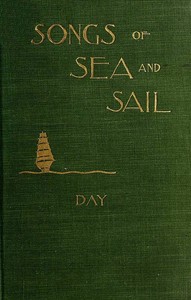
The catalog record for Songs of Sea and Sail — Context and Discussion provides practical reading context through 15,812 words, 1 hr 9 min estimated reading time, and 7 detected text sections.
The text analysis averages about 27.1 words per sentence, while the detected sections provide another way to judge how the source is divided.
Project Gutenberg metadata also associates the work with “Sea poetry,” connecting these edition facts with the source record’s subject description.
Explore this collection
These alternatives are selected using recorded categories and estimated reading time.
About 71 minutes
Adventure Picaresque Fiction
16,265 recorded words. 2 minutes difference from this book's estimate.
View Gutenberg source #48927About 74 minutes
Adventure Picaresque Fiction
16,951 recorded words. 5 minutes difference from this book's estimate.
View Gutenberg source #47842About 79 minutes
Adventure Picaresque Fiction
18,013 recorded words. 10 minutes difference from this book's estimate.
View Gutenberg source #37085Search stored excerpts and compare books → Choose by your preferences →
Choices use stored catalog measurements. Estimates vary with reading speed. A shared category is a catalog label, not a claim that two books have the same argument or literary quality.
Search reads excerpt text stored with this catalog and links to its associated Gutenberg record. The connection is stored in the site database; this tool does not recheck that every excerpt is word-for-word identical to that external record. Excerpt search does not cover every chapter and does not verify historical publication dates.
Catalog snapshot checked: 2026-09-26. Coverage: 90 public books, 90 available source excerpts.
Calculated from edition completeness, EPUB availability, text structure and catalogue metadata. Not a user rating.
Total of 100 points, scaled to a 2.5-5.0 range. Editions with an empty description or a missing EPUB file are not scored.
Public-domain source text
The source text is kept in the dedicated reader, separate from this catalogue record and its commentary.
Thomas Fleming Day's Songs of Sea and Sail opens with a mermaid's song that immediately establishes a tension between allure and sorrow: the speaker's heart is 'enmeshed in the mystical strain' of a world beneath the waves. This collection of 43 poems, first published in 1898, does not present a uniform sea but a series of shifting moods—from the privateering nostalgia of 'The Old Buccaneer's Song' to the stark warning of 'The Belfry of the Sea.' Day varies his meters and refrains to match each subject, sometimes using the long, flowing lines of a ballad, other times a clipped, insistent rhythm that mimics the urgency of a ship's bell.
Day frequently employs refrains that anchor each poem's emotional core. In 'The Mermaid's Song,' the line 'Of the world that is under the sea' recurs with slight variations, each time deepening the speaker's longing. The repetition mimics the hypnotic pull of the sea itself—a device that appears again in 'The Old Buccaneer's Song,' where the opening 'Oh, my heart goes privateering along the Spanish Main' returns at the start of each stanza. This structural choice gives the poems a chant-like quality, as if the speaker is trying to convince himself through repetition. The effect is not monotonous but cumulative: each return to the refrain adds a layer of loss or defiance. In 'The Belfry of the Sea,' the bell's voice is personified and its repeated warnings become a curse: 'Curse and chide them, / Mock, deride them.' Here the refrain turns accusatory, showing Day's range from wistful to bitter.
Day shifts between first-person lyric and dramatic monologue, often blurring the line between the poet and his speakers. 'The Mermaid's Song' is a lyric of personal enchantment, but 'The Old Buccaneer's Song' adopts the voice of a retired privateer longing for his violent past: 'A curse upon this slothful life and this black northern land!' The contrast is sharp: one speaker is passive, mesmerized; the other is active, nostalgic for action. In 'The Belfry of the Sea,' the speaker becomes the bell itself, addressing mariners with a mix of blessing and curse: 'Men who bless them / And caress them— / Bells that call upon the land— / Curse and chide them.' This ventriloquism allows Day to explore the sea's dual nature—seductive and treacherous—without committing to a single perspective. The variety of voices keeps the collection from becoming a monotone celebration of the sea.
Day's metrical choices often mirror the action he describes. In 'The Mermaid's Song,' the lines are irregular, with short phrases like 'The world which lies / Where human eyes / Are never allowed to see' creating a halting, breathless quality that suggests the speaker's struggle to articulate his longing. By contrast, 'The Old Buccaneer's Song' uses a steady iambic heptameter—'Oh, my heart goes privateering along the Spanish Main'—that evokes the rolling gait of a ship under way. The most striking shift occurs in 'The Belfry of the Sea,' where the meter becomes choppy and imperative: 'Haste away! / Haste away! / For the breeze / Frets the seas.' The short lines and exclamation points create a sense of urgency, as if the bell is ringing an alarm. Day also varies stanza length: some poems are tightly structured quatrains, while others, like 'The Mermaid's Song,' unfold in long, winding stanzas that mirror the sea's endless motion.
Readers approaching Songs of Sea and Sail should listen for the shifts in rhythm and voice that distinguish each poem. Day is not a poet of grand narratives but of precise, emotional moments—a sailor's longing, a bell's warning, a buccaneer's regret. The collection rewards attention to its formal craft: the way a refrain changes meaning with repetition, or how a sudden break in meter signals a change in mood. These poems are best read aloud, allowing the sea's cadences to emerge from the page.
The rain drummed on the window while I drifted through Songs of Sea and Sail, caught between Fleming Day's mermaid wistfulness and the grit of a deckhand's lament. That odd marriage of the fanciful and the mundane stuck with me. Later, browsing idly, I found myself pleased by a similar quiet paradox in Minor Poets of the Caroline Period, Vol. III — Context and Discussion. It felt like hearing a distant verse echo through the years—same tide, different shore.
Your answers remain private and are stored only in this browser.