1

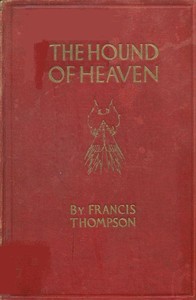
The Hound of Heaven — Text and Context
(11 User reviews)
1493
Project Gutenberg
2009
Not confirmed
English poetry
Readers of public-domain and historical texts
Project Gutenberg digital edition
en
Edition facts
Words
11,355
Reading time
50 min
Text sections
2
Before opening The Hound of Heaven — Text and Context, the edition data offers a quick orientation: 11,355 words, 50 min estimated reading time, and 2 detected text sections.
The text analysis averages about 23.1 words per sentence, while the detected sections provide another way to judge how the source is divided.
Project Gutenberg metadata also associates the work with “English poetry,” connecting these edition facts with the source record’s subject description.
Source:
Project Gutenberg record #30730
An editorial note examining the linguistic and theological tensions in Francis Thompson's 'The Hound of Heaven,' focusing on the poem's archaic diction, the paradox of divine pursuit, and the interplay between scientific modernity and spiritual intimacy.
Editorial Edition Score
4.5/5
★★★★★
★★★★★
Calculated from edition completeness, EPUB availability, text structure and catalogue metadata. Not a user rating.
How this score is calculated
- Description quality20 pts
- Title & short description10 pts
- Source metadata20 pts
- Text length15 pts
- Chapters / structure15 pts
- EPUB file integrity20 pts
Total of 100 points, scaled to a 2.5-5.0 range. Editions with an empty description or a missing EPUB file are not scored.
Edition quality
Read the Text
Francis was of the silent and secretive sort where he could not hope to find intelligent sympathy. This, and some cloudy compromise with his sense of filial dutifulness, will perhaps explain why he passed six years as a student of medicine without any serious purpose of becoming a physician and without informing his father of his disinclination. Three examinations and three failures at intervals of a year were necessary to convince the father of the true state of affairs. Stern measures were adopted; and, although the consequences were pitifully tragical, it is hard to blame the father of Francis. How are we to discover the extraordinary seal in a case that requires special and extraordinary treatment?
Francis was twenty-four years old with no more idea than a child's of how life is planned on practical lines of prosperity. The senior Thompson thought it time for him to learn and issued orders to find employment of some remunerative kind. Accordingly during the next two years Francis served indifferently for brief periods as a clerk in the shop of a maker of surgical instruments and as a canvasser of an encyclopedia. Both experiments in the art of making a living were failures, increasing paternal dissatisfaction. The desperate young man then enlisted in the army, and after a few weeks' of drilling was rejected on the score of physical weakness.
During these shiftless and unhappy years as a listless medical student and laggard apprentice the poet's chief solace was the public library of Manchester. In his daily absences from home his misery suggested another solace of a sinister kind. After a severe illness during his second year of medicine his mother, says his biographer, presented him with a copy of De Quincey's "Confessions of an Opium Eater." It is incredible that a _helluo librorum_, like Thompson, should have reached the age of twenty without ever having read a book which is one of the first to attract every bright school-boy. This would be particularly true of a school-boy who lived near Manchester, De Quincey's own town. But the evidence seems to be against probabilities. Thompson succumbed completely to the influence of the great genius whose temper and circumstances of life were singularly like his own. Experiments in laudanum were made and habits contracted which accentuated a natural unfitness to wrestle with the practical problems of getting on and rendered family intercourse drearier than ever.
Francis Thompson's 'The Hound of Heaven' opens with a striking image of a soul fleeing from divine pursuit, a chase rendered in language that deliberately strains against ordinary speech. The poem's vocabulary mixes neologisms and archaic words, a stylistic choice that the introductory essay defends as an effort to 'soar above the limitations of time.' This linguistic tension mirrors the central paradox: a God who is both immanent and elusive, pursuing a creature who cannot escape yet feels abandoned. The 1926 edition, illustrated by Stella Langdale, presents the poem alongside a substantial critical introduction that frames these contrasts within a broader cultural debate about science, faith, and human significance.
Archaic Diction and Temporal Liberation
The introductory essay explicitly addresses Thompson's use of 'neologisms and archaic words,' describing it as a 'legitimate and instinctive effort' to break free from 'transient accretions of a living, and therefore constantly changing, mode of speech.' This is not mere stylistic ornament; the essay argues that Thompson sought 'an enfranchisement of utterance, devoid of stratifying peculiarities, assignable to no age or epoch.' The result is a poetic voice that feels both ancient and invented, pulling the reader out of any specific historical moment. The essay's own language—comparing the poem's expression to 'impetuous volcanic fires that fling heavenward mighty fragments'—echoes this grand, elemental register. Readers should note how the poem's diction creates a sense of timelessness that reinforces its theological argument about a God who exists outside of time.
The Paradox of Divine Pursuit
The introduction recounts an anecdote about a Japanese student explaining the poem's central metaphor: God as a hound pursuing the soul. The student clarifies that Thompson is not chasing God but 'running away from God,' and that the pursuit is 'moral'—God is 'after Thompson's love.' This exchange highlights the poem's inversion of conventional religious imagery. The essay further develops this paradox by contrasting the Christian view of a personal God with modern philosophical tendencies that, in its words, 'deny any personal relationship between God and man' because God is 'too great to be interested in man.' Thompson's poem, by making divine love a relentless chase, insists on intimacy despite cosmic scale. The tension between God's omnipresence and the experience of being pursued is central to the poem's emotional power.
Science, Scale, and Human Significance
The essay engages directly with the challenge posed by modern science to religious faith. It quotes Hazlitt's remark that 'the heavens have gone farther off and become astronomical,' and describes a 'curious notion' that humanity 'must sink lower into insignificance with every new discovery of the vastness and huge design of creation.' Against this, the essay asserts that 'the most massive star of the Milky Way is not so wonderful as the smallest human child,' and that God's 'prodigality' reveals 'endless resources' rather than diminishing human importance. This defense of human dignity in an expanding universe provides a philosophical backdrop for Thompson's poem, which dramatizes the soul's worth through the very intensity of divine pursuit. The poem thus becomes a counter-narrative to scientific dehumanization, insisting on personal meaning within infinite space.
Readers approaching 'The Hound of Heaven' in this edition will find a work that is as much about language and belief as about the chase itself. Pay attention to how Thompson's diction creates a sense of urgency and timelessness, and consider the introductory essay's arguments about science and faith as a lens for the poem. The illustrations by Stella Langdale, though not reproduced here, were designed to complement this visionary text. The poem rewards multiple readings, each revealing new layers of its central paradox: that to be pursued by God is both terrifying and redemptive.
I was re-reading Thompson’s archaic diction last night, the way his pursuit is both terrifying and tender—it felt familiar, somehow unresolved. That tension between old phrasing and a modern ache made me think of another collection I once skimmed, which handles similar collisions with gentler wit. There’s a quiet kinship there. The Battle of the Bays — Key Ideas to Explore holds something of that same spirit, I think.
Isaac Young
1 month agoMia Williams
4 weeks agoAmelia Scott
1 month agoDavid Flores
1 month agoThere are no comments for this eBook.
Reader reflection
How did this book work for you?
Your answers remain private and are stored only in this browser.
Your progress
0
/
10
2
Did this book hold your interest?
3
How likely are you to recommend this book?
4
How easy was the book to follow?
5
How useful did the reading feel?
6
How would you describe its reading pace?
7
How closely did the book connect with your experience?
8
Which aspect of the book did you value most?
9
What is the main idea you are taking away?
10


Samuel Baker
2 weeks ago