About 967 minutes
Chaucer's Works, Volume 6 — Introduction, Glossary, and Indexes — Context and Discussion
Science Fiction Utopias
222,204 recorded words. 35 minutes difference from this book's estimate.
View Gutenberg source #43097
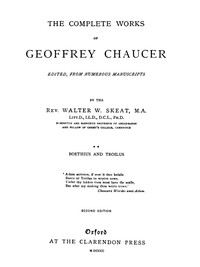
Before opening Chaucer's Works, Volume 2 — Boethius and Troilus — A Reader’s Guide, the edition data offers a quick orientation: 214,323 words, 15 hr 32 min estimated reading time, and 50 detected text sections.
The text analysis averages about 17.3 words per sentence, while the detected sections provide another way to judge how the source is divided.
Project Gutenberg metadata also associates the work with “English poetry -- Middle English, 1100-1500,” connecting these edition facts with the source record’s subject description.
Explore this collection
These alternatives are selected using recorded categories and estimated reading time.
About 967 minutes
Science Fiction Utopias
222,204 recorded words. 35 minutes difference from this book's estimate.
View Gutenberg source #43097About 389 minutes
Science Fiction Utopias
89,441 recorded words. 543 minutes difference from this book's estimate.
View Gutenberg source #53855About 252 minutes
Science Fiction Utopias
57,738 recorded words. 680 minutes difference from this book's estimate.
View Gutenberg source #43660Search stored excerpts and compare books → Choose by your preferences →
Choices use stored catalog measurements. Estimates vary with reading speed. A shared category is a catalog label, not a claim that two books have the same argument or literary quality.
Search reads excerpt text stored with this catalog and links to its associated Gutenberg record. The connection is stored in the site database; this tool does not recheck that every excerpt is word-for-word identical to that external record. Excerpt search does not cover every chapter and does not verify historical publication dates.
Catalog snapshot checked: 2026-09-26. Coverage: 90 public books, 90 available source excerpts.
Calculated from edition completeness, EPUB availability, text structure and catalogue metadata. Not a user rating.
Total of 100 points, scaled to a 2.5-5.0 range. Editions with an empty description or a missing EPUB file are not scored.
Public-domain source text
The source text is kept in the dedicated reader, separate from this catalogue record and its commentary.
The volume pairs Chaucer's prose translation of Boethius's Consolation of Philosophy with his narrative poem Troilus and Criseyde, a juxtaposition that immediately signals thematic resonance. The editor, Walter W. Skeat, provides extensive introductions, manuscript notes, and a glossary, framing the texts as objects of philological study. For a first reader, the opening pages of Boethius—a dialogue between the narrator and Lady Philosophy—establish a contemplative, argumentative mode, while the first book of Troilus plunges into the Trojan war and the protagonist's unrequited love. The contrast in form and tone invites comparison between philosophical consolation and poetic tragedy.
Skeat's introduction occupies nearly fifty pages, detailing the date, sources, manuscripts, and textual history of each work. For Boethius, he traces Chaucer's translation method, noting mistakes and borrowings from Jean de Meun. For Troilus, he discusses Boccaccio's Filostrato as the primary source and the mysterious 'Lollius.' A first reader may find this apparatus daunting, but it offers a transparent view of how the text was constructed. Skeat's notes, placed after the poems, gloss Middle English words and cite parallel passages. The frontispiece—a facsimile of a manuscript page—reinforces the volume's status as a critical edition.
The Consolation alternates between prose sections (the narrator's complaints and Philosophy's arguments) and metrical poems (the narrator's songs). In Book I, the narrator laments his exile in verse, then Philosophy responds in prose, diagnosing his sickness as forgetfulness of true good. This rhythm creates a pedagogical drama: the reader follows the narrator's gradual reorientation from worldly grief to philosophical understanding. Chaucer's prose is direct, often literal, but occasionally awkward—Skeat notes several mistranslations. The metra (verse sections) employ rhyme and meter, offering a lyrical counterpoint. A first reader might attend to how the form itself enacts the movement from emotion to reason.
In the excerpt from Book II (stanzas 102–115), Criseyde weighs whether to love Troilus. Her soliloquy reveals a shrewd, self-aware mind: she considers his worth, her own freedom, and the risks of scandal. The passage is structured as a series of conditional arguments ('Now set a cas...'), punctuated by proverbial wisdom ('In every thing, I woot, ther lyth mesure'). The simile of the March cloud (lines 765–770) dramatizes her shifting emotions. Chaucer gives her a voice that is both rational and vulnerable, making her decision feel like a genuine moral dilemma. A first reader should note how this interiority contrasts with the more external action of Book I.
Recurring imagery of light and shadow links the two texts. In Boethius, Philosophy promises to dispel the 'clouds' of error; in Troilus, Criseyde's 'cloudy thought' overspreads her 'brighte thoughtes.' The March sun that 'chaungeth ofte tyme his face' mirrors the instability of love. These images are not merely decorative—they structure the reader's experience of uncertainty. In Boethius, the movement is toward clarity; in Troilus, the cloud may never fully lift. A first reader attuned to this pattern will see how Chaucer adapts Boethian consolation to a narrative where happiness is fleeting.
Reading these works together, a first-time reader benefits from Skeat's notes but should not let them overshadow the texts themselves. The Consolation rewards slow, patient reading, while Troilus demands attention to character and voice. The volume's structure—philosophy first, then poetry—suggests a progression, but the excerpts show that both works grapple with fortune, free will, and human suffering. Let the texts speak; the apparatus is a guide, not a substitute.
Some evenings, I still recall how Chaucer’s Boece murmurs against Criseyde’s wavering, prose and verse trading the same anxious breath. That measured struggle finds a quieter echo in The Hound of Heaven — Text and Context, where a soul’s flight and pursuit feel less like doctrine than a held sigh. Two books, keeping each other company on my shelf.
Save your reaction, strongest insight, and memorable passage.