1

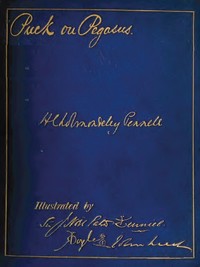
Puck on Pegasus Fourth Edition — Background and Themes
(10 User reviews)
1224
Project Gutenberg
2015
Not confirmed
Humorous poetry, English; English poetry -- 19th century
Readers of public-domain and historical texts
Project Gutenberg digital edition
en
Edition facts
Words
17,348
Reading time
76 min
Text sections
6
The catalog record for Puck on Pegasus Fourth Edition — Background and Themes provides practical reading context through 17,348 words, 1 hr 16 min estimated reading time, and 6 detected text sections.
The text analysis averages about 20.0 words per sentence, while the detected sections provide another way to judge how the source is divided.
Project Gutenberg metadata also associates the work with “Humorous poetry, English,” connecting these edition facts with the source record’s subject description.
Source:
Project Gutenberg record #49684
A fourth edition of H. Cholmondeley-Pennell's comic verse collection, illustrated by Leech, Phiz, Tenniel, and Cruikshank. The poems blend satire, wordplay, and absurdity, with recurring motifs of mishap, urban frustration, and mock-heroic treatment of everyday and historical subjects.
Editorial Edition Score
4.6/5
★★★★★
★★★★★
Calculated from edition completeness, EPUB availability, text structure and catalogue metadata. Not a user rating.
How this score is calculated
- Description quality20 pts
- Title & short description10 pts
- Source metadata20 pts
- Text length15 pts
- Chapters / structure15 pts
- EPUB file integrity20 pts
Total of 100 points, scaled to a 2.5-5.0 range. Editions with an empty description or a missing EPUB file are not scored.
Edition quality
Read the Text
And thought the eye would go.
Time's up!--Again they battle;
Again the strokes" fly free;
But Sayers' right arm--that arm of pride--
Now dangles pow'rless by his side,
Plain for all eyes to see;
And thro' that long and desp'rate shock--
Two mortal hours on the clock--
By sheer indomitable pluck
With his _left hand_ fought he!
With his left hand he fought him,
Though he was sore in pain,--
Full twenty times hurl'd backward,
Still pressing on again!
With his left hand he fought him,
Till each could fight no more;
Till Sayers could scarcely strike a blow,
Till Heenan could not see his foe--
Such fighting England never knew
Upon her soil before!
They gave him of the standard
Gold coinage of the realm,
As much as one stout guardsman
Could carry in his helm;
They made him an ovation
On the Exchange hard by,--
And they may slap their pockets
And ev'ry soul in England
Was glad, both high and low,
And books were voted snobbish,
And "gloves" were all the go;
And each man told the story,
Whilst ladies' hearts did melt,
How Sayers, the British Champion,
Did battle for the Belt.
And still, when Yankees swagger
Th' almighty "stars and stripes,"
And put eternal bunkum
Into their neighbours' pipes,--
With joke and gibe and banter
Long shall the tale be told,
How stout Tom Sayers kept the Belt
And Yankee Doodle sold!
H! pause awhile, kind gentleman,
Nor turn thy face away;
There is a boon that I must ask,
A pray'r that I would pray.
Thou hast a gentle wife at home?
A son--perchance like me--
And children fair with golden hair
To cling around thy knee?
Then by their love I pray thee,
And by their merry tone;
By home, and all its tender joys,
Which I have never known,--
By all the smiles that hail thee now;
By ev'ry former sigh;
By ev'ry pang that thou hast felt
When lone, perchance, as I,--
By youth and all its blossoms bright,
By manhood's ripen'd fruits,
By Faith and Hope and Charity--
Yer'll let me clean yer boots!
HOW THE DAUGHTERS COME DOWN AT DUNOON
(By R--b--t S--th--y.)
_"There standyth on the one tide of Dunoon, a hill or moleock of passynge steepnesse, and right slipperie withal; wherepon in gaye timet, ye youths and ye maidens of that towne do exceedingly disport themselvet and take their pleasaunce; runnynge both uppe and downe with great glee and to the much endangerment of their fair nekkes."_
And clashing and shying,
And starting and bolting,
And darting and jolting,
And rushing and crushing,
And leaping and creeping,
And tottering and staggering,
And lumbering and slithering,
And hurrying and skurrying,
And worrying and flurrying,
Feathers a-flying all--bonnets untying all--
Crinolines rapping and flapping and slapping all,
Balmorals dancing and glancing entrancing all,--
Nymphs on declivity--
Mothers in extacies--
Fathers in vextacies--
Lady-loves whisking and frisking and clinging on
True-lovers puffing and blowing and springing on,
Flushing and blushing and wriggling and giggling on,
Teazing and pleasing and wheezing and squeezing on,
Everlastingly falling and bawling and sprawling on,
Rumbling and tumbling and grumbling and stumbling
That's just how the Daughters
(_Mr. "Barney Maguire's" Account._)
CH! botheration! what a perturbation
And exasperation in the Press arose,
At the first mintion of the Queen's intintion
To confer a pinsion on the Poet Close!
There was the True-Blues-Man and the Farthing--
All in the confushan fighting cheek by jowl;
And the Whigs and Tories forgett'n their furies
In their indignation and giniral howl!
The _TittlerTattle_ and the _Penny-Rattle_
Led off the battle with a puny squake,
Whilst the _Big-Tin-Kettle_ and the 'heavy metal'
His hash for to settle took the liberty to spake;--
"Shure'twas most ongracious, not to say owdacious,
And enough to bring the water to their eyes,
To take the loaves and fishes from the chilthren's dishes
And bestow the Royal Bounty in such wise.
"If so be that noble Er-rls and infarior chur-rls
Has parties they don't love and daresen't bate,
Let them squeeze their purses to choke off the curses
And not foist their verses on the Public State!
'Twas worse than jobbery, and a right down robbery,
For to give the ruffian fifty pounds a year,--
Becase the swate nobilities were dhreading his civilities,
And ould Lord Lonsdale in a state of bodily fear.
"Themselves despiting, there was Carlisle writing,
And Brougham inditing of saft-sardering notes,
And Viscount Palmerston a-chuckling at the harm he's
And dipping his fingers in the county votes.--
'Twould be a wrong entirely, to be remimber'd direly,
If the scribbling blackguard on 'the List' was placed,
And should the Legislature support the crature
Then for sartin shure the counthry was disgraced!"
H. Cholmondeley-Pennell's Puck on Pegasus opens with a preface that acknowledges the author's debt to critics and explains the substitution of lighter pieces with more serious poems like "The Night Mail North" and "Derby Day." The collection's title invokes Shakespeare's Puck, but the poems themselves often veer toward the mundane and the mishap-prone. In "Wus, Ever Wus," the speaker laments a series of petty disasters: spotless trousers splashed, a beetle charging into an eye, and smuts settling on the nose. This self-deprecating tone recurs throughout, as does a fascination with the rhythms of speech—stammering, dialect, and colloquial outbursts.
Stammering and Stuttering as Comic Device
Several poems in the collection use stammering or interrupted speech as a structural gag. In "The Days the Thing," a speaker trying to give directions to Waterloo Place is repeatedly derailed by a stutter: "Wuw—Wuw—Wuw—Wuw—Wuw—Wuw— / W-Waterloo Place?" The line breaks mimic the hesitation, and the poem ends with the speaker's exasperated admission that the listener will arrive before the directions are finished. Similarly, "Too Bad, You Know" features a cabman whose speech is peppered with colloquial curses and broken syntax: "I say, you Sir,—come out of that!— / I say, you Sir in there—" The effect is one of comic frustration, where language itself becomes an obstacle. These poems suggest a fascination with the gap between intention and expression, a theme that aligns with the collection's broader interest in failed plans and thwarted expectations.
Mock-Heroic and Parodic Inversions
Pennell frequently adapts well-known poetic forms for satirical ends. "Charge of the Light (Irish) Brigade" parodies Tennyson's famous poem, replacing the heroic cavalry charge with a farcical retreat: "No—where they stood they stay'd, / Tho' Lamoriciere pray'd, / Threaten'd, and thunder'd." The poem's refrain "Blessed Six Hundred" becomes ironic as the soldiers scatter and surrender. In "Ghostries," the gothic horror of a spectral visitation is undercut by the revelation that the creeping figure is merely a cat: "And you could not, / Or you would not, / See it was the cat?" This deflationary technique recurs in "Marriage in High Life," where Sir Toby's portly, aldermanic dignity is punctured by the poem's abrupt truncation. The effect is a consistent refusal to let any subject remain elevated, whether it be military glory, supernatural terror, or domestic respectability.
Urban and Industrial Settings as Sources of Comedy
The collection frequently sets its scenes in the city, using the specifics of Victorian London—fog, cabs, smuts, and railway stations—as comic material. "The Night Mail North" opens with a bustling railway scene: "Clap on the steam, and sharp's the word / 'You men in scarlet cloth.'" The poem's rhythm mimics the urgency of departure. In "Too Bad, You Know," the fog is so thick that the cabman cannot see: "There aint a thimblefull of shine, / The fog's as black as pitch." The urban environment is not merely backdrop but active antagonist, splashing pedestrians, blinding drivers, and frustrating communication. Even the celestial is invaded by the city's grime: in "Wus, Ever Wus," the speaker's attempt to stroll in Regent Street is foiled by "smuts the most prodigious" that settle on his nose. These details ground the poems in a recognizable, gritty reality that contrasts with the fantastical title's promise of airborne mischief.
Readers approaching Puck on Pegasus should expect a collection that prizes variety over consistency, moving from railway timetables to ghost stories to parliamentary satire. The fourth edition's revisions, as noted in the preface, tilt the balance toward longer, more serious poems, but the comic sensibility remains dominant. Pay attention to the illustrations by Leech, Phiz, Tenniel, and Cruikshank, which often amplify the poems' visual humor. The book rewards those who enjoy wordplay, parody, and the peculiar texture of mid-Victorian urban life.
I remember that gray afternoon when Puck on Pegasus sat open on my knee, the drizzle blurring the window and Tenniel’s inkwork sharpening the absurdity of falling hats and punctured pride. Somewhere between the wordplay and the mock-heroic stumble lay a quieter patience for verbal trickery, which drifted me toward The Scribleriad, and The Difference Between Verbal and Practical Virtue — A Closer Reading, and I found the same laughter, somehow slower and more thoughtful.
Camila Green
1 month agoCamila Jackson
1 month agoLuke Lee
3 weeks agoAria Hall
1 month agoThere are no comments for this eBook.
Reader reflection
Your personal reading reflection
Build a private reading journal entry for this title.
Your progress
0
/
10
2
What was your overall reaction to the book?
3
Would you encourage someone else to read it?
4
How much effort did this book require?
5
What was its emotional impact?
6
Was the book what you thought it would be?
7
Which aspect of the book did you value most?
8
How clearly were the main ideas presented?
9
What changed or sharpened your thinking?
10

Alexander Johnson
1 month ago