About 87 minutes
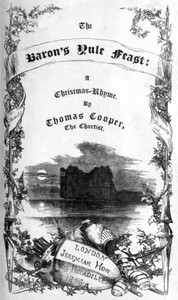
The Baron's Yule Feast: A Christmas Rhyme — Background and Themes
Fantasy Juvenile Worlds
19,968 recorded words. 4 minutes difference from this book's estimate.
View Gutenberg source #29722
The catalog record for Rhymes Old and New : collected by M.E.S. Wright — Text and Context provides practical reading context through 18,992 words, 1 hr 23 min estimated reading time, and 3 detected text sections.
The text analysis averages about 20.2 words per sentence, while the detected sections provide another way to judge how the source is divided.
Project Gutenberg metadata also associates the work with “Children's poetry,” connecting these edition facts with the source record’s subject description.
Explore this collection
These alternatives are selected using recorded categories and estimated reading time.
About 87 minutes
Fantasy Juvenile Worlds
19,968 recorded words. 4 minutes difference from this book's estimate.
View Gutenberg source #29722About 76 minutes
Fantasy Juvenile Worlds
17,348 recorded words. 7 minutes difference from this book's estimate.
View Gutenberg source #49684About 72 minutes
Fantasy Juvenile Worlds
16,523 recorded words. 11 minutes difference from this book's estimate.
View Gutenberg source #50509Search stored excerpts and compare books → Choose by your preferences →
Choices use stored catalog measurements. Estimates vary with reading speed. A shared category is a catalog label, not a claim that two books have the same argument or literary quality.
Search reads excerpt text stored with this catalog and links to its associated Gutenberg record. The connection is stored in the site database; this tool does not recheck that every excerpt is word-for-word identical to that external record. Excerpt search does not cover every chapter and does not verify historical publication dates.
Catalog snapshot checked: 2026-09-26. Coverage: 90 public books, 90 available source excerpts.
Calculated from edition completeness, EPUB availability, text structure and catalogue metadata. Not a user rating.
Total of 100 points, scaled to a 2.5-5.0 range. Editions with an empty description or a missing EPUB file are not scored.
Public-domain source text
The source text is kept in the dedicated reader, separate from this catalogue record and its commentary.
The compiler M.E.S. Wright states in her preface that this collection aims to gather rhymes 'which for the greater part are not included in other books for the nursery or schoolroom.' Many entries appear with local variations—Essex, Staffordshire, Devonshire, and Norfolk are named—and several were repeated to her by people who could not recall their origin. The volume draws on printed sources such as Halliwell's Nursery Rhymes of England, Notes and Queries, and Jewitt's Reliquary, alongside named authors like the Taylors, the Lambs, and Mary Howitt.
The rhymes are grouped into sections: Couplets, Weather and Season Rhymes, Baby Songs, Men Women and Children, Beasts Birds etc., Alphabets, Games, and Miscellaneous Rhymes. This structure foregrounds the oral and folk character of the material, with many verses attributed to specific counties or to older printed miscellanies.
Wright's preface emphasizes that many rhymes appear 'with local variations,' and the text bears this out. The weather couplets are tagged by county: Essex gives 'Winter thunder, and summer flood, / Bode England no good'; Staffordshire offers 'Cuckoo oats and Michaelmas hay, / Will make the farmer run away'; and a Devonshire cuckoo rime runs 'March he sits upon his perch; / April he soundeth his bell.' These attributions ground the verses in specific landscapes and oral traditions, suggesting that Wright valued regional distinctiveness over a single standardized version.
Several rhymes are explicitly noted as coming from particular sources: 'The complete version of “The Ram of Derby,” is taken from Jewitt’s “Reliquary”;' and 'A Dutch Lullaby' from Eugene Field's A Little Book of Western Verse is included by permission. The compiler also acknowledges selections from Notes and Queries, Chambers's Popular Rhymes, and Northall's Folk Rhymes. This careful sourcing gives the collection an ethnographic texture, even as many pieces remain unattributed.
The opening 'Couplets' and 'Weather and Season Rhymes' sections are dominated by proverbial observations about farming and the calendar. 'A bushel of March dust is a thing / Worth the ransom of a king' and 'A cold April / Is the poor man’s fill' compress practical wisdom into two lines. The seasonal rhymes often pair weather with crop outcomes: 'A shower of rain in July, when the corn begins to fill, / Is worth a plough of oxen, and all belongs theretill.'
Animal behavior is also read as omen or instruction. The Norfolk cuckoo rime warns: 'When the cuckoo comes to the bare thorn, / Sell your cow and buy your corn; / But when she comes to the full bit, / Sell your corn and buy you sheep.' A note glosses 'mooncall' as the cuckoo in Norfolk dialect. These verses treat the natural world as a system of signs, where birds and weather dictate human action—a worldview that the collection preserves without commentary.
Several entries shift from simple rhyme into miniature dramatic scenes. 'The Ape and the Cockatoo' is a quarrel in alternating voices, complete with a footnote identifying the 'Wanderoo' as a Ceylonese ape. 'The Obstinate Chicken' presents a hen and chick in dialogue: 'Hen: “Go not down that distant walk; / Yonder flies the savage hawk;” / Chicken: “Nasty hawk is far away, / I may safely go and play.”' The chicken's defiance leads to an implied consequence, though the excerpt breaks off before the resolution.
Other rhymes employ tongue-twisters ('A peacock picked a peck of pepper'), cumulative structures, or abrupt nonsense. The Dorset rime 'Vlee away, blackie cap! / Don’t ye hurt measter’s crap' uses dialect spelling to capture a speaker's voice. These pieces show the collection's range beyond simple didacticism, incorporating humor, threat, and verbal play that reward reading aloud.
Readers approaching Rhymes Old and New will find a deliberately heterogeneous gathering: some verses are familiar nursery staples, others are obscure local variants or dialect pieces. The compiler's preface acknowledges the difficulty of tracing authorship and apologizes for any inadvertent copyright infringement. Because the text is a collection rather than a single authored work, its interest lies in the juxtaposition of tones—from agricultural proverbs to nonsense dialogues—and in the regional and historical layers that Wright has preserved. The rhymes reward reading in sequence, where shifts in voice and subject create a mosaic of nineteenth-century folk and juvenile verse.
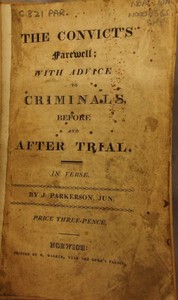
The rain found a rhythm matching old verses from M.E.S. Wright’s collection, those sturdy rhymes about magpies and weather signs. It made me think how every caution carries a story. That afternoon, I drifted to a different sort of warning, the gallows lament in The Convict's Farewell: with Advice to Criminals, before and after Trial — Story, Setting & Ideas, and the weight of both felt strangely kindred.
Build a private reading journal entry for this title.