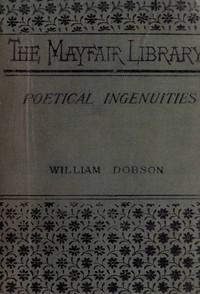
This collection, assembled by William T. Dobson as a sequel to his earlier Literary Frivolities, gathers verse that plays with form, language, and subject matter in ways that defy conventional poetic decorum. The editor’s preface acknowledges that the earlier volume was faulted for omissions—a sin he here claims to atone for by including pieces that had not previously “been glorified in type.” The result is a miscellany that ranges from macaronic verses mixing Latin and English to technical poems on geology and microscopy, each testing the boundaries of what can be cast in meter and rhyme.
Macaronic and Multilingual Play
The anthology draws heavily on macaronic verse, where languages are deliberately mixed for comic or ingenious effect. One example, attributed to an unnamed author, laments in a blend of English and French: “Oh, heaux! The girls have gone back on me seaux, / What to do I really don’t kneaux.” The humor depends on the reader’s ear for the clash between the French-looking spellings and the English pronunciation. Such pieces, often anonymous or attributed to minor wits, suggest a tradition of learned play that Dobson sought to preserve. The editor’s own Literary Frivolities is cited as a source for historical accounts of these forms, but here the emphasis falls on the examples themselves, many of which are presented without extensive commentary.
Technical Verse: Geology and Microscopy
Two poems stand out for their use of specialized scientific vocabulary within conventional poetic structures. Bishop Shuttleworth’s “Anticipatory Dirge on Professor Buckland, the Geologist” mourns the professor in terms drawn from his own field: “Mourn, Ammonites, mourn o’er his funeral urn, / Whose neck ye must grace no more.” The poem’s stanzas catalogue geological strata and fossils, ending with a wry proposal to petrify the professor and place him on a shelf “mid Mammoths and Crocodiles.” A footnote reports that when Buckland’s grave was dug, workers indeed struck solid limestone—a coincidence that the editor finds “remarkable.” Jacob F. Henrici’s “A Microscopic Serenade” similarly adapts the language of microscopy to a love poem, inviting the beloved to a realm “where green conferva-threads lie curled” and “protists” hold sway. Both poems treat their technical subjects with affectionate mockery, turning scientific precision into a source of poetic ingenuity.
Epitaphs and Learned Jests
The collection includes epitaphs that exploit specialized jargon for humorous effect. Dr. Charles Smith’s “Epitaphium Chemicum” reduces a chemist’s life to a series of alchemical and chemical processes: “Here lieth to digest, macerate, and amalgamate with clay, / In Balneo Arenæ, Stratum super stratum, / The Residuum, Terra Damnata, and Caput Mortuum.” The Latin terms and laboratory procedures are applied to the human body with deadpan solemnity, creating a tension between the clinical language and the occasion of death. Such pieces, read at meetings of learned societies, suggest that these verses were not merely printed curiosities but part of a living culture of intellectual humor. Dobson’s selection preserves these occasional pieces, giving modern readers a glimpse into the playful side of Victorian scholarship.
Readers approaching this anthology should expect no sustained narrative or unified theme. The pleasure lies in the variety of contrivance: the unexpected rhyme, the borrowed vocabulary, the solemn application of technical terms to trivial or morbid subjects. Dobson’s editorial hand is light, letting the poems speak for themselves. Those curious about the historical background of these forms will find it in the earlier Literary Frivolities; here, the emphasis is on the curiosities themselves, offered as specimens of a wit that is at once learned and irreverent.
Flipping through Poetical Ingenuities, I paused on a microscopic ode—how the Victorians found such gravely tender wonder in tiny things. It reminded me, strangely, of holding The Young Guard — Inside the Classic, feeling that same quiet devotion to details most would overlook. There’s a shared reverence there, a patience for the small and earnest.