About 60 minutes
Some Imagist Poets, 1916: An Annual Anthology — Reading Companion
Fantasy Juvenile Worlds
13,710 recorded words. 1 minutes difference from this book's estimate.
View Gutenberg source #37469
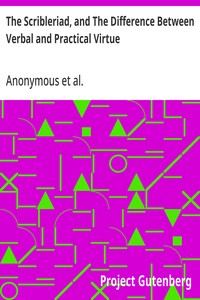
The catalog record for The Scribleriad, and The Difference Between Verbal and Practical Virtue — A Closer Reading provides practical reading context through 13,423 words, 59 min estimated reading time, and 2 detected text sections.
The text analysis averages about 25.2 words per sentence, while the detected sections provide another way to judge how the source is divided.
Project Gutenberg metadata also associates the work with “Pope, Alexander, 1688-1744 -- Poetry,” connecting these edition facts with the source record’s subject description.
Explore this collection
These alternatives are selected using recorded categories and estimated reading time.
About 60 minutes
Fantasy Juvenile Worlds
13,710 recorded words. 1 minutes difference from this book's estimate.
View Gutenberg source #37469About 57 minutes
Fantasy Juvenile Worlds
12,890 recorded words. 2 minutes difference from this book's estimate.
View Gutenberg source #48371About 55 minutes
Fantasy Juvenile Worlds
12,574 recorded words. 4 minutes difference from this book's estimate.
View Gutenberg source #32491Search stored excerpts and compare books → Choose by your preferences →
Choices use stored catalog measurements. Estimates vary with reading speed. A shared category is a catalog label, not a claim that two books have the same argument or literary quality.
Search reads excerpt text stored with this catalog and links to its associated Gutenberg record. The connection is stored in the site database; this tool does not recheck that every excerpt is word-for-word identical to that external record. Excerpt search does not cover every chapter and does not verify historical publication dates.
Catalog snapshot checked: 2026-09-26. Coverage: 90 public books, 90 available source excerpts.
Calculated from edition completeness, EPUB availability, text structure and catalogue metadata. Not a user rating.
Total of 100 points, scaled to a 2.5-5.0 range. Editions with an empty description or a missing EPUB file are not scored.
Public-domain source text
The source text is kept in the dedicated reader, separate from this catalogue record and its commentary.
The two poems in this volume, both published in 1742, belong to the thicket of literary warfare that surrounded Alexander Pope in his later years. The anonymous Scribleriad adopts a mock-heroic frame: a goddess presides over a contest of scribblers, each claimant advancing his case in verse. Lord Hervey’s The Difference between Verbal and Practical Virtue takes a more direct satirical aim, charging Pope with hypocrisy by contrasting his moralizing poems with his reported behavior. Together they show how the same quarrel could be fought in two distinct registers—one allegorical and sprawling, the other pointed and personal.
The Scribleriad opens with a goddess receiving a procession of literary claimants. Each petitioner speaks in a distinctive voice: one boasts he has “study’d Swift with so much Pains”; another, a theatrical figure, claims to have revived “the Arts of Rome and Greece” by giving “for Shakespear’s Monument I gave a Play.” The goddess’s responses are terse and dismissive. To one she retorts, “Obscenity, when dull, is always scorn’d.” The poem’s structure is a series of such encounters, each a miniature character sketch. The setting—a supernatural court where “Fantoms hover round the Place” and “shew their Crimes in Mirrors to their Face”—allows the poet to catalogue abuses without narrative continuity. The effect is less a story than a satirical gallery.
Lord Hervey’s poem is more tightly focused. Its title announces the theme: the gap between what a person professes and what he does. Hervey applies this to Pope directly, drawing examples from the lives of Horace, Seneca, and Sallust to argue that moral writing does not guarantee moral living. The poem’s tone is cooler than the Scribleriad’s burlesque, relying on antithesis and epigram. Hervey had already made the same case in a prose pamphlet, where he called Pope “a second-rate Poet, a bad Companion, a dangerous Acquaintance.” The verse version condenses the attack into a series of pointed contrasts. The reader should note that the excerpts do not include the poem’s full argument, only its framing.
Both poems are embedded in a specific historical moment: the 1742 escalation of the Pope-Cibber quarrel, which also involved engravings, prose pamphlets, and stage politics. The Scribleriad alludes to contemporary theatrical figures—“Ambivius Turpia, the Stage ’Squire”—and to specific productions, such as “R—ch bestows an Orpheus on the Town.” Hervey’s poem, meanwhile, was published less than a week after his own prose pamphlet on the same subject. The introduction by James Sambrook notes that the Scribleriad comes “from or near Grub Street itself,” while Hervey writes from the court. This social contrast—Grub Street versus aristocracy—adds another layer to the quarrel, visible in the poems’ different manners of attack.
Readers coming to these poems for the first time may find it useful to know that both are occasional works, written to wound specific opponents in a quarrel now two and a half centuries old. The notes in this edition supply the names behind the initials and allusions. Neither poem aspires to the formal finish of Pope’s own satires; their interest lies in the raw energy of literary combat and the period’s willingness to turn personal animosity into public verse.
There’s something almost tender about watching two poets in 1742 fight over what virtue truly means, especially when I recall sitting with Poe’s raven years later, both of them circling the same quiet gap between what we say and what we do. The Raven Illustrated — A Reader’s Guide brings that old ache back, gently.
Save your reaction, strongest insight, and memorable passage.