About 19 minutes
The Raven Illustrated — A Reader’s Guide
Fantasy Juvenile Worlds
4,241 recorded words. 3 minutes difference from this book's estimate.
View Gutenberg source #45484
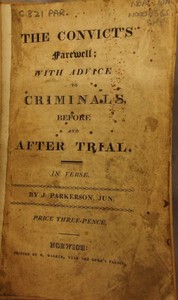
For The Convict's Farewell: with Advice to Criminals, before and after Trial — Story, Setting & Ideas, the stored edition analysis reports 4,890 words, 22 min estimated reading time, and 1 detected text section.
The text analysis averages about 31.4 words per sentence, while the detected sections provide another way to judge how the source is divided.
Project Gutenberg metadata also associates the work with “English poetry,” connecting these edition facts with the source record’s subject description.
Explore this collection
These alternatives are selected using recorded categories and estimated reading time.
About 19 minutes
Fantasy Juvenile Worlds
4,241 recorded words. 3 minutes difference from this book's estimate.
View Gutenberg source #45484About 19 minutes
Fantasy Juvenile Worlds
4,269 recorded words. 3 minutes difference from this book's estimate.
View Gutenberg source #53449About 26 minutes
Fantasy Juvenile Worlds
5,894 recorded words. 4 minutes difference from this book's estimate.
View Gutenberg source #52559Search stored excerpts and compare books → Choose by your preferences →
Choices use stored catalog measurements. Estimates vary with reading speed. A shared category is a catalog label, not a claim that two books have the same argument or literary quality.
Search reads excerpt text stored with this catalog and links to its associated Gutenberg record. The connection is stored in the site database; this tool does not recheck that every excerpt is word-for-word identical to that external record. Excerpt search does not cover every chapter and does not verify historical publication dates.
Catalog snapshot checked: 2026-09-26. Coverage: 90 public books, 90 available source excerpts.
Calculated from edition completeness, EPUB availability, text structure and catalogue metadata. Not a user rating.
Total of 100 points, scaled to a 2.5-5.0 range. Editions with an empty description or a missing EPUB file are not scored.
Public-domain source text
The source text is kept in the dedicated reader, separate from this catalogue record and its commentary.
James Parkerson’s The Convict’s Farewell: with Advice to Criminals, before and after Trial (printed by R. Walker, Norwich, early 1800s) is a verse pamphlet that adopts the voice of a condemned man addressing his wife and children. The poem’s title and subtitle promise moral instruction, and the text delivers a first-person narrative of ruin: the speaker traces his downfall from a contented domestic life—‘I liv’d serenely in my little cot’—to imprisonment in chains. The catalog assigns this work to ‘English poetry’ and ‘general literature,’ but the excerpt reveals a tightly focused didactic purpose, blending personal lament with direct admonition to young men.
The poem opens with a farewell to the speaker’s ‘partner of my woes’ and immediately establishes a confessional tone. Parkerson uses a regular rhyming couplet form, but the voice is distinctly personal: the convict describes waking from a dream of his family to find ‘my legs encompass’d round with chains.’ This physical detail grounds the abstract moral warning in a specific, embodied experience. The speaker does not name his crime, but the sequence of events—neglect of his master, loss of honest reputation, estrangement from a virtuous wife—suggests a pattern of petty theft or fraud. The verse form, while simple, allows for direct address and emotional appeal, making the pamphlet suitable for oral performance or cheap print distribution.
Parkerson’s convict enumerates the steps that led to his downfall with a methodical clarity. He identifies ‘a love of dice’ and ‘cards the great promoter of our vice’ as the ‘first step to ruin.’ The poem then broadens into a social critique, calling on magistrates to ‘punish Publicans’ and force spendthrifts to retire. This catalogue of causes—gambling, public houses, bad company, and ‘an artful female’—serves both as personal confession and as a warning to readers. The reference to ‘Millwood’ (likely a stock figure from George Lillo’s 1731 play The London Merchant) links the poem to a known literary type of the seductive temptress, though Parkerson does not develop the character beyond a single name. The speaker’s advice to ‘young men’ is explicit: avoid these traps or suffer the same fate.
The Project Gutenberg transcription includes only the opening portion of the poem; the full text, as indicated by the word count of 4,890 words, likely continues the convict’s advice and possibly describes the trial or transportation. The excerpt breaks off after the speaker urges his wife to ‘bring up my little ones in such a way / As they will holy keep the sabbath-day.’ The catalog subject ‘English poetry’ is accurate, but the work’s practical, moralizing purpose aligns it more closely with cheap print genres such as gallows literature or criminal biography. Readers should note that the surviving text may have been issued as a single sheet or small pamphlet, priced at three-pence, and intended for a popular audience rather than a literary one.
The poem’s value lies in its directness: it offers a rare first-person criminal narrative from the early nineteenth century, filtered through a moralizing lens. Readers interested in the social history of crime, popular print, or didactic verse will find it a compact example of how reformers and publishers used the convict’s voice to warn against vice. The brevity of the work (estimated 22 minutes’ reading) makes it accessible, but the incomplete excerpt leaves the full arc of the convict’s story—including his trial and fate—untold.
Reading about J. Parkerson’s convict, with his dice and Millwood, I kept thinking of quieter verses. That poem’s stern rhythm felt almost like a memory of a different collection—my old copy of Rhymes Old and New : collected by M.E.S. Wright — Text and Context has a similar plainness, a hand reaching across years, not judging, just telling.
Your answers remain private and are stored only in this browser.