About 63 minutes
The Art of Politicks — Edition Insights
Historical Psychological Social Fiction
14,481 recorded words. 6 minutes difference from this book's estimate.
View Gutenberg source #40895
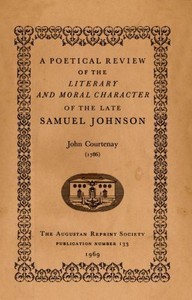
This digital edition of A Poetical Review of the Literary and Moral Character of the late Samuel Johnson (1786) — Context and Discussion is described by source-level measurements including 12,961 words, 57 min estimated reading time, and 2 detected text sections.
The text analysis averages about 19.6 words per sentence, while the detected sections provide another way to judge how the source is divided.
Project Gutenberg metadata also associates the work with “Johnson, Samuel, 1709-1784 -- Poetry,” connecting these edition facts with the source record’s subject description.
Explore this collection
These alternatives are selected using recorded categories and estimated reading time.
About 63 minutes
Historical Psychological Social Fiction
14,481 recorded words. 6 minutes difference from this book's estimate.
View Gutenberg source #40895About 44 minutes
Historical Psychological Social Fiction
10,098 recorded words. 13 minutes difference from this book's estimate.
View Gutenberg source #31928About 70 minutes
Historical Psychological Social Fiction
16,083 recorded words. 13 minutes difference from this book's estimate.
View Gutenberg source #36543Search stored excerpts and compare books → Choose by your preferences →
Choices use stored catalog measurements. Estimates vary with reading speed. A shared category is a catalog label, not a claim that two books have the same argument or literary quality.
Search reads excerpt text stored with this catalog and links to its associated Gutenberg record. The connection is stored in the site database; this tool does not recheck that every excerpt is word-for-word identical to that external record. Excerpt search does not cover every chapter and does not verify historical publication dates.
Catalog snapshot checked: 2026-09-26. Coverage: 90 public books, 90 available source excerpts.
Calculated from edition completeness, EPUB availability, text structure and catalogue metadata. Not a user rating.
Total of 100 points, scaled to a 2.5-5.0 range. Editions with an empty description or a missing EPUB file are not scored.
Public-domain source text
The source text is kept in the dedicated reader, separate from this catalogue record and its commentary.
John Courtenay's A Poetical Review of the Literary and Moral Character of the late Samuel Johnson (1786) is a 304-line poem that participates in the immediate posthumous flood of reflections on Johnson. The Augustan Reprint Society edition, with an introduction by Robert E. Kelley, reproduces the third edition of that year. Courtenay, a Member of Parliament and friend of Boswell, writes in heroic couplets, a form Johnson himself mastered. The poem's notes, longer than the verse, quote Johnson's Prayers and Meditations and other sources, creating a layered text where the poet's voice competes with Johnson's own words.
Courtenay adopts the closed heroic couplet, the meter of Johnson's The Vanity of Human Wishes. The verse moves through balanced antitheses: 'His genius, learning, virtue, all conspire / To raise the poet's, and the patriot's fire.' Yet the poem's energy often lies in its extensive footnotes. One note reproduces Johnson's meditation on his wife's death: 'I returned home, but could not settle my mind. At last I read a chapter. Then went down about six or seven, and eat two cross-buns.' The mundane detail—'two cross-buns'—contrasts sharply with the elevated couplets. Another note records Johnson's failed resolutions: 'To rise at eight.—Oct. 3d. Of all this I have done nothing.' Courtenay lets Johnson's self-accusation stand without comment, trusting the reader to measure the gap between moral aspiration and daily practice.
Robert E. Kelley's introduction situates Courtenay's poem within the 'countless reflections, sermons, poems, pamphlets, biographical sketches, and biographies about Samuel Johnson' that appeared after 1784. Kelley notes that the poem's popularity 'was determined less by Courtenay's poetic talent than by public interest in the Johnsoniana that flooded the market.' This framing invites the reader to consider the poem as a commodity as much as a tribute. Kelley also observes that Courtenay 'remains a shadowy figure' despite his notoriety as a wit and Boswell's intimate. The introduction thus establishes a tension between the public appetite for Johnson and the relative obscurity of his elegist.
The poem's apparatus includes a letter from Dr. Adams of Oxford, who denies having encouraged publication of Johnson's Prayers and Meditations. Adams writes: 'Dr. Adams never saw a line of these compositions, before they appeared in print, nor ever heard from Dr. Johnson, or the editor, that any such existed. Had he been consulted about the publication, he would certainly have given his voice against it.' This inserted protest disrupts the poem's eulogistic surface. Another note quotes Seneca's epigram on preferring life under torture to annihilation, then reports that Johnson 'in his last illness, is said to have declared ... that he would prefer a state of existence in eternal pain to annihilation.' The note does not confirm the anecdote, but its placement next to Seneca's lines creates a grim echo. Courtenay's poem thus becomes a contested space where praise, doubt, and Johnson's own recorded struggles coexist.
Readers approaching this edition should attend to the interplay between verse and footnote. Courtenay's couplets offer conventional praise, but the notes—drawn from Johnson's private writings and contemporary disputes—introduce a more troubled figure. The poem's value lies less in its literary merit than in the documentary texture it preserves: Johnson's failed resolutions, his wife's death, the controversy over publishing his prayers. Kelley's introduction provides essential context for understanding why this minor poem went through three editions in one year.
There’s something touching about how John Courtenay gently weighed Johnson’s flaws alongside his brilliance, not to judge, but simply to understand him whole. I felt that same careful patience leafing through The Vision and Creed of Piers Ploughman, Volume 2 — Reading Notes, where old voices are treated with such quiet tenderness. Some books stay with you less for what they argue, and more for the warmth they leave behind.
A brief reflection can help important ideas stay with you longer.