An Alphabet of History — Reading Notes
Edition facts
The source record for An Alphabet of History — Reading Notes measures this digital text at 9,989 words, 44 min estimated reading time, and 2 detected text sections.
The text analysis averages about 24.9 words per sentence, while the detected sections provide another way to judge how the source is divided.
Project Gutenberg metadata also associates the work with “Alphabets,” connecting these edition facts with the source record’s subject description.
Calculated from edition completeness, EPUB availability, text structure and catalogue metadata. Not a user rating.
How this score is calculated
- Description quality20 pts
- Title & short description10 pts
- Source metadata20 pts
- Text length15 pts
- Chapters / structure15 pts
- EPUB file integrity20 pts
Total of 100 points, scaled to a 2.5-5.0 range. Editions with an empty description or a missing EPUB file are not scored.
Read the Text
There were not at that time magazines for a dime, And his articles could not be printed.
Though it may seem unkind, ere his life we've outlined, We must say in some ways he was hateful; And in truth, we have heard he went back on his word, And was not Alexander the Grateful.
Back in the time of Rome sublime, There lived great Julius Caesar Who wore the crown with haughty frown And was a frosty geezer.
Three times, they say, upon the way Called Lupercal, they fetched it For him to wear, but then and there He said they should have stretched it.
And we are told that Jule was cold And frigid as Alaska, Ambitious, too,--that would not do For Cassius and Casca.
They told their friends: "It all depends On having things to suit us. We think that Jule is much too cool; Let us conspire with Brutus."
They furthermore let out this roar: "Shall Caesar further scoff us? Next week, they say, he'll have his way About the Rome postoffice."
With dirk and sword in togas stored-- You know those times they wore 'em-- They made a muss of Ju-li-us One morning in the Forum.
With "Et tu, Brute?" J. C. grew mute. (Some claim it's "Et tu, Bru-te"; We mention it both whole and split As is our bounden duty.)
Mark Antony arose, and he Talked some,--we shall not quote it; We've understood 'twas not as good As when Bill Shakespeare wrote it.
Then Brutus skipped lest he be nipped-- And since his dissolution He's been accused and much abused In schools of elocution.
When Christopher Columbus stood the egg upon its end, He solved a weighty problem that no one could comprehend-- Perhaps it was the puzzle whose solution clearly showed The psychologic motives of the hen that crossed the road. Perhaps cold storage minstrels never might have heard of this If it hadn't been for Chris.
Columbus packed his little grip and got upon the train And went to see that noble man, King Ferdinand of Spain. Result: He found America--oh, do not idly nod, For if it hadn't been for this we couldn't go abroad! Just think of all the travel and the voyages we'd miss If it hadn't been for Chris.
Columbus found America and won a lot of fame-- Nobody ever thought to ask him how he knew its name; Nobody ever booked him for some lectures to declare In eloquent assertions how he knew the land was there. Today we might be savages, unknowing modern bliss, If it hadn't been for Chris.
He landed near Havana, and he said: "It seems to me That sometime in the future little Cuby shall be free." His vision was prophetic--far adown the future's track He saw the dauntless Hobson and the sinking Merrimac. We might have still been tyros in the ethics of the kiss If it hadn't been for Chris.
Today there are big cities and big buildings named for him, And yet he was so poor that once he thought he'd have to swim To find this wondrous country, for he was so badly broke; But Isabella nobly put her watch and ring in soak. Who knows but Isabella never might have thought of this If it hadn't been for Chris?
Diogenes lived in a tub His fellows analyzing; These words were carved upon his club: "First Class Philosophizing." If any question came his way Involving people's morals, The things that he felt moved to say Were sure to start some quarrels. In fact, his tub became a booth In which he dealt in wholesale truth.
This world was but a fleeting show-- He knew a lot about it; When he was told a thing was so He then began to doubt it. He seldom left his narrow home-- Not even on a Sunday; The only time that he would roam Abroad was on a Monday. He had to roam then, anyway, For that, you know, is washing day.
Society, with all its sham, Gave him a paroxysm; He always spoke in epigram And thought in aphorism. One day he took his lantern down And polished it and lit it-- But first he frowned a peevish frown And growled: "The wick don't fit it." And then, with pessimistic scan, He sought to find an honest man.
Diogenes has long been dead; His search was not well heeded, For no historian has said If ever he succeeded. But there's this thought for you and me: It would not be quite pleasant If on that quest the sage should be With his fierce light, at present. For, if he were, one may but think How much that light would make him blink.
Wilbur D. Nesbit's An Alphabet of History (1905) treats historical figures not as icons but as punchlines. Each letter of the alphabet introduces a figure—Alexander, Brutus, Columbus—and subjects them to anachronistic mockery. Alexander the Great, for instance, is "grouchy and grumpy" because no war correspondent was present to photograph his battles. The poems are built on a single comic premise: that these figures would be frustrated by the lack of modern media, fame, or convenience. Nesbit's diction mixes colloquialisms ("skedaddled," "pull my freight") with deliberately mangled names ("Shakspeare" appears in multiple spellings). The result is a series of biographical burlesques that question how history is packaged.
Anachronism as Satirical Device
Nesbit consistently transplants modern concerns into ancient settings. Alexander weeps because there is no "clicking kodak" to record his exploits; Brutus and Cassius worry about Caesar's control of the "Rome postoffice." These anachronisms are not errors but deliberate jokes, highlighting the gap between grand historical narratives and mundane modern life. The poems imply that fame depends on media coverage, not deeds. In "Ulysses," the hero's long absence is reframed as a failure to pay rent, with Penelope struggling "to get cash to pay the rent" while Telemachus "never earned a cent." The humor undercuts epic heroism by applying domestic economics to myth.
Diction and Rhyme: Comic Collisions
Nesbit's verse relies on jarring word choices and forced rhymes. He pairs formal names with slang: Julius Caesar is a "frosty geezer," and Brutus is told "it all depends on having things to suit us." The meter often stumbles for comic effect, as in the line about Alexander: "He was grouchy and grumpy, was Aleck." Nesbit also plays with spelling and pronunciation, noting that Shakespeare's signature appears as "Shaxpere," "Shakspere," and "Shaikspeare." This metrical and lexical playfulness mirrors the poems' thematic point: history itself is a kind of mishearing or distortion. The rhymes are often deliberately weak or silly, reinforcing the sense that these are not serious biographies.
Ellsworth Young's Illustrations and the Visual Frame
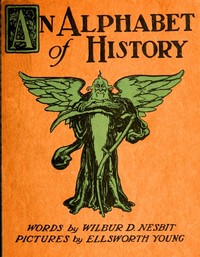
The book's subtitle credits "The Words by Wilbur D. Nesbit" and "The Pictures by Ellsworth Young." Although the excerpts do not include the illustrations, the table of contents lists each figure alongside a corresponding image. The visual component likely amplifies the satirical tone, as suggested by the opening quatrain: "Who frets about the mystery / Enshrouding all of history / On reading this will, maybe, see / We've made it plain as A, B, C." The claim to make history "plain" is ironic, given the poems' deliberate distortions. Young's style, known from other works of the period, probably rendered historical figures in caricatured or anachronistic settings, complementing Nesbit's verbal jokes.
The Alphabet as Structural Constraint
Nesbit organizes his poems alphabetically, from Alexander to Zenobia, a structure that imposes arbitrary order on historical chronology. This format allows for unexpected juxtapositions: the Greek philosopher Diogenes appears between Columbus and Euripides, while the pirate Kidd follows the playwright Jonson. The alphabetical sequence does not follow historical period or geography, emphasizing the artificiality of categorization. Each poem is a self-contained vignette, roughly equal in length, suggesting that all figures are equally subject to mockery. The constraint also forces Nesbit to include lesser-known figures like Yvetot (a French village) and Zenobia (a Palmyrene queen), expanding the scope beyond typical historical rosters.
Readers should approach An Alphabet of History as a period piece of early twentieth-century humor, not as a reference work. Nesbit's irreverence anticipates later satirical histories, but his targets are specific to the popular historical knowledge of 1905. The poems reward attention to wordplay and anachronistic detail, while Ellsworth Young's illustrations (not reproduced here) likely complete the comic effect. The book is best read in short bursts, one letter at a time, allowing each figure's absurd premise to land.
There’s something touching in how Nesbit’s old verses make history feel like gossip shared between friends. I kept thinking of that while rereading Wordsworth’s quieter, more patient lines — both books hold a fondness for what time does to memory. The Poetical Works of William Wordsworth — Volume 4 (of 8) — Reading Companion sits beside it on my shelf, a different kind of looking back.

There are no reviews for this eBook.
Record your reading impressions
A brief reflection can help important ideas stay with you longer.
Gary Thompson - 1 month ago
Scott Herman - 2 weeks ago
Gregory Perry - 2 weeks ago