About 32 minutes
Cosmos — A Reader’s Guide
Historical Psychological Social Fiction
7,219 recorded words. 3 minutes difference from this book's estimate.
View Gutenberg source #49631
Before opening Ruthless Rhymes for Heartless Homes — Context and Discussion, the edition data offers a quick orientation: 6,544 words, 29 min estimated reading time, and 2 detected text sections.
The text analysis averages about 22.5 words per sentence, while the detected sections provide another way to judge how the source is divided.
Project Gutenberg metadata also associates the work with “Humorous poetry, English,” connecting these edition facts with the source record’s subject description.
Explore this collection
These alternatives are selected using recorded categories and estimated reading time.
About 32 minutes
Historical Psychological Social Fiction
7,219 recorded words. 3 minutes difference from this book's estimate.
View Gutenberg source #49631About 25 minutes
Historical Psychological Social Fiction
5,748 recorded words. 4 minutes difference from this book's estimate.
View Gutenberg source #37091About 34 minutes
Historical Psychological Social Fiction
7,712 recorded words. 5 minutes difference from this book's estimate.
View Gutenberg source #34790Search stored excerpts and compare books → Choose by your preferences →
Choices use stored catalog measurements. Estimates vary with reading speed. A shared category is a catalog label, not a claim that two books have the same argument or literary quality.
Search reads excerpt text stored with this catalog and links to its associated Gutenberg record. The connection is stored in the site database; this tool does not recheck that every excerpt is word-for-word identical to that external record. Excerpt search does not cover every chapter and does not verify historical publication dates.
Catalog snapshot checked: 2026-09-26. Coverage: 90 public books, 90 available source excerpts.
Calculated from edition completeness, EPUB availability, text structure and catalogue metadata. Not a user rating.
Total of 100 points, scaled to a 2.5-5.0 range. Editions with an empty description or a missing EPUB file are not scored.
Public-domain source text
The source text is kept in the dedicated reader, separate from this catalogue record and its commentary.
Harry Graham's Ruthless Rhymes for Heartless Homes, first published in 1901 under the pseudonym Col. D. Streamer, opens with a dedication that sets its wry, self-aware tone: the author dedicates the book to an unnamed recipient “without permission,” framing the verses as a private joke. The preface then addresses parents directly, warning them to keep the rhymes away from young children—not because the content is innocent, but because the artist, not the author, is to blame if “baby suffers.” This layered framing immediately establishes the collection's central tension: a nursery-rhyme form used for decidedly un-nursery subject matter.
The poems rely on tight, predictable meter and rhyme schemes—typically ABAB or AABB—to deliver punchlines with deadpan precision. In “Impetuous Samuel,” the quatrain “Sam had spirits naught could check, / And to-day, at breakfast, he / Broke his baby sister's neck, / So he shan't have jam for tea!” uses the jaunty rhythm of a children's verse to undercut the violence, making the trivial punishment (no jam) the absurd climax. Similarly, “Uncle Joe” ends with the speaker mourning his uncle's death because “He had such good cigars,” the rhyme of “stars” and “cigars” forcing a bathetic connection between heaven and tobacco. This formal discipline turns each poem into a miniature trap: the reader is lulled by the sing-song pattern, then caught off-guard by the macabre or selfish turn.
Graham adopts a persona that is at once parental and mischievous, offering advice that is clearly ironic. In the longer poem “Don't,” the speaker instructs children not to “empty beetles in her bath” or “hide a hedgehog in his hat,” but the very specificity of these warnings suggests familiarity with such acts. The voice shifts between mock-seriousness and outright flippancy: “Don't take the life of any one, / However horrid he may be; / That sort of thing is never done, / Not in the best society.” The phrase “best society” implies that murder is merely a breach of etiquette, not morality. This persona—a worldly, slightly cynical adult—creates a consistent narrative stance that colors every poem, making the reader complicit in the joke.
While most poems are brief (four to eight lines), the collection includes longer pieces like “Don't” and the preface, which build a cumulative effect through repetition and escalating absurdity. The short poems deliver their shock quickly, often in the final line, while the longer sections allow for more elaborate setups. For example, “Don't” lists forbidden acts in a catalog style, each couplet adding a new transgression, before ending with a mock-serious moral: “And if to lie is bad, no doubt / 'Tis even worse to get found out!” This variation in length and pace prevents monotony: the reader moves from rapid-fire quatrains to extended monologues, each form serving a different comic purpose. The envoi, “Speed, Ruthless Rhymes,” closes the collection with a self-referential plea for the poems to “flutter back—to die,” mirroring the cycle of reading and forgetting.
Graham's collection rewards attention to its formal craft: the way a dropped rhyme or a sudden shift in register can amplify a joke. Readers may notice how the poems' brevity forces economy—every word counts, and the most shocking effects come from the most mundane details. The book's structure, from dedication to envoi, creates a closed loop that invites rereading, each pass revealing new layers of irony in the author's deadpan delivery.
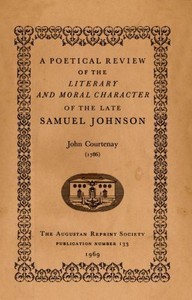
Sitting with Graham’s Ruthless Rhymes, I often think of that stern old volume, A Poetical Review of the Literary and Moral Character of the late Samuel Johnson (1786) — Context and Discussion. One finds such blunt truth in both—Johnson’s measured judgments and these sharp little verses share a quiet, unsentimental honesty about our own frailties. It’s a kinship felt rather than spoken, like two old friends nodding across a reading room.
Save your reaction, strongest insight, and memorable passage.