About 63 minutes
The Art of Politicks — Edition Insights
Historical Psychological Social Fiction
14,481 recorded words. 7 minutes difference from this book's estimate.
View Gutenberg source #40895
The source record for The Motley Muse (Rhymes for the Times) — Story, Setting & Ideas measures this digital text at 16,083 words, 1 hr 10 min estimated reading time, and 3 detected text sections.
The text analysis averages about 24.0 words per sentence, while the detected sections provide another way to judge how the source is divided.
Project Gutenberg metadata also associates the work with “Humorous poetry, English,” connecting these edition facts with the source record’s subject description.
Explore this collection
These alternatives are selected using recorded categories and estimated reading time.
About 63 minutes
Historical Psychological Social Fiction
14,481 recorded words. 7 minutes difference from this book's estimate.
View Gutenberg source #40895About 77 minutes
Historical Psychological Social Fiction
17,520 recorded words. 7 minutes difference from this book's estimate.
View Gutenberg source #49493About 57 minutes
Historical Psychological Social Fiction
12,961 recorded words. 13 minutes difference from this book's estimate.
View Gutenberg source #29324Search stored excerpts and compare books → Choose by your preferences →
Choices use stored catalog measurements. Estimates vary with reading speed. A shared category is a catalog label, not a claim that two books have the same argument or literary quality.
Search reads excerpt text stored with this catalog and links to its associated Gutenberg record. The connection is stored in the site database; this tool does not recheck that every excerpt is word-for-word identical to that external record. Excerpt search does not cover every chapter and does not verify historical publication dates.
Catalog snapshot checked: 2026-09-26. Coverage: 90 public books, 90 available source excerpts.
Calculated from edition completeness, EPUB availability, text structure and catalogue metadata. Not a user rating.
Total of 100 points, scaled to a 2.5-5.0 range. Editions with an empty description or a missing EPUB file are not scored.
Public-domain source text
The source text is kept in the dedicated reader, separate from this catalogue record and its commentary.
Harry Graham's The Motley Muse (Rhymes for the Times), published in 1913 with illustrations by Lewis Baumer, is a collection of satirical verse that targets the manners, institutions, and fads of Edwardian England. The poems originally appeared in periodicals such as The Observer and The Pall Mall Gazette, and they retain the brisk, topical quality of newspaper verse. Graham's voice is consistently ironic, but the tone shifts noticeably across the book's three sections: the opening 'Rhymes for the Times' offers broad social commentary, the 'Club Cantos' settle into a more sustained mock-heroic mode, and the final 'Songs in Season' follow the calendar with seasonal satire. This structure creates a varied reading experience, with pace and subject matter changing from poem to poem.
The book's first section, 'Rhymes for the Times,' covers a wide range of targets: modern dancing, militant suffragettes, motorists, and even the 'triumph of jam.' The poems are short and punchy, often ending with a twist or a deflating punchline. For instance, 'The Triumph of Jam' mocks domestic fads, while 'The Militants' takes a wry look at the suffrage movement. The pace is quick, with each poem offering a self-contained joke or observation.
In contrast, the 'Club Cantos' section slows down and expands into a series of nine poems, each devoted to a specific London club (the Athenaeum, White's, the Garrick, etc.). Here Graham adopts a more elaborate stanza form and a mock-heroic tone, describing club rituals and members with affectionate satire. The repeated refrain 'To Mr. Gillett' in 'The Bachelors' Club' canto creates a rhythmic anchor, while the longer lines in 'White's' allow for historical digressions about betting and past members. This shift in pace—from rapid-fire quips to leisurely, descriptive verse—gives the collection a structural variety that rewards reading in sequence.
Across the collection, Graham repeatedly returns to the idea of social performance—how people present themselves in public, whether at the club, on the street, or at a dance. In 'The Garrick' canto, he contrasts those who 'abominate the presence of your kind' with those who 'fraternise with any one you meet,' framing club membership as a choice of social style. The poem 'Nobody's Darling!' (from the first section) similarly plays on the desire for attention, while 'Stage Support' mocks theatrical pretension.
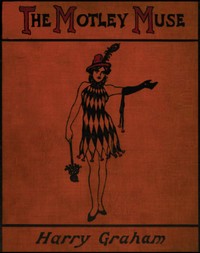
This theme is reinforced by the book's title and cover: 'Motley' evokes the jester's costume, and the poems often adopt a playful, self-aware voice that comments on its own performance. The foreword, 'The World We Laugh In!,' explicitly states that melancholy is out of fashion, positioning the poet as a purveyor of timely humor. Graham's language is full of theatrical metaphors—'pose,' 'role,' 'stage'—and his rhymes often deflate solemnity, as when he describes 'the terrors of the tomb' in the same stanza as 'hearts that are as hard as something oaken.' This recurring motif gives the collection a cohesive thread despite its varied subjects.
Graham's technical skill is evident in his consistent use of regular meter and inventive rhymes. He favors anapestic and iambic rhythms, often with a strong caesura that sets up the final punchline. In 'The Bachelors' Club,' the refrain 'To Mr. Gillett' is repeated at the end of each stanza, creating a cumulative comic effect. The poem 'White's' uses a longer line with internal rhymes ('Brummels and Nashes still twirl their moustaches'), demonstrating a playful command of sound.
The punchlines themselves are often anticlimactic or deflating, a hallmark of Graham's style. For example, in 'The Garrick,' the line 'Then the Garrick is a club you should fight shy of' reverses the expected advice. This technique keeps the reader off-balance and reinforces the satirical tone. The poems also vary in length: some are tight eight-line squibs, while others, like the club cantos, run to multiple stanzas. This variation in form mirrors the shifts in pace noted earlier, making the collection feel dynamic rather than monotonous.
Readers approaching The Motley Muse will find it best enjoyed as a sequence rather than dipped into at random, since the arrangement of poems—from broad satire to club-focused cantos to seasonal verses—creates a deliberate arc. Graham's humor is dry and occasionally arch, but his observations of Edwardian social life remain sharp. The illustrations by Lewis Baumer, though not reproduced here, originally complemented the verse with visual wit. For those interested in the period's light verse, this collection offers a well-crafted example of how satire can capture the mood of an era without losing its comic edge.
That rainy afternoon, Graham’s sharp rhymes on motorists and suffragettes left me smiling, yet oddly weary of so much cleverness. I set the book down, and my gaze drifted to a plain volume on the shelf—The Poetical Works of William Wordsworth — Volume 4 (of 8) — Reading Companion. His quiet lines felt like a deep breath after all that laughter.
Build a private reading journal entry for this title.