About 29 minutes
Ruthless Rhymes for Heartless Homes — Context and Discussion
Historical Psychological Social Fiction
6,544 recorded words. 4 minutes difference from this book's estimate.
View Gutenberg source #35051
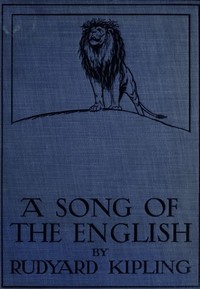
The source record for A Song of the English — Reading Companion measures this digital text at 5,748 words, 25 min estimated reading time, and 1 detected text section.
The text analysis averages about 23.9 words per sentence, while the detected sections provide another way to judge how the source is divided.
Project Gutenberg metadata also associates the work with “Poetry,” connecting these edition facts with the source record’s subject description.
Explore this collection
These alternatives are selected using recorded categories and estimated reading time.
About 29 minutes
Historical Psychological Social Fiction
6,544 recorded words. 4 minutes difference from this book's estimate.
View Gutenberg source #35051About 20 minutes
Historical Psychological Social Fiction
4,393 recorded words. 5 minutes difference from this book's estimate.
View Gutenberg source #45521About 20 minutes
Historical Psychological Social Fiction
4,569 recorded words. 5 minutes difference from this book's estimate.
View Gutenberg source #53747Search stored excerpts and compare books → Choose by your preferences →
Choices use stored catalog measurements. Estimates vary with reading speed. A shared category is a catalog label, not a claim that two books have the same argument or literary quality.
Search reads excerpt text stored with this catalog and links to its associated Gutenberg record. The connection is stored in the site database; this tool does not recheck that every excerpt is word-for-word identical to that external record. Excerpt search does not cover every chapter and does not verify historical publication dates.
Catalog snapshot checked: 2026-09-26. Coverage: 90 public books, 90 available source excerpts.
Calculated from edition completeness, EPUB availability, text structure and catalogue metadata. Not a user rating.
Total of 100 points, scaled to a 2.5-5.0 range. Editions with an empty description or a missing EPUB file are not scored.
Public-domain source text
The source text is kept in the dedicated reader, separate from this catalogue record and its commentary.
Kipling's 'A Song of the English' opens with a direct address to the nation: 'Fair is our lot—O goodly is our heritage!' The poem immediately establishes a tone of collective responsibility, warning against 'evil counsellors' and urging obedience to 'the Law.' The first section, 'The Coastwise Lights,' personifies England's lighthouses as sentinels that 'bridge across the dark' and guide ships from 'the guardports of the Morn.' This maritime framing recurs throughout the sequence, with each poem adopting a distinct voice—from the dead sailors in 'The Song of the Dead' to the submarine cables in 'The Deep-Sea Cables.'
The sequence is structured as a series of dramatic monologues. 'The Coastwise Lights' speaks as the lighthouses themselves, describing their vigil over 'the ships of England.' 'The Song of the Dead' shifts to the perspective of drowned mariners, who claim 'we have fed our sea for a thousand years.' Kipling gives agency to inanimate objects and collective entities: the deep-sea cables 'run' and 'bear the Word,' while the cities in 'The Song of the Cities' each boast of their role—'I am the market of the North' (Hull). This technique creates a chorus of voices that together define England's global reach.
Kipling uses repeated lines to bind the poems together. 'The Coastwise Lights' ends with the refrain 'The Coastwise Lights of England,' and 'The Song of the Dead' echoes 'We have fed our sea for a thousand years.' The final poem, 'England's Answer,' returns to the opening stanza's phrasing: 'Fair is our lot—O goodly is our heritage!' This circular structure gives the collection a liturgical quality, as if the poems are responses in a service. The refrains also serve as mnemonic devices, reinforcing key images of duty and sacrifice.
W. Heath Robinson's illustrations, though not reproduced in this text-only edition, are integral to the original volume. The title page notes that the edition is 'illustrated by W. Heath Robinson,' and the poems were first published with his drawings. Robinson's style—detailed, fantastical, and often whimsical—contrasts with Kipling's earnest tone. Readers of the illustrated edition would encounter visual interpretations of the 'Coastwise Lights' as anthropomorphic figures or the 'Deep-Sea Cables' as serpentine creatures. The interplay between text and image adds a layer of irony or wonder that the bare text alone does not convey.
Kipling's language is steeped in the language of empire: 'the Lord our God Most High He hath made the deep as dry,' 'He smote for us a pathway to the ends of all the Earth.' Yet the poems also acknowledge failure—'we sinned—and our rulers went from righteousness'—and demand moral accountability: 'Make ye sure to each his own / That he reap where he hath sown.' The tension between divine mission and human fallibility runs through the sequence. 'The Song of the Sons' warns against 'whoring not with visions,' while 'England's Answer' ends with a plea for 'the peace among Our peoples.' The poems do not resolve this tension but hold it in suspension.
Reading the poems in sequence reveals a deliberate arc: from the coastal sentinels to the deep-sea cables, from the dead to the living cities, and finally to England's own voice. Kipling's use of varied speakers and refrains creates a cumulative effect, each poem adding a layer to the collective identity. The excerpts are sufficient to trace this structure, though the full collection includes additional poems not present here. Readers may wish to compare the text with the original illustrated edition to see how Robinson's art complements or complicates Kipling's vision.
Reading Kipling’s sea-verse, I remembered my grandfather’s worn atlas, the margins scored with tide-lines. His quiet duty felt heavy, like those illustrated ships. Years later, a small book of nasty couplets gave me the same strange ache—not humor, but the weight of rules we keep. That old gallows tickle stays with Ruthless Rhymes for Heartless Homes — Context and Discussion, a shadow I half-recognize.
Create a short personal record of your experience with this book.