About 55 minutes
The Wild Swans at Coole — A Reader’s Guide
Fantasy Juvenile Worlds
12,574 recorded words. 2 minutes difference from this book's estimate.
View Gutenberg source #32491
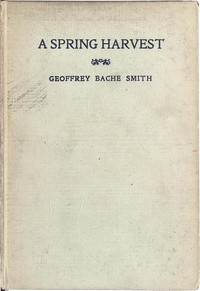
This digital edition of A Spring Harvest — A Closer Reading is described by source-level measurements including 12,890 words, 57 min estimated reading time, and 7 detected text sections.
The text analysis averages about 35.6 words per sentence, while the detected sections provide another way to judge how the source is divided.
Project Gutenberg metadata also associates the work with “World War, 1914-1918 -- Poetry,” connecting these edition facts with the source record’s subject description.
Explore this collection
These alternatives are selected using recorded categories and estimated reading time.
About 55 minutes
Fantasy Juvenile Worlds
12,574 recorded words. 2 minutes difference from this book's estimate.
View Gutenberg source #32491About 59 minutes
Fantasy Juvenile Worlds
13,423 recorded words. 2 minutes difference from this book's estimate.
View Gutenberg source #34821About 60 minutes
Fantasy Juvenile Worlds
13,710 recorded words. 3 minutes difference from this book's estimate.
View Gutenberg source #37469Search stored excerpts and compare books → Choose by your preferences →
Choices use stored catalog measurements. Estimates vary with reading speed. A shared category is a catalog label, not a claim that two books have the same argument or literary quality.
Search reads excerpt text stored with this catalog and links to its associated Gutenberg record. The connection is stored in the site database; this tool does not recheck that every excerpt is word-for-word identical to that external record. Excerpt search does not cover every chapter and does not verify historical publication dates.
Catalog snapshot checked: 2026-09-26. Coverage: 90 public books, 90 available source excerpts.
Calculated from edition completeness, EPUB availability, text structure and catalogue metadata. Not a user rating.
Total of 100 points, scaled to a 2.5-5.0 range. Editions with an empty description or a missing EPUB file are not scored.
Public-domain source text
The source text is kept in the dedicated reader, separate from this catalogue record and its commentary.
Geoffrey Bache Smith's A Spring Harvest (1918) opens with a dedicatory poem that frames the entire collection as a 'spoiléd sheaf / Of rime that scarcely came to harvesting'—a metaphor that signals both the poet's awareness of his interrupted craft and the editor's role in gathering scattered fragments. The volume is divided into three parts, with the third containing poems written after the outbreak of war, many from the trenches of France. Smith's diction oscillates between the ornate ('panoply of flowers') and the stark ('voice of guns'), while his verse forms—sonnets, quatrains, irregular stanzas—show a formal conservatism that contrasts with the disruptive experience he records.
Smith frequently employs archaic or elevated language that aligns his poetry with a pre-modernist tradition. In 'Anglia Valida in Senectute,' he writes of a 'pride that will not brook / The taunts of fools too saucy grown,' using 'brook' in its older sense of 'tolerate' and 'saucy' with a Shakespearean flavor. The poem's title itself—Latin for 'England strong in old age'—signals a classical frame. Similarly, 'Ære Perennius' (Horace's 'more lasting than bronze') and 'Creator Spiritus' invoke Latin hymns. This archaism is not mere ornament; it creates a deliberate tension between the ancient authority of the forms and the modern horror they contain. In 'We who have bowed ourselves to Time,' the poet describes his 'uneventful rime' armed 'with panoply of flowers,' where 'panoply' (a full suit of armor) clashes with the fragile 'flowers,' suggesting that poetic tradition itself is being conscripted into war.
The poems written in France adopt a noticeably different register from the earlier pieces. 'Awakening' compresses a pastoral image—'Gold-crested towers against the veilèd skies'—into a single line before the abrupt command: 'Up, and away! the belted squadrons ride!' The exclamation mark and the shift from static description to imperative action mirror the soldier's sudden call to duty. In 'Ave atque Vale,' Smith juxtaposes the permanence of Oxford ('evermore the same') with the contingency of the speaker's return: 'God knows if it be ours to see / Again the earliest hoar-frost white.' The conditional 'if' and the direct address to God break the measured quatrains, introducing a note of genuine uncertainty. The poem's title—Catullus's farewell to his brother—adds a layer of classical mourning that the text itself does not fully resolve, as the speaker never explicitly states his own death.
Several poems in the collection employ repetition to create a sense of entrapment or ritual. 'Dark is the World our Fathers left us' begins and ends with nearly identical stanzas: 'Dark is the world our fathers left us, / Wearily, greyly the long years flow' becomes 'Dark is the world our fathers left us, / Heavily, greyly the long years flow' in the final iteration. The substitution of 'Heavily' for 'Wearily' subtly intensifies the burden. Similarly, 'Ave atque Vale' frames its central stanzas with the couplet 'Oxford is evermore the same, / Unto the uttermost verge of time,' which appears both at the opening and the close. This circularity suggests a world that cannot be escaped—the speaker may leave Oxford, but the city remains unchanged, indifferent to his fate. The repetition also mirrors the cyclical nature of war, where each day resembles the last, and the only variation is loss.
J. R. R. Tolkien's editorial note, dated 1918, provides crucial context: the poems are arranged non-chronologically, with the third part containing only war poems, some 'written in England (at Oxford in particular), some in Wales and very many during a year in France.' The final poem, 'The Burial of Sophocles,' was 'begun before the war and continued at odd times and in various circumstances afterwards; the final version was sent me from the trenches.' This editorial framing emphasizes the fragmentary nature of the collection—poems 'welded together sans due ordinance,' as Smith himself writes in the dedicatory poem. The reader encounters the text as a composite, aware that many poems were composed under conditions that precluded revision. The presence of unfinished or irregular pieces, such as 'A Fragment' and 'A Preface for a Tale I have never told,' underscores the sense of a career cut short, where even the act of completion is provisional.
Readers approaching A Spring Harvest should attend to the interplay between Smith's formal choices—his archaisms, his classical titles, his use of repetition—and the biographical circumstances that shaped them. The poems do not offer a straightforward narrative of war; instead, they register the strain of maintaining poetic tradition in the face of unprecedented violence. Tolkien's editorial presence, though minimal, reminds us that this is a curated selection, a 'harvest' of what survived. The collection rewards those who read slowly, noticing how diction and structure carry the weight of what is left unsaid.
That rainy afternoon, A Spring Harvest kept returning to the same ache—words trying to hold a world already slipping. Smith’s classical restraint felt less like distance, more like a hand gripping a railing. Later, idly, I picked up The Young Guard — Inside the Classic. Different war, different language, yet the same quiet stubbornness against erasure. I closed it remembering how grief finds its own grammar.
Build a private reading journal entry for this title.