The Young Guard — Inside the Classic
Edition facts
The source record for The Young Guard — Inside the Classic measures this digital text at 9,468 words, 42 min estimated reading time, and 3 detected text sections.
The text analysis averages about 19.9 words per sentence, while the detected sections provide another way to judge how the source is divided.
Project Gutenberg metadata also associates the work with “World War, 1914-1918 -- Poetry,” connecting these edition facts with the source record’s subject description.
Calculated from edition completeness, EPUB availability, text structure and catalogue metadata. Not a user rating.
How this score is calculated
- Description quality20 pts
- Title & short description10 pts
- Source metadata20 pts
- Text length15 pts
- Chapters / structure15 pts
- EPUB file integrity20 pts
Total of 100 points, scaled to a 2.5-5.0 range. Editions with an empty description or a missing EPUB file are not scored.
Read the Text
What was your childish share?
To rush upon the flames of Hell,
To quench them with your blood!
To be of England's flower that fell
Ere yet it brake the bud!
And we who wither where we grew,
And never shed but tears,
As children now would follow you
Through the remaining years;
Tread' in the steps we thought to guide,
As firmly as you trod;
And keep the name you glorified
Clean before matt and God._
No Lord's this year: no silken lawn on which
A dignified and dainty throng meanders.
The Schools take guard upon a fierier pitch
Somewhere in Flanders.
Bigger the cricket here; yet some who tried
In vain to earn a Colour while at Eton
Have found a place upon an England side
That can't be beaten!
A demon bowler's bowling with his head--
His heart's as black as skins in Carolina!
Either he breaks, or shoots almost as dead
While the deep-field-gun, trained upon your
From concrete grand-stand far beyond the
Lifts up his ugly mouth and fairly pumps
Shells from Krupp's foundry.
But like the time the game is out of joint--
No screen, and too much mud for cricket
Both legs go slip, and there's sufficient point
Cricket? 'Tis Sanscrit to the super-Hun--
Cheap cross between Caligula and Cassius,
To whom speech, prayer, and warfare are all
Playing a game's beyond him and his hordes;
Theirs but to play the snake or wolf or
Better one sporting lesson learnt at Lord's
Than all their Kultur....
Sinks a torpedoed Phoebus from our sight;
Over the field of play see darkness stealing;
Only in this one game, against the light
There's no appealing.
Now for their flares... and now at last the
Only the stars now, in their heavenly million,
Glisten and blink for pity on our scars
Last summer, centuries ago,
I watched the postman's lantern glow,
As night by night on leaden feet
He twinkled down our darkened street.
So welcome on his beaten track,
The bent man with the bulging sack!
But dread of every sleepless couch,
A whistling imp with leathern pouch!
And now I meet him in the way,
And earth is Heaven, night is Day,
For oh! there shines before his lamp
An envelope without a stamp!
Address in pencil; overhead,
The Censor's triangle in red.
Indoors and up the stair I bound:
One from the boy, still safe, still sound!
"Still merry in a dubious trench
They've taken over from the French;
Still making light of duty done;
Still full of Tommy, Fritz, and fun!
Still finding War of games the cream,
And his platoon a priceless team--
Still running it by sportsman's rule,
Just as he ran his house at school.
"Still wild about the 'bombing stunt'
He makes his hobby at the front.
Still trustful of his wondrous luck--
Prepared to take on old man Kluck!'"
Awed only in the peaceful spells,
And only scornful of their shells,
His beaming eye yet found delight
In ruins lit by flares at night,
In clover field and hedgerow green,
Apart from cover or a screen,
In Nature spurting spick-and-span
For all the devilries of Man.
He said those weeks of blood and tears
Were worth his score of radiant years.
He said he had not lived before--
Our boy who never dreamt of War!
He gave us of his own dear glow,
Last summer, centuries ago.
Bronzed leaves still cling to every bough.
I don't waylay the postman now.
Doubtless upon his nightly beat
He still comes twinkling down our street.
I am not there with straining eye--
A whistling imp could tell you why.
"Who is the one with the empty sleeve?"
"Some sport who was in the swim."
"And the one with the ribbon who's home on
"Good Lord! I remember _him!_
A hulking fool, low down in the school,
And no good at games was he--
All fingers and thumbs--and very few chums.
(I wish he'd shake hands with me!)"
"Who is the one with the heavy stick,
Who seems to walk from the shoulder?"
"Why, many's the goal you have watched him
"He's looking a lifetime older.
Who is the one that's so full of fun--
I never beheld a blither--
Yet his eyes are fixt as the furrow betwixt?"
"He cannot see out of either,"
"Who are the ones that we cannot see,
Though we feel them as near as near?
In Chapel one felt them bend the knee,
At the match one felt them cheer.
In the deep still shade of the Colonnade,
In the ringing quad's full light,
They are laughing here, they are chaffing there,
Yet never in sound or sight."
"Oh, those are the ones who never shall leave,
As they once were afraid they would!
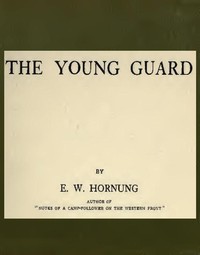
E. W. Hornung's The Young Guard (1919) is a collection of poems that draws heavily on the diction and rhythms of the battlefield and the home front. The poems employ a range of voices—from the colloquial drawl of an American soldier to the clipped observations of a British linesman—and frequently juxtapose the language of sport, especially cricket, with the brutal mechanics of war. Hornung's verse is notable for its precise, often startling imagery: a howitzer's sound is likened to 'a giant cracking a cable,' and the faces of returning troops are described as a 'gaunt, undaunted, haunted, whitening, frightening herd.' These choices reveal an author intent on making the unfamiliar horrors of modern warfare tangible through familiar, concrete comparisons.
Cricket as a Lens for Combat
Hornung repeatedly borrows the vocabulary of cricket to frame the experience of battle. In 'Lord's Leave (1915),' the speaker notes that 'The Schools take guard upon a fierier pitch / Somewhere in Flanders,' and a bowler is described as 'bowling with his head.' The poem explicitly contrasts the orderly world of Lord's cricket ground with the chaotic 'field of play' in France, where 'the deep-field-gun, trained upon your stumps' replaces fielders. This sustained metaphor does not trivialize war; rather, it makes the danger immediate by mapping it onto a familiar English institution. The effect is to suggest that the soldiers are still playing a game, but one with lethal stakes—a point reinforced by the final image of stars 'glisten[ing] and blink[ing] for pity on our scars / From the Pavilion.'
Colloquial Voices and Vernacular Contrasts
Several poems rely on dialogue that captures specific speech patterns. In 'The Big Thing (1918),' an American soldier drawls, 'Big Bill's our proposition an' we're goin' for him bald,' while a British linesman replies with a 'venial verb (and other parts of speech).' The American's slang—'cute onlooker,' 'Old Man Bull and Uncle Sam aboard the same blamed hooker'—is set against the linesman's more formal, wistful tone. This contrast in vernacular underscores the cultural gap between the allies even as they fight a common enemy. Hornung also uses the American's naive enthusiasm ('so brave and naïve and cock-a-hoop') to highlight the linesman's weary experience, creating a layered portrait of the Allied forces.
Sensory Specificity and Auditory Detail
Hornung's descriptions often focus on sound, using onomatopoeia and simile to convey the acoustic environment of the trenches. In 'The Big Thing,' a sixty-pounder gun leaves 'an absolute aural scar,' and its noise is compared to 'a giant cracking a cable' or 'tear[ing] up a mile of calico with one unthinkable r-r-r-r-rip.' The poem 'Shell-Shock in Arras' traces the psychological effect of constant bombardment: 'Like a noisy clock, or a steamer's screw, / Their beat debauched the ear.' The speaker becomes inured to the 'deafening few' that burst nearby, yet flinches at 'some idiot slam[ming] a door.' This precise calibration of auditory response—from the mechanical rhythm of shells to the sudden, jarring slam—demonstrates Hornung's attention to the way war reshapes perception.
The Domestic and the Macabre
Several poems juxtapose homely, domestic imagery with the grotesque realities of war. In 'Last Post (1915),' the postman's lantern and the 'envelope without a stamp' become symbols of life and connection, yet the poem's opening—'Last summer, centuries ago'—establishes a temporal dislocation. 'Consecration' addresses children directly, calling them 'Children we deemed you all the days / We vexed you with our care' before describing them as 'England's flower that fell / Ere yet it brake the bud.' The metaphor of the bud is conventional, but the preceding lines—'To rush upon the flames of Hell, / To quench them with your blood'—introduce a violent, sacrificial tone. Hornung's willingness to mix the tender with the horrific gives his verse an unsettling, elegiac quality.
Readers approaching The Young Guard should attend to Hornung's use of multiple registers—from the slang of the trenches to the formal diction of elegy. His poems reward close attention to sound patterns and metaphor, particularly the extended cricket conceit that runs through several pieces. The collection offers a snapshot of wartime attitudes filtered through a distinctly Edwardian literary sensibility, one that grapples with the inadequacy of language to capture the scale of the conflict.
There’s a particular ache in Hornung’s verses, the way he folds cricket into mud and gas — youth gone before its time. I remember that feeling of quiet sorrow turning to wonder when I later held Baby-Land — Text and Context, finding the same tender distance between what we imagine and what war leaves behind. Baby-Land — Text and Context sits beside him on my shelf now, two voices asking the same unanswerable question.

Aria Baker
3 weeks ago-
Adam Dominguez - 1 month ago
An important work of Soviet literature that offers a unique perspective on World War II. The characters are well-drawn and the narrative is engaging, though the ideological undertones are sometimes heavy-handed. For those interested in historical fiction from this era, it's a worthwhile read, but it may not resonate with all modern readers. -
Daniel Matthew Lewis - 4 weeks ago
A gripping historical novel that immerses you in the Soviet Union during the Great Patriotic War. The young protagonists are relatable and their journey of growth amidst hardship is both moving and inspiring. Fadeyev masterfully captures the spirit of resistance and the bonds of friendship. A classic that remains relevant today. -
Mike Heather Craig - 3 weeks ago
Despite its historical significance, this novel feels dated and overly propagandistic. The characters are one-dimensional, and the plot is predictable. The writing, though earnest, lacks subtlety. It's more valuable as a historical artifact than as a piece of literature. Unless you have a specific interest in Soviet war novels, you might find it tedious.
How will you remember this book?
Save your reaction, strongest insight, and memorable passage.
Evelyn Martinez
3 weeks ago