About 71 minutes
On Patrol — Background and Themes
Fantasy Juvenile Worlds
16,312 recorded words. 0 minutes difference from this book's estimate.
View Gutenberg source #41944
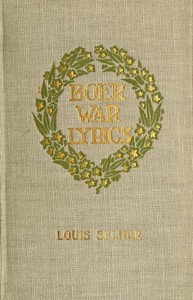
The catalog record for Boer War Lyrics — Reading Companion provides practical reading context through 16,283 words, 1 hr 11 min estimated reading time, and 3 detected text sections.
The text analysis averages about 33.6 words per sentence, while the detected sections provide another way to judge how the source is divided.
Project Gutenberg metadata also associates the work with “South African War, 1899-1902 -- Poetry,” connecting these edition facts with the source record’s subject description.
Explore this collection
These alternatives are selected using recorded categories and estimated reading time.
About 71 minutes
Fantasy Juvenile Worlds
16,312 recorded words. 0 minutes difference from this book's estimate.
View Gutenberg source #41944About 72 minutes
Fantasy Juvenile Worlds
16,523 recorded words. 1 minutes difference from this book's estimate.
View Gutenberg source #50509About 76 minutes
Fantasy Juvenile Worlds
17,348 recorded words. 5 minutes difference from this book's estimate.
View Gutenberg source #49684Search stored excerpts and compare books → Choose by your preferences →
Choices use stored catalog measurements. Estimates vary with reading speed. A shared category is a catalog label, not a claim that two books have the same argument or literary quality.
Search reads excerpt text stored with this catalog and links to its associated Gutenberg record. The connection is stored in the site database; this tool does not recheck that every excerpt is word-for-word identical to that external record. Excerpt search does not cover every chapter and does not verify historical publication dates.
Catalog snapshot checked: 2026-09-26. Coverage: 90 public books, 90 available source excerpts.
Calculated from edition completeness, EPUB availability, text structure and catalogue metadata. Not a user rating.
Total of 100 points, scaled to a 2.5-5.0 range. Editions with an empty description or a missing EPUB file are not scored.
Public-domain source text
The source text is kept in the dedicated reader, separate from this catalogue record and its commentary.
Louis Selmer's Boer War Lyrics (1903) is a sequence of poems that moves from a preface defending the volume's late publication to a series of titled pieces such as "On the Trail of the Lion," "The Gibbet-Song," and "War." The work is structured around recurring images of blood, seed, and furrow, with war personified as a grim sower who "broad-cast flings his dripping grain." Selmer's preface explicitly states that the verses were conceived around the time of Cronje's surrender at Paardeberg, and he presents them as a "hearty condemnation" of England's use of force against the South African republics.
The collection is not a random gathering of poems but a deliberate sequence. The table of contents lists twenty-one pieces, beginning with a "Prelude" and ending with "Sine Die" and "A Concordance." The central poem "War" personifies conflict as a figure who "walketh the War" along a "blood-red furrow," tending his "fierce acre." This image recurs in "The Gibbet-Song" and "The Scar," where the physical and moral wounds of war are explored. Selmer's preface frames the entire work as a response to the "stupendous struggle of moral Right ... against an aggressive and overweening Might." The poems thus form a coherent argument, moving from specific events (Cronje, De Wet, Rhodes) to broader meditations on war and peace.
Throughout the excerpts, a cluster of related images appears: blood, seed, furrow, and harvest. In "War," the speaker describes the war-god as a sower who "broad-cast flings his dripping grain" and tends his "dank pastures, whose soil, / Moistened by ages, augur his toil." This agricultural metaphor is extended to include the idea of purging: "Lest, unpurged of tare and weed, / God's dear harvest come in vain." The same imagery appears in the preface, where Selmer speaks of the "long, though fruitless attempt on England's part to compel a surrender." The poems thus consistently link war to the cycle of sowing and reaping, suggesting that violence is a kind of grim husbandry.
Selmer's sequence alternates between poems named after historical individuals—"Peter Cronje," "Christian De Wet," "Oom Paul," "Cecil Rhodes," "Chamberlain," "Salisbury"—and more abstract pieces like "War," "Peace," and "Greatness." This movement creates a rhythm between the particular and the universal. The named poems likely offer character sketches or judgments, while the abstract ones develop the philosophical framework. The preface indicates that Selmer sees the war as illustrating "how rampant is still in Man ... a tacit faith in the bigger fist." The structure thus allows him to move from concrete examples to general condemnation, a technique that gives the collection both historical specificity and moral weight.
The preface is an integral part of the work, not merely a conventional introduction. Selmer uses it to explain the delay in publication, to state his political stance, and to frame the poems as a "conscientious, if necessarily, censorious verse." He also includes a postscript dated November 1902, after peace was declared, noting that the lyrics remain relevant. The inclusion of a "Concordance" at the end suggests a scholarly or systematic intent, perhaps indexing key terms or themes. These paratexts—preface, postscript, concordance—give the volume a self-conscious, almost academic structure, reinforcing the idea that the poems are meant to be read as a coherent argument rather than as spontaneous outpourings.
Readers approaching Boer War Lyrics should attend to the interplay between the named poems and the abstract ones, as well as the recurring imagery of blood and seed. The preface provides essential context for Selmer's polemical intent, while the concordance hints at a deliberate architecture. The work is best read as a unified sequence rather than a collection of separate pieces.
I found myself turning back to the blood-soaked furrows in Selmer’s preface, the way he lets that single image carry the whole weight of the thing. It reminded me, oddly, of another quiet book I once kept nearby, On Patrol — Background and Themes, where the same sense of ground being reluctantly claimed comes through in a softer register. Strange how one sorrow echoes another.
Your answers remain private and are stored only in this browser.