About 72 minutes
Baby-Land — Text and Context
Fantasy Juvenile Worlds
16,523 recorded words. 4 minutes difference from this book's estimate.
View Gutenberg source #50509
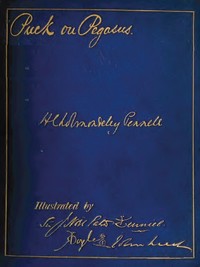
The catalog record for Puck on Pegasus Fourth Edition — Background and Themes provides practical reading context through 17,348 words, 1 hr 16 min estimated reading time, and 6 detected text sections.
The text analysis averages about 20.0 words per sentence, while the detected sections provide another way to judge how the source is divided.
Project Gutenberg metadata also associates the work with “Humorous poetry, English,” connecting these edition facts with the source record’s subject description.
Explore this collection
These alternatives are selected using recorded categories and estimated reading time.
About 72 minutes
Fantasy Juvenile Worlds
16,523 recorded words. 4 minutes difference from this book's estimate.
View Gutenberg source #50509About 71 minutes
Fantasy Juvenile Worlds
16,312 recorded words. 5 minutes difference from this book's estimate.
View Gutenberg source #41944About 71 minutes
Fantasy Juvenile Worlds
16,283 recorded words. 5 minutes difference from this book's estimate.
View Gutenberg source #44641Search stored excerpts and compare books → Choose by your preferences →
Choices use stored catalog measurements. Estimates vary with reading speed. A shared category is a catalog label, not a claim that two books have the same argument or literary quality.
Search reads excerpt text stored with this catalog and links to its associated Gutenberg record. The connection is stored in the site database; this tool does not recheck that every excerpt is word-for-word identical to that external record. Excerpt search does not cover every chapter and does not verify historical publication dates.
Catalog snapshot checked: 2026-09-26. Coverage: 90 public books, 90 available source excerpts.
Calculated from edition completeness, EPUB availability, text structure and catalogue metadata. Not a user rating.
Total of 100 points, scaled to a 2.5-5.0 range. Editions with an empty description or a missing EPUB file are not scored.
Public-domain source text
The source text is kept in the dedicated reader, separate from this catalogue record and its commentary.
H. Cholmondeley-Pennell's Puck on Pegasus opens with a preface that acknowledges the author's debt to critics and explains the substitution of lighter pieces with more serious poems like "The Night Mail North" and "Derby Day." The collection's title invokes Shakespeare's Puck, but the poems themselves often veer toward the mundane and the mishap-prone. In "Wus, Ever Wus," the speaker laments a series of petty disasters: spotless trousers splashed, a beetle charging into an eye, and smuts settling on the nose. This self-deprecating tone recurs throughout, as does a fascination with the rhythms of speech—stammering, dialect, and colloquial outbursts.
Several poems in the collection use stammering or interrupted speech as a structural gag. In "The Days the Thing," a speaker trying to give directions to Waterloo Place is repeatedly derailed by a stutter: "Wuw—Wuw—Wuw—Wuw—Wuw—Wuw— / W-Waterloo Place?" The line breaks mimic the hesitation, and the poem ends with the speaker's exasperated admission that the listener will arrive before the directions are finished. Similarly, "Too Bad, You Know" features a cabman whose speech is peppered with colloquial curses and broken syntax: "I say, you Sir,—come out of that!— / I say, you Sir in there—" The effect is one of comic frustration, where language itself becomes an obstacle. These poems suggest a fascination with the gap between intention and expression, a theme that aligns with the collection's broader interest in failed plans and thwarted expectations.
Pennell frequently adapts well-known poetic forms for satirical ends. "Charge of the Light (Irish) Brigade" parodies Tennyson's famous poem, replacing the heroic cavalry charge with a farcical retreat: "No—where they stood they stay'd, / Tho' Lamoriciere pray'd, / Threaten'd, and thunder'd." The poem's refrain "Blessed Six Hundred" becomes ironic as the soldiers scatter and surrender. In "Ghostries," the gothic horror of a spectral visitation is undercut by the revelation that the creeping figure is merely a cat: "And you could not, / Or you would not, / See it was the cat?" This deflationary technique recurs in "Marriage in High Life," where Sir Toby's portly, aldermanic dignity is punctured by the poem's abrupt truncation. The effect is a consistent refusal to let any subject remain elevated, whether it be military glory, supernatural terror, or domestic respectability.
The collection frequently sets its scenes in the city, using the specifics of Victorian London—fog, cabs, smuts, and railway stations—as comic material. "The Night Mail North" opens with a bustling railway scene: "Clap on the steam, and sharp's the word / 'You men in scarlet cloth.'" The poem's rhythm mimics the urgency of departure. In "Too Bad, You Know," the fog is so thick that the cabman cannot see: "There aint a thimblefull of shine, / The fog's as black as pitch." The urban environment is not merely backdrop but active antagonist, splashing pedestrians, blinding drivers, and frustrating communication. Even the celestial is invaded by the city's grime: in "Wus, Ever Wus," the speaker's attempt to stroll in Regent Street is foiled by "smuts the most prodigious" that settle on his nose. These details ground the poems in a recognizable, gritty reality that contrasts with the fantastical title's promise of airborne mischief.
Readers approaching Puck on Pegasus should expect a collection that prizes variety over consistency, moving from railway timetables to ghost stories to parliamentary satire. The fourth edition's revisions, as noted in the preface, tilt the balance toward longer, more serious poems, but the comic sensibility remains dominant. Pay attention to the illustrations by Leech, Phiz, Tenniel, and Cruikshank, which often amplify the poems' visual humor. The book rewards those who enjoy wordplay, parody, and the peculiar texture of mid-Victorian urban life.
I remember that gray afternoon when Puck on Pegasus sat open on my knee, the drizzle blurring the window and Tenniel’s inkwork sharpening the absurdity of falling hats and punctured pride. Somewhere between the wordplay and the mock-heroic stumble lay a quieter patience for verbal trickery, which drifted me toward The Scribleriad, and The Difference Between Verbal and Practical Virtue — A Closer Reading, and I found the same laughter, somehow slower and more thoughtful.
Build a private reading journal entry for this title.