1

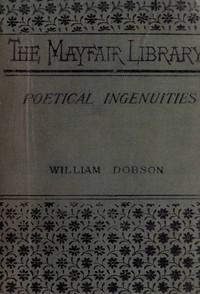
Poetical Ingenuities and Eccentricities — Text and Context
(11 User reviews)
3125
Project Gutenberg
2012
Not confirmed
Humorous poetry; Macaronic poetry
Readers of public-domain and historical texts
Project Gutenberg digital edition
en
Edition facts
Words
49,812
Reading time
217 min
Text sections
8
This digital edition of Poetical Ingenuities and Eccentricities — Text and Context is described by source-level measurements including 49,812 words, 3 hr 37 min estimated reading time, and 8 detected text sections.
The text analysis averages about 20.2 words per sentence, while the detected sections provide another way to judge how the source is divided.
Project Gutenberg metadata also associates the work with “Humorous poetry,” connecting these edition facts with the source record’s subject description.
Source:
Project Gutenberg record #40124
A Victorian anthology of whimsical verse, from macaronic poems and acrostics to technical odes on geology and microscopy, edited by William T. Dobson as a sequel to 'Literary Frivolities.'
Editorial Edition Score
4.7/5
★★★★★
★★★★★
Calculated from edition completeness, EPUB availability, text structure and catalogue metadata. Not a user rating.
How this score is calculated
- Description quality20 pts
- Title & short description10 pts
- Source metadata20 pts
- Text length15 pts
- Chapters / structure15 pts
- EPUB file integrity20 pts
Total of 100 points, scaled to a 2.5-5.0 range. Editions with an empty description or a missing EPUB file are not scored.
Edition quality
Read the Text
Pat was the urchin's name--a red-haired youth, Fonder of purl and skittle-grounds than truth. Silence, ye gods! to keep your tongues in awe, The Muse shall tell an accident she saw. Pat Jennings in the upper gallery sat, But, leaning forward, Jennings lost his hat; Down from the gallery the beaver flew, And spurned the one to settle in the two. How shall he act? Pay at the gallery-door Two shillings for what cost, when new, but four? Or till half-price, to save his shilling, wait, And gain his hat again at half-past eight? Now, while his fears anticipate a thief, John Mullens whispered, 'Take my handkerchief.' 'Thank you,' cries Pat; 'but one won't make a line.' 'Take mine,' cried Wilson; and cried Stokes, 'Take mine.' A motley cable soon Pat Jennings ties, Where Spitalfields with real India vies. Like Iris' bow down darts the painted clue, Starred, striped, and spotted, yellow, red, and blue, Old calico, torn silk, and muslin new. George Green below, with palpitating hand, Loops the last 'kerchief to the beaver's band-- Upsoars the prize! The youth, with joy unfeigned, Regained the felt, and felt what he regained; While to the applauding galleries grateful Pat Made a low bow, and touched the ransomed hat!"
From the same work is taken this parody on a beautiful passage in Southey's "Kehama:"
"Midnight, yet not a nose From Tower Hill to Piccadilly snored! Midnight, yet not a nose From Indra drew the essence of repose. See with what crimson fury, By Indra fann'd, the god of fire ascends the walls of Drury! The tops of houses, blue with lead, Bend beneath the landlord's tread; Master and 'prentice, serving-man and lord, Nailor and tailor, Grazier and brazier, Through streets and alleys poured, All, all abroad to gaze, And wonder at the blaze. Thick calf, fat foot, and slim knee, Mounted on roof and chimney; The mighty roast, the mighty stew To see, As if the dismal view Were but to them a mighty jubilee."
The brothers Smith reproduced Byron in the familiar "Childe Harold" stanza, both in style and thought:
"For what is Hamlet, but a hare in March? And what is Brutus but a croaking owl? And what is Rolla? Cupid steeped in starch, Orlando's helmet in Augustin's cowl. Shakespeare, how true thine adage, 'fair is foul!' To him whose soul is with fruition fraught, The song of Braham is an Irish howl, Thinking is but an idle waste of thought, And nought is everything, and everything is nought."
Moore, also, was imitated in the same way, as in these verses:
"The apples that grew on the fruit-tree of knowledge By women were plucked, and she still wears the prize, To tempt us in theatre, senate, or college-- I mean the love-apples that bloom in the eyes.
There, too, is the lash which, all statutes controlling, Still governs the slaves that are made by the fair; For man is the pupil who, while her eye's rolling, Is lifted to rapture or sunk in despair."
From the parody on Sir Walter Scott, it is difficult to select, being all good; calling from Scott himself the remark, "I must have done this myself, though I forget on what occasion."
A TALE OF DRURY LANE.
This collection, assembled by William T. Dobson as a sequel to his earlier Literary Frivolities, gathers verse that plays with form, language, and subject matter in ways that defy conventional poetic decorum. The editor’s preface acknowledges that the earlier volume was faulted for omissions—a sin he here claims to atone for by including pieces that had not previously “been glorified in type.” The result is a miscellany that ranges from macaronic verses mixing Latin and English to technical poems on geology and microscopy, each testing the boundaries of what can be cast in meter and rhyme.
Macaronic and Multilingual Play
The anthology draws heavily on macaronic verse, where languages are deliberately mixed for comic or ingenious effect. One example, attributed to an unnamed author, laments in a blend of English and French: “Oh, heaux! The girls have gone back on me seaux, / What to do I really don’t kneaux.” The humor depends on the reader’s ear for the clash between the French-looking spellings and the English pronunciation. Such pieces, often anonymous or attributed to minor wits, suggest a tradition of learned play that Dobson sought to preserve. The editor’s own Literary Frivolities is cited as a source for historical accounts of these forms, but here the emphasis falls on the examples themselves, many of which are presented without extensive commentary.
Technical Verse: Geology and Microscopy
Two poems stand out for their use of specialized scientific vocabulary within conventional poetic structures. Bishop Shuttleworth’s “Anticipatory Dirge on Professor Buckland, the Geologist” mourns the professor in terms drawn from his own field: “Mourn, Ammonites, mourn o’er his funeral urn, / Whose neck ye must grace no more.” The poem’s stanzas catalogue geological strata and fossils, ending with a wry proposal to petrify the professor and place him on a shelf “mid Mammoths and Crocodiles.” A footnote reports that when Buckland’s grave was dug, workers indeed struck solid limestone—a coincidence that the editor finds “remarkable.” Jacob F. Henrici’s “A Microscopic Serenade” similarly adapts the language of microscopy to a love poem, inviting the beloved to a realm “where green conferva-threads lie curled” and “protists” hold sway. Both poems treat their technical subjects with affectionate mockery, turning scientific precision into a source of poetic ingenuity.
Epitaphs and Learned Jests
The collection includes epitaphs that exploit specialized jargon for humorous effect. Dr. Charles Smith’s “Epitaphium Chemicum” reduces a chemist’s life to a series of alchemical and chemical processes: “Here lieth to digest, macerate, and amalgamate with clay, / In Balneo Arenæ, Stratum super stratum, / The Residuum, Terra Damnata, and Caput Mortuum.” The Latin terms and laboratory procedures are applied to the human body with deadpan solemnity, creating a tension between the clinical language and the occasion of death. Such pieces, read at meetings of learned societies, suggest that these verses were not merely printed curiosities but part of a living culture of intellectual humor. Dobson’s selection preserves these occasional pieces, giving modern readers a glimpse into the playful side of Victorian scholarship.
Readers approaching this anthology should expect no sustained narrative or unified theme. The pleasure lies in the variety of contrivance: the unexpected rhyme, the borrowed vocabulary, the solemn application of technical terms to trivial or morbid subjects. Dobson’s editorial hand is light, letting the poems speak for themselves. Those curious about the historical background of these forms will find it in the earlier Literary Frivolities; here, the emphasis is on the curiosities themselves, offered as specimens of a wit that is at once learned and irreverent.
Flipping through Poetical Ingenuities, I paused on a microscopic ode—how the Victorians found such gravely tender wonder in tiny things. It reminded me, strangely, of holding The Young Guard — Inside the Classic, feeling that same quiet devotion to details most would overlook. There’s a shared reverence there, a patience for the small and earnest.
Isaac Wilson
2 weeks agoWyatt Davis
1 week agoIsaac Thompson
2 weeks agoAlexander Smith
3 weeks ago-

Mackenzie Bell - 1 month ago
A delightful collection that celebrates the whimsical and unconventional side of poetry. Each piece is a treasure trove of clever wordplay and unexpected twists, making it a joy for both casual readers and poetry enthusiasts. The eccentricities are charming, and the ingenuity shines through on every page. A must-read for anyone who loves poetry that dares to be different. -
Paul Smith - 2 weeks ago
While the concept of exploring poetic eccentricities is intriguing, the execution falls flat. Many of the poems feel forced and lack the polish of traditional works. The collection is uneven, and some entries are more confusing than clever. A more careful curation and editing could have elevated this into something truly special. -
Sarah Garcia - 2 weeks ago
This anthology offers a fascinating glimpse into the playful and quirky aspects of poetry. The selection is eclectic and often entertaining, though some pieces feel more dated than others. If you enjoy literary oddities, you'll find plenty to appreciate here. Just don't expect a consistent tone or theme throughout.
Reader reflection
Take a moment to reflect on this book
Create a short personal record of your experience with this book.
Your progress
0
/
10
2
How much did you enjoy the reading experience?
3
Is this a title you would suggest to others?
4
How demanding did the text feel?
5
How closely did the book connect with your experience?
6
Did you gain anything practical from the text?
7
What was the strongest part of the book?
8
Is this a title worth rereading?
9
In one sentence, what did you learn?
10

Gabriel Martinez
1 month ago