About 87 minutes
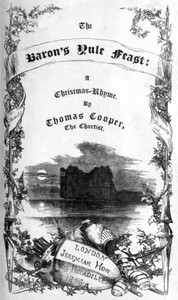
The Baron's Yule Feast: A Christmas Rhyme — Background and Themes
Fantasy Juvenile Worlds
19,968 recorded words. 28 minutes difference from this book's estimate.
View Gutenberg source #29722
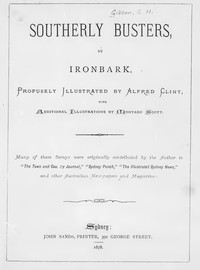
Before opening Southerly Busters — Reading Notes, the edition data offers a quick orientation: 26,380 words, 1 hr 55 min estimated reading time, and 7 detected text sections.
The text analysis averages about 23.8 words per sentence, while the detected sections provide another way to judge how the source is divided.
Project Gutenberg metadata also associates the work with “Humorous poetry,” connecting these edition facts with the source record’s subject description.
Explore this collection
These alternatives are selected using recorded categories and estimated reading time.
About 87 minutes
Fantasy Juvenile Worlds
19,968 recorded words. 28 minutes difference from this book's estimate.
View Gutenberg source #29722About 83 minutes
Fantasy Juvenile Worlds
18,992 recorded words. 32 minutes difference from this book's estimate.
View Gutenberg source #30426About 76 minutes
Fantasy Juvenile Worlds
17,348 recorded words. 39 minutes difference from this book's estimate.
View Gutenberg source #49684Search stored excerpts and compare books → Choose by your preferences →
Choices use stored catalog measurements. Estimates vary with reading speed. A shared category is a catalog label, not a claim that two books have the same argument or literary quality.
Search reads excerpt text stored with this catalog and links to its associated Gutenberg record. The connection is stored in the site database; this tool does not recheck that every excerpt is word-for-word identical to that external record. Excerpt search does not cover every chapter and does not verify historical publication dates.
Catalog snapshot checked: 2026-09-26. Coverage: 90 public books, 90 available source excerpts.
Calculated from edition completeness, EPUB availability, text structure and catalogue metadata. Not a user rating.
Total of 100 points, scaled to a 2.5-5.0 range. Editions with an empty description or a missing EPUB file are not scored.
Public-domain source text
The source text is kept in the dedicated reader, separate from this catalogue record and its commentary.
G.H. Gibson, writing as “Ironbark,” opens Southerly Busters with a preface that apologizes with deliberate thinness for “inflicting this work on mankind.” The collection gathers pieces originally printed in Sydney newspapers, and the author’s self-deprecating tone—calling his excuse “somewhat ‘thin’”—sets the stage for a book that treats colonial ambitions and everyday mishaps with comic exaggeration. The first poem, “LINES BY A (PAWN)BROKEN-HEARTED YOUTH,” immediately signals a fondness for puns and parody, while the appended notes define terms like “billy” and “jackeroo,” grounding the humor in specific bush vocabulary.
The poem “A PEELER’S APPEAL” (a “peeler” being a policeman) offers a sustained comic monologue. The speaker imagines himself as a heroic figure: “My look alone would petrify / A breaker of the peace.” He dreams of a beat in George’s Street, not “nasty slums,” and fantasizes about crushing a cabby’s overcharge with an “eagle glance.” The humor escalates as he threatens a pea-shooting boy with a truncheon blow that would leave him “mutilated past repair.” Yet the poem pivots sharply when a real policeman appears, raises a blister on his head, and the dream collapses. The refrain “I’m not a trap at all!” undercuts the entire fantasy, turning self-importance into self-mockery.
“SUPERNATURAL REVELATIONS OF A FANCY-GOODS MAN” parodies Gothic horror by transplanting it to a Sydney drain. The hero, Joe, a fancy-goods shopman, is summoned by a ghost who commands him to “slay the demon dread / Of Wattle Swamp the Black.” The spirit’s instructions are absurdly practical: “Bring kerosene, and bring thy lamp, / And arm thee to the teeth.” Gibson’s verse mimics the rhythms of balladry while undercutting it with colloquial details—Joe “nightly sniffed its odours sweet” from Parramatta Street. The poem’s title alone signals a mock-heroic treatment of urban folklore, where the demon is less a monster than a punchline waiting to happen.
A cluster of poems titled after trades—the butcher’s picnic, the oystermen’s, the wheelwrights’, the undertaker’s, the hairdressers’—suggests a serial structure built on occupational stereotypes. These pieces likely extend the collection’s pattern of using a single premise (a picnic) to expose the pretensions or absurdities of each group. The undertaker’s picnic, for instance, promises dark humor, while the hairdressers’ may play on vanity. Gibson’s notes reveal that many of these “scraps” first appeared in The Town and Country Journal and Sydney Punch, indicating they were written for an audience familiar with local types and slang. The reader should expect each poem to follow a similar formula of escalating mishap.
The author’s footnotes are integral to the reading experience. They define “billy” as “a tin pot for making tea in,” and explain that “jackeroos” are young gentlemen gaining “colonial experience.” One note describes the Yanko sheep-station as “the Paradise of loafers,” where travellers were “feasted … on a scale of great magnificence.” These glosses do more than clarify; they provide a satirical commentary on bush customs and the tension between squatters and tramps. Gibson even notes that the ration system “became frightfully abused by loafers,” a wry observation that colors the poems. Readers unfamiliar with 1870s Australia will find these notes essential for catching the jokes, while those in the know may appreciate the insider’s wink.
Reading Southerly Busters sequentially reveals a deliberate arc: the preface’s mock apology, the constable’s deflated ego, the fancy-goods man’s gothic parody, and the trade picnics’ repetitive structure. Gibson’s verse rewards attention to his footnotes and to the recurring pattern of self-important characters meeting comic comeuppance. Approach each poem as a self-contained sketch, but watch for the author’s consistent voice—colloquial, ironic, and fond of anticlimax.
I remember browsing Ironbark’s verses, that constable chasing phantoms through colonial dust, and how the humor wore thin to a fine, wry ache. It put me in mind of another bedside volume, The Scribleriad, and The Difference Between Verbal and Practical Virtue — A Closer Reading, which polishes the same old coin of pretense versus deed, though from a cooler, more deliberate mint. They whisper across a century, these two.
Save your reaction, strongest insight, and memorable passage.