About 22 minutes
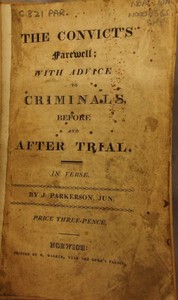
The Convict's Farewell: with Advice to Criminals, before and after Trial — Story, Setting & Ideas
Fantasy Juvenile Worlds
4,890 recorded words. 4 minutes difference from this book's estimate.
View Gutenberg source #33533
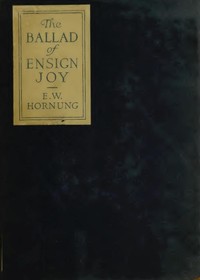
The catalog record for The Ballad of Ensign Joy — Reading Companion provides practical reading context through 5,894 words, 26 min estimated reading time, and 2 detected text sections.
The text analysis averages about 20.5 words per sentence, while the detected sections provide another way to judge how the source is divided.
Project Gutenberg metadata also associates the work with “World War, 1914-1918 -- Poetry,” connecting these edition facts with the source record’s subject description.
Explore this collection
These alternatives are selected using recorded categories and estimated reading time.
About 22 minutes
Fantasy Juvenile Worlds
4,890 recorded words. 4 minutes difference from this book's estimate.
View Gutenberg source #33533About 30 minutes
Fantasy Juvenile Worlds
6,836 recorded words. 4 minutes difference from this book's estimate.
View Gutenberg source #40345About 30 minutes
Fantasy Juvenile Worlds
6,795 recorded words. 4 minutes difference from this book's estimate.
View Gutenberg source #47144Search stored excerpts and compare books → Choose by your preferences →
Choices use stored catalog measurements. Estimates vary with reading speed. A shared category is a catalog label, not a claim that two books have the same argument or literary quality.
Search reads excerpt text stored with this catalog and links to its associated Gutenberg record. The connection is stored in the site database; this tool does not recheck that every excerpt is word-for-word identical to that external record. Excerpt search does not cover every chapter and does not verify historical publication dates.
Catalog snapshot checked: 2026-09-26. Coverage: 90 public books, 90 available source excerpts.
Calculated from edition completeness, EPUB availability, text structure and catalogue metadata. Not a user rating.
Total of 100 points, scaled to a 2.5-5.0 range. Editions with an empty description or a missing EPUB file are not scored.
Public-domain source text
The source text is kept in the dedicated reader, separate from this catalogue record and its commentary.
E. W. Hornung's The Ballad of Ensign Joy (1917) is a narrative poem that intertwines a love story with the experiences of a young officer during World War I. The poem opens with a direct address to the reader, declaring it "the story of Ensign Joy" and praising "each gentle English boy / Who jumped to his country's call." This sets a patriotic tone, but the poem quickly complicates this by introducing Ermyntrude, described as "a less appropriate name / For the dearest prig and the prettiest prude." The contrast between the idealized home front and the harsh realities of war becomes a central tension.
Hornung employs a traditional ballad meter—alternating tetrameter and trimeter lines—but infuses it with colloquial, even flippant language. The narrator uses phrases like "sick-keen to be drafted hence" and describes Ensign Joy's letters as "full of gay bloodshed and Old Man Fritz." This blend of formal structure and informal diction mirrors the poem's thematic conflict: the clash between the romanticized notion of war and its gritty reality. The narrator also inserts parenthetical asides, such as "(I would gazette them Second to none / Who faces a gun in Gaul!)" which break the fourth wall and create a conversational intimacy with the reader.
Ermyntrude is portrayed as a product of her environment: "the usual consanguineous squad / Had made her an honest child of God— / And left her to play the game." She reacts to Ensign Joy's letters with discomfort, finding his "tactless truth" and "grim" jokes jarring. When she learns he is wounded, she imagines "the reddening lint, / The drawn damp face and the draggled hair," only to find him "blooming in Grosvenor Square, / With a punctured shin in a splint." This gap between her imagined suffering and his actual experience highlights the disconnect between the front and the home front. Her eventual realization—seeing his name in a list of those awarded a cross—prompts a shift in her perception, as she "sank into her heart instead" of viewing him as a type.
The poem repeatedly undercuts heroic expectations. Ensign Joy shows Ermyntrude "the bullet that did the trick" and "the trick, x-ray'd," along with a map made by an airman, but he "never mentioned a certain cross / For his part in the escapade." The narrator later reflects on the fate of young soldiers: "Cut down in his high heyday, / Or ever the Sweets of the Morning cloy, / Or the Green Leaf wither away." The final stanza addresses Ermyntrude and "many a hundred more— / Compact of foibles and fortitude— / Woo'd, won, and widow'd, in War." The poem thus acknowledges the loss and sacrifice while maintaining a tone of gallant resignation, ending with a prayer: "God, keep us gallant and undefiled, / Worthy of Husband, Lover, or —Child..."
Readers should note that the poem's catalog subject is "World War, 1914-1918 -- Poetry," but the excerpts reveal a work more focused on the emotional dynamics between a soldier and a civilian woman than on battle scenes. The poem's voice is deliberately uneven—shifting from patriotic fervor to ironic detachment—and its treatment of Ermyntrude's growth from prude to widow offers a nuanced view of wartime romance. The incomplete text prevents full assessment of the poem's resolution, but the extant stanzas suggest a meditation on the cost of war and the resilience required to bear it.
Your answers remain private and are stored only in this browser.