1

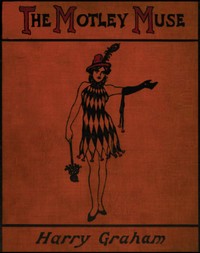
The Motley Muse (Rhymes for the Times) — Story, Setting & Ideas
(6 User reviews)
850
Project Gutenberg
2011
Not confirmed
Humorous poetry, English
Readers of public-domain and historical texts
Project Gutenberg digital edition
en
Edition facts
Words
16,083
Reading time
70 min
Text sections
3
The source record for The Motley Muse (Rhymes for the Times) — Story, Setting & Ideas measures this digital text at 16,083 words, 1 hr 10 min estimated reading time, and 3 detected text sections.
The text analysis averages about 24.0 words per sentence, while the detected sections provide another way to judge how the source is divided.
Project Gutenberg metadata also associates the work with “Humorous poetry, English,” connecting these edition facts with the source record’s subject description.
Source:
Project Gutenberg record #36543
Harry Graham's 1913 collection of satirical verse skewers Edwardian society with wry rhymes on clubs, motorists, suffragettes, and seasonal follies, illustrated by Lewis Baumer. The poems shift from topical commentary to playful club cantos, revealing a sharp ear for social absurdity.
Editorial Edition Score
4.5/5
★★★★★
★★★★★
Calculated from edition completeness, EPUB availability, text structure and catalogue metadata. Not a user rating.
How this score is calculated
- Description quality20 pts
- Title & short description10 pts
- Source metadata20 pts
- Text length15 pts
- Chapters / structure15 pts
- EPUB file integrity20 pts
Total of 100 points, scaled to a 2.5-5.0 range. Editions with an empty description or a missing EPUB file are not scored.
Edition quality
Read the Text
Time was when Society wooed me, The populace fawned at my feet; Men petted and praised and pursued me, My social success was complete. The pick of the Peerage, with smiles on their faces, Would sell me their family portraits and places.
With stairs of pure marble below me, My stand as a host I would take, While guests (who, of course, didn't know me) The hand of my butler would shake, Averring, in phrases delightfully hearty, How much they enjoyed his agreeable party.
I gave away libraries gratis, Each village and town to adorn, Till with the expression '_Jam satis!_' Lord Rosebery laughed them to scorn; And soon Mr. Gosse and the groundlings were snarling At one who must style himself Nobody's Darling!
And now when I purchase their pictures, Or bid for some family seat, Men pass most disparaging strictures, Discussing my action with heat; While newspapers term it a 'public disaster' Each time I endeavour to buy an Old Master!
The country I rob of its treasures (By carting its ruins away!); I lessen all popular pleasures By spoiling the market, they say; And so they invoke Mr. George's assistance To tax the poor plutocrat out of existence!
['Mr. Frank Lascelles left London yesterday for Calcutta. As he entered the railway carriage at Victoria, Lady Jane Kenney-Herbert handed him a basket of roses.'--The _Times_.]
Each year in vain I take the train To Dinard, Trouville or Le Touquet; No lady fair is ever there To speed me with a bouquet; No maiden on my brow imposes A snood of Gloire de Dijon roses!
No purple phlox adorns the locks Of scanty hair that fringe my cranium; No garlands deck my shapely neck With jasmine or geranium. I travel, like a social pariah, Without a single calceolaria!
Though up and down I 'train' to town, Each day, with fellow-clerk or broker, No female hand has ever planned To trim my third-class 'smoker,' To wreathe the rack with scarlet dahlias, Or drape the seats with pink azaleas!
Let others envy wealthy men --The Rothschilds, Vanderbilts or Cassels-- I'd much prefer, I must aver, Like lucky Mr. Lascelles, To travel well supplied with posies Of (on the 'Underground') _Tube_-roses!
(_With shamefaced apologies to the author of a beautiful poem_)
[The _Daily Mirror_, in a leading article, deplored the fact that 'roly-poly' pudding, otherwise known as 'jam-roll,' was not to be obtained at fashionable West End restaurants.]
Although our wives deride for ever, Though cooks grow captious or gaze aghast (Cooks, swift to sunder, to slash and sever The ties that bind us to things long past), We will say as much as a man might wish Whose whole life's love comes up on a dish, Which he never again may feast on, and never Shall taste of more while the ages last.
I shall never again be friends with 'rolies,' I shall lack sweet 'polies' where, thick like glue, The jam in some secret Holy of Holies Crouches and cowers from mortal view. There are tastes that a tongue would fain forget, There are savours the soul must e'er regret; My tongue how hungry, how starved my soul is! I shall miss 'jam-pudding' my whole life through!
The gleam and the glamour, glimmering through it, The steam that rises, to greet the sun, The fragrant fumes of the jam and suet That mix and mingle, to blend as one; The white-capped cook who stirs so hard, To twine the treacle and knead the lard, To soak and season, to blend and brew it-- These things are over, and no more done!
I must go _my_ ways (others shall follow), Filling myself, till I rise replete, With fugitive things not good to swallow, Drink as my friends drink, eat what they eat; But if I could hear that sound (O squish!) Of the 'roly-poly' leaving its dish, My heart would be lighter, my life less hollow, At sight of my childhood's favourite sweet!
Ah, why do I live in an age that winces At 'shape' (blanc-mange) of a bygone brand, At tripe and trotters, at stews and minces, At hash or at haggis, heavy in hand? Come lunch, come dinner, no word is said Of the jam that in suet so veils its head. I shall never eat it again, for at Princes' If I cry for it there, will they understand?
[A recent by-law of the Eastbourne Town Council renders the owner of any dog who barks upon the beach liable to a fine of forty shillings.]
Harry Graham's The Motley Muse (Rhymes for the Times), published in 1913 with illustrations by Lewis Baumer, is a collection of satirical verse that targets the manners, institutions, and fads of Edwardian England. The poems originally appeared in periodicals such as The Observer and The Pall Mall Gazette, and they retain the brisk, topical quality of newspaper verse. Graham's voice is consistently ironic, but the tone shifts noticeably across the book's three sections: the opening 'Rhymes for the Times' offers broad social commentary, the 'Club Cantos' settle into a more sustained mock-heroic mode, and the final 'Songs in Season' follow the calendar with seasonal satire. This structure creates a varied reading experience, with pace and subject matter changing from poem to poem.
From General Satire to Clubby Cantos
The book's first section, 'Rhymes for the Times,' covers a wide range of targets: modern dancing, militant suffragettes, motorists, and even the 'triumph of jam.' The poems are short and punchy, often ending with a twist or a deflating punchline. For instance, 'The Triumph of Jam' mocks domestic fads, while 'The Militants' takes a wry look at the suffrage movement. The pace is quick, with each poem offering a self-contained joke or observation.
In contrast, the 'Club Cantos' section slows down and expands into a series of nine poems, each devoted to a specific London club (the Athenaeum, White's, the Garrick, etc.). Here Graham adopts a more elaborate stanza form and a mock-heroic tone, describing club rituals and members with affectionate satire. The repeated refrain 'To Mr. Gillett' in 'The Bachelors' Club' canto creates a rhythmic anchor, while the longer lines in 'White's' allow for historical digressions about betting and past members. This shift in pace—from rapid-fire quips to leisurely, descriptive verse—gives the collection a structural variety that rewards reading in sequence.
The Recurring Motif of Social Performance
Across the collection, Graham repeatedly returns to the idea of social performance—how people present themselves in public, whether at the club, on the street, or at a dance. In 'The Garrick' canto, he contrasts those who 'abominate the presence of your kind' with those who 'fraternise with any one you meet,' framing club membership as a choice of social style. The poem 'Nobody's Darling!' (from the first section) similarly plays on the desire for attention, while 'Stage Support' mocks theatrical pretension.
This theme is reinforced by the book's title and cover: 'Motley' evokes the jester's costume, and the poems often adopt a playful, self-aware voice that comments on its own performance. The foreword, 'The World We Laugh In!,' explicitly states that melancholy is out of fashion, positioning the poet as a purveyor of timely humor. Graham's language is full of theatrical metaphors—'pose,' 'role,' 'stage'—and his rhymes often deflate solemnity, as when he describes 'the terrors of the tomb' in the same stanza as 'hearts that are as hard as something oaken.' This recurring motif gives the collection a cohesive thread despite its varied subjects.
Rhyme, Meter, and the Art of the Punchline
Graham's technical skill is evident in his consistent use of regular meter and inventive rhymes. He favors anapestic and iambic rhythms, often with a strong caesura that sets up the final punchline. In 'The Bachelors' Club,' the refrain 'To Mr. Gillett' is repeated at the end of each stanza, creating a cumulative comic effect. The poem 'White's' uses a longer line with internal rhymes ('Brummels and Nashes still twirl their moustaches'), demonstrating a playful command of sound.
The punchlines themselves are often anticlimactic or deflating, a hallmark of Graham's style. For example, in 'The Garrick,' the line 'Then the Garrick is a club you should fight shy of' reverses the expected advice. This technique keeps the reader off-balance and reinforces the satirical tone. The poems also vary in length: some are tight eight-line squibs, while others, like the club cantos, run to multiple stanzas. This variation in form mirrors the shifts in pace noted earlier, making the collection feel dynamic rather than monotonous.
Readers approaching The Motley Muse will find it best enjoyed as a sequence rather than dipped into at random, since the arrangement of poems—from broad satire to club-focused cantos to seasonal verses—creates a deliberate arc. Graham's humor is dry and occasionally arch, but his observations of Edwardian social life remain sharp. The illustrations by Lewis Baumer, though not reproduced here, originally complemented the verse with visual wit. For those interested in the period's light verse, this collection offers a well-crafted example of how satire can capture the mood of an era without losing its comic edge.
That rainy afternoon, Graham’s sharp rhymes on motorists and suffragettes left me smiling, yet oddly weary of so much cleverness. I set the book down, and my gaze drifted to a plain volume on the shelf—The Poetical Works of William Wordsworth — Volume 4 (of 8) — Reading Companion. His quiet lines felt like a deep breath after all that laughter.
There are no comments for this eBook.
Reader reflection
Your personal reading reflection
Build a private reading journal entry for this title.
Your progress
0
/
10
2
What was your overall reaction to the book?
3
How likely are you to recommend this book?
4
How demanding did the text feel?
5
Did the book offer a fresh perspective?
6
How strongly did the book affect you emotionally?
7
Would you start a conversation about this book?
8
How clear did the writing feel?
9
What did this book teach you most?
10


Evelyn Scott
4 weeks ago