About 177 minutes
The Epic of Hades, in Three Books — Reading Notes
Historical Psychological Social Fiction
40,601 recorded words. 3 minutes difference from this book's estimate.
View Gutenberg source #38011
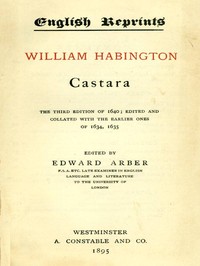
Before opening Castara The Third Edition of 1640; Edited and Collated with the Earlier Ones of 1634, 1635 — Context and Discussion, the edition data offers a quick orientation: 39,817 words, 2 hr 54 min estimated reading time, and 23 detected text sections.
The text analysis averages about 18.4 words per sentence, while the detected sections provide another way to judge how the source is divided.
Project Gutenberg metadata also associates the work with “English poetry -- Early modern, 1500-1700,” connecting these edition facts with the source record’s subject description.
Explore this collection
These alternatives are selected using recorded categories and estimated reading time.
About 177 minutes
Historical Psychological Social Fiction
40,601 recorded words. 3 minutes difference from this book's estimate.
View Gutenberg source #38011About 166 minutes
Historical Psychological Social Fiction
38,005 recorded words. 8 minutes difference from this book's estimate.
View Gutenberg source #50666About 187 minutes
Historical Psychological Social Fiction
42,882 recorded words. 13 minutes difference from this book's estimate.
View Gutenberg source #29879Search stored excerpts and compare books → Choose by your preferences →
Choices use stored catalog measurements. Estimates vary with reading speed. A shared category is a catalog label, not a claim that two books have the same argument or literary quality.
Search reads excerpt text stored with this catalog and links to its associated Gutenberg record. The connection is stored in the site database; this tool does not recheck that every excerpt is word-for-word identical to that external record. Excerpt search does not cover every chapter and does not verify historical publication dates.
Catalog snapshot checked: 2026-09-26. Coverage: 90 public books, 90 available source excerpts.
Calculated from edition completeness, EPUB availability, text structure and catalogue metadata. Not a user rating.
Total of 100 points, scaled to a 2.5-5.0 range. Editions with an empty description or a missing EPUB file are not scored.
Public-domain source text
The source text is kept in the dedicated reader, separate from this catalogue record and its commentary.
William Habington's Castara, as presented in Edward Arber's 1895 edition collating the first three editions (1634, 1635, 1640), reveals a poet attentive to the precise diction of devotion and the measured cadence of courtly compliment. The work is not a single sequence but a triptych: poems of courtship, then of wedded life, and finally sacred verse, each prefaced by a prose 'Character' defining the ideal mistress, wife, and holy man. Habington's voice is notably restrained, favouring metaphysical conceits that are anchored in domestic and natural imagery rather than extravagant hyperbole.
Habington's lexical choices consistently temper passion with moral gravity. In 'To Castara, How happy, though in an obscure fortune,' he writes of being 'throwne downe below our feare' and questions 'Natures care / In our provision,' using the homely image of a 'feather'd garment fit for every bird' to argue for contentment. The word 'innocence' is rhymed with 'sence,' linking moral purity to sensory experience. Elsewhere, in 'To Vaine hope,' he dismisses ambition as a 'dreame of madmen' and a 'wanton breath,' contrasting the 'gaudy saile' of fools with the 'secure at ease' of the cabin. The poet's restraint is evident in his avoidance of erotic excess; even in love, his language remains chaste, preferring 'shadowes of true blisse' to explicit desire.
Many poems are structured as direct addresses to Castara, creating an intimate yet formal dialogue. Habington uses the second-person pronoun 'thou' and 'thee' consistently, as in 'To Castara, What can the freedome of our love enthrall?' where he imagines a 'forsaken cave' as a retreat, and 'each wild beast' as an 'avaritious Courtier.' This apostrophe allows the poet to articulate ideals of mutual fidelity and self-sufficiency. The dialogue is one-sided—Castara never speaks—but her presence is invoked through the poet's questions and hypotheticals. In the elegy for the Earl of Saint Albans, the address shifts to the deceased: 'Bright Saint, thy pardon, if my sadder verse,' momentarily breaking the love-dialogue to mourn, before promising to 'returne to Love and you.'
Habington's descriptions of nature are spare and functional, often serving as moral analogies. In the poem beginning 'Were we by fate throwne downe,' he notes that nature 'apparels Lillies in their white' and 'in damaske doth attire the Rose,' using colour and fabric to suggest innocence and beauty. The violet is 'purple cloathed,' a small but precise detail. These images are not ornamental but argumentative: they support the claim that divine providence cares for all creation. In the elegy, the 'amaz'd marriner' who 'lookes up but findes no starres' becomes a figure for grief and disorientation. The sea is a 'tempestuous desart,' a phrase that compresses vastness and barrenness into two words. Habington's descriptive touch is light, avoiding the lushness of Spenser or the density of Donne.
Arber's collation reveals how Habington expanded the work between 1634 and 1640. The first edition contained only the first part (love poems); the second added the second part (wedded happiness and elegies); the third introduced the third part (sacred poems) and revised earlier texts. The prose 'Characters'—'A Mistress,' 'A Wife,' 'A Friend,' 'A Holy Man'—frame each section with abstract ideals that the poems then embody. For instance, the 'Character of a Wife' defines her as 'the onely Sov'raigne of those waters,' a phrase echoed in the poem to Castara. The addition of scriptural texts in the third part marks a turn from earthly to divine love. Habington's revisions, such as changing 'he's' to 'is' in line 27 of one poem, show a meticulous concern for metrical smoothness and clarity.
Readers approaching Castara should attend to the interplay between the prose Characters and the verse that follows them: the ideals stated abstractly are tested and dramatised in the poems. Habington's voice is consistent across the three parts, but his themes shift from courtship to marriage to piety, offering a coherent vision of love as a ladder to the divine. The collated edition allows one to trace the poet's craft across a decade, noting small but telling revisions in diction and structure.
What struck me in Castara wasn’t the love poems themselves, but how quietly the editor notes the poet’s shifting choices — a word softened here, a line reworked there. It felt like watching someone tend a garden they know intimately. That same patient attention to layered language lives in The Vision and Creed of Piers Ploughman, Volume 2 — Reading Notes, where every margin feels like a whispered conversation across centuries. I kept thinking about why we return to certain texts, and how they keep changing under our gaze without ever moving.
Save your reaction, strongest insight, and memorable passage.