1

Leda — Themes and Context
(12 User reviews)
2832
Project Gutenberg
2015
Not confirmed
English literature -- 20th century; English poetry -- 20th century
Readers of public-domain and historical texts
Project Gutenberg digital edition
en
Edition facts
Words
17,520
Reading time
77 min
Text sections
4
Before opening Leda — Themes and Context, the edition data offers a quick orientation: 17,520 words, 1 hr 17 min estimated reading time, and 4 detected text sections.
The text analysis averages about 22.3 words per sentence, while the detected sections provide another way to judge how the source is divided.
Project Gutenberg metadata also associates the work with “English literature -- 20th century,” connecting these edition facts with the source record’s subject description.
Source:
Project Gutenberg record #49493
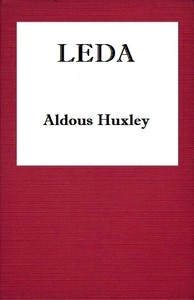
Aldous Huxley's 'Leda' pairs a lush, mythic retelling of Leda's encounter with Zeus with a series of poems and a fragmented prose meditation on Troy, Helen, and the search for truth, marked by ornate diction and shifting perspectives.
Editorial Edition Score
4.5/5
★★★★★
★★★★★
Calculated from edition completeness, EPUB availability, text structure and catalogue metadata. Not a user rating.
How this score is calculated
- Description quality20 pts
- Title & short description10 pts
- Source metadata20 pts
- Text length15 pts
- Chapters / structure15 pts
- EPUB file integrity20 pts
Total of 100 points, scaled to a 2.5-5.0 range. Editions with an empty description or a missing EPUB file are not scored.
Edition quality
Read the Text
is torches but one week About her bed (and still o’er her young cheek Passed rosy shadows of those thoughts that sped Across her mind, still virgin, still unwed, For all her body was her own no more), When Leda with her maidens to the shore Of bright Eurotas came, to escape the heat Of summer noon in waters coolly sweet. By a brown pool which opened smooth and clear Below the wrinkled water of a weir They sat them down under an old fir-tree To rest: and to the laughing melody Of their sweet speech the river’s rippling bore A liquid burden, while the sun did pour Pure colour out of heaven upon the earth. The meadows seethed with the incessant mirth Of grasshoppers, seen only when they flew Their curves of scarlet or sudden dazzling blue. Within the fir-tree’s round of unpierced shade The maidens sat with laughter and talk, or played, Gravely intent, their game of knuckle-bones; Or tossed from hand to hand the old dry cones Littered about the tree. And one did sing A ballad of some far-off Spartan king, Who took a wife, but left her, well-away! Slain by his foes upon their wedding-day. “That was a piteous story,” Leda sighed, “To be a widow ere she was a bride.” “Better,” said one, “to live a virgin life Alone, and never know the name of wife And bear the ugly burden of a child And have great pain by it. Let me live wild, A bird untamed by man!” “Nay,” cried another, “I would be wife, if I should not be mother. Cypris I honour; let the vulgar pay Their gross vows to Lucina when they pray. Our finer spirits would be blunted quite By bestial teeming; but Love’s rare delight Wings the rapt soul towards Olympus’ height.” “Delight?” cried Leda. “Love to me has brought Nothing but pain and a world of shameful thought. When they say love is sweet, the poets lie; ’Tis but a trick to catch poor maidens by. What are their boasted pleasures? I am queen To the most royal king the world has seen; Therefore I should, if any woman might, Know at its full that exquisite delight. Yet these few days since I was made a wife Have held more bitterness than all my life, While I was yet a child.” The great bright tears Slipped through her lashes. “Oh, my childish years! Years that were all my own, too sadly few, When I was happy—and yet never knew How happy till to-day!” Her maidens came About her as she wept, whispering her name, Leda, sweet Leda, with a hundred dear Caressing words to soothe her heavy cheer. At last she started up with a fierce pride Upon her face. “I am a queen,” she cried, “But had forgotten it a while; and you, Wenches of mine, you were forgetful too. Undress me. We would bathe ourself.” So proud A queen she stood, that all her maidens bowed In trembling fear and scarcely dared approach To do her bidding. But at last the brooch Pinned at her shoulder is undone, the wide Girdle of silk beneath her breasts untied; The tunic falls about her feet, and she Steps from the crocus folds of drapery, Dazzlingly naked, into the warm sun. God-like she stood; then broke into a run, Leaping and laughing in the light, as though Life through her veins coursed with so swift a flow Of generous blood and fire that to remain Too long in statued queenliness were pain To that quick soul, avid of speed and joy. She ran, easily bounding, like a boy, Narrow of haunch and slim and firm of breast. Lovelier she seemed in motion than at rest, If that might be, when she was never less, Moving or still, than perfect loveliness. At last, with cheeks afire and heaving flank, She checked her race, and on the river’s bank Stood looking down at her own echoed shape And at the fish that, aimlessly agape, Hung midway up their heaven of flawless glass, Like angels waiting for eternity to pass. Leda drew breath and plunged; her gasping cry Splashed up; the water circled brokenly Out from that pearly shudder of dipped limbs; The glittering pool laughed up its flowery brims, And everything, save the poor fish, rejoiced: Their idiot contemplation of the Moist, The Cold, the Watery, was in a trice Ended when Leda broke their crystal paradise.
The title poem of Aldous Huxley's Leda opens with Eurotas, a river 'brown and bright as an agate, mountain-cool,' slipping from pool to pool. This sensory precision—the agate simile, the river's movement—establishes a landscape where myth and nature intertwine. Huxley's diction is deliberately ornate: 'the young grace of bodies pale and bare, / Shimmering far down' evokes a world of remembered beauty. The poem's voice alternates between lyrical description and direct speech, as when Leda's maidens debate marriage: 'Let me live wild, / A bird untamed by man!' This tension between wildness and domesticity, embodied in the swan's impending arrival, shapes the narrative's undercurrent.
Myth as Sensory Landscape
Huxley's retelling of the Leda myth is less concerned with plot than with atmosphere. The opening lines immerse the reader in a landscape of 'cavernous pines,' 'terraced vines,' and 'valleys grey / With olive trees.' The river Eurotas becomes a mirror for past beauty: 'the ghosts these mirrors hold / Of all the beauty they beheld of old.' This layering of time—present pools holding ancient reflections—is a recurring structural device. The poem dwells on sensory details: the 'incessant mirth / Of grasshoppers,' the 'old dry cones' tossed by maidens, the 'laughing melody' of speech. These accumulate to create a world that feels both immediate and distant, as if viewed through a lens of memory.
Dialogue and the Voices of Women
The maidens' conversation in the title poem offers a rare glimpse of female perspective within a mythic frame. One declares, 'Better to live a virgin life / Alone, and never know the name of wife / And bear the ugly burden of a child.' Another counters, 'I would be wife, if I should not be / ...' The excerpt cuts off, but the contrast is clear: Huxley uses direct speech to dramatize conflicting views on marriage and autonomy. Leda herself is largely silent, her sighs and sighs noted rather than her words. This asymmetry—the maidens articulate, Leda passive—suggests a deliberate authorial choice to foreground the chorus over the protagonist, perhaps reflecting the myth's focus on divine intervention rather than human agency.
Fragmented Prose and the Search for Truth
The later sections of the book shift abruptly to a first-person prose meditation. The narrator describes Troy as 'most of all real and fabulous with its charnel beauty,' and Helen as 'paradisal little World, symbol and epitome of the Great.' The prose is aphoristic and allusive: 'Rome was seven hills of butcher's meat, Athens an abstraction of marble.' This catalog of cities contrasts with the sustained lyricism of the opening poem. The narrator's quest—'When I have learnt the truth, I will return and build a new palace'—is interrupted by 'a hundred Liliputian tethers' and 'epidermical magnetism.' The voice is restless, intellectual, and self-aware, a sharp departure from the mythic register.
Imagery of Architecture and Nature
Throughout the prose sections, Huxley juxtaposes natural and man-made forms. Trees are 'half-fossilised exuberances of a passionate life, petrified fountains of intemperance.' Their removal marks 'the realm of reason,' where 'geometry, lines and planes, smooth edges' dominate. The Acropolis is described as a 'single red monolith, fluted with thirstily shining organ pipes.' This architectural imagery—domes, minarets, bridges—is rendered with a surreal precision: 'the down-struck lamps are pyramids of phantom green.' The natural world, by contrast, is associated with passion and chaos. This binary echoes the earlier tension between wildness and civilization, but here it is explored through a more abstract, philosophical lens.
Huxley's Leda resists easy categorization, moving from mythic narrative to lyric sequence to fragmented philosophical prose. Readers attentive to diction will note the shift from the poem's 'rapturous hours of gazing' to the prose's 'ordered horror of perspectives.' The collection rewards those who engage with its contrasts—between voices, registers, and modes of seeing. Approach each section on its own terms, and consider how the juxtaposition of forms might itself be a statement about the limits of any single perspective.
I remember finishing Leda — Themes and Context and lingering on how Huxley’s luminous, elusive prose made certainty feel like a distant shore. That same ache—of grasping for patterns in vastness—returned while reading Cosmos — A Reader’s Guide. Both hold questions rather than answers, like turning a shell over in your palm, knowing something true hides within its quiet weight.
Henry Thomas
3 weeks agoSamuel Green
1 month agoElijah Hall
2 weeks agoJames Johnson
1 month agoThere are no comments for this eBook.
Reader reflection
What did you think of this book?
Answer a few questions and save a private reflection on this device.
Your progress
0
/
10
2
How did the book work for you overall?
3
Would you recommend this book to another reader?
4
What was the reading difficulty like?
5
Was the book what you thought it would be?
6
Could you follow the author’s main argument?
7
How would you rate its originality?
8
What did you appreciate most?
9
In one sentence, what did you learn?
10

Elijah Martin
1 week ago