About 30 minutes
A Song of the Guns — Key Ideas to Explore
Fantasy Juvenile Worlds
6,836 recorded words. 0 minutes difference from this book's estimate.
View Gutenberg source #40345
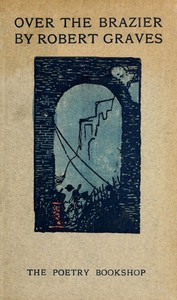
The source record for Over the Brazier — Key Ideas to Explore measures this digital text at 6,795 words, 30 min estimated reading time, and 2 detected text sections.
The text analysis averages about 24.8 words per sentence, while the detected sections provide another way to judge how the source is divided.
Project Gutenberg metadata also associates the work with “World War, 1914-1918 -- Poetry,” connecting these edition facts with the source record’s subject description.
Explore this collection
These alternatives are selected using recorded categories and estimated reading time.
About 30 minutes
Fantasy Juvenile Worlds
6,836 recorded words. 0 minutes difference from this book's estimate.
View Gutenberg source #40345About 26 minutes
Fantasy Juvenile Worlds
5,894 recorded words. 4 minutes difference from this book's estimate.
View Gutenberg source #52559About 22 minutes
Fantasy Juvenile Worlds
4,890 recorded words. 8 minutes difference from this book's estimate.
View Gutenberg source #33533Search stored excerpts and compare books → Choose by your preferences →
Choices use stored catalog measurements. Estimates vary with reading speed. A shared category is a catalog label, not a claim that two books have the same argument or literary quality.
Search reads excerpt text stored with this catalog and links to its associated Gutenberg record. The connection is stored in the site database; this tool does not recheck that every excerpt is word-for-word identical to that external record. Excerpt search does not cover every chapter and does not verify historical publication dates.
Catalog snapshot checked: 2026-09-26. Coverage: 90 public books, 90 available source excerpts.
Calculated from edition completeness, EPUB availability, text structure and catalogue metadata. Not a user rating.
Total of 100 points, scaled to a 2.5-5.0 range. Editions with an empty description or a missing EPUB file are not scored.
Public-domain source text
The source text is kept in the dedicated reader, separate from this catalogue record and its commentary.
Robert Graves's Over the Brazier (1916, revised 1920) opens with a foreword noting the poems were written between ages fourteen and twenty, while the author served in France. The collection's diction and structure oscillate between nursery-rhyme cadences and the jarring syntax of trench experience. In 'The Poet in the Nursery,' a young speaker steals a 'thin pretty book' from an ancient poet, its 'metre twisting like a chain of daisies'—a self-conscious image of poetic apprenticeship. Yet the same volume contains 'It's a Queer Time,' where the line 'It's hard to know if you're alive or dead' introduces a voice that slips from battle into hallucinated childhood scenes. This tension between crafted whimsy and raw reportage defines the collection's authorial choices.
Graves frequently abandons regular meter for lines that mimic mental or physical dislocation. In 'Star-Talk,' the Pleiades speak in a sing-song trimeter ('See us cuddle and hug'), while Orion's reply stretches into a pentameter catalogue. The effect is a deliberate unevenness, as if the speaker cannot sustain a steady beat. In 'It's a Queer Time,' the opening couplet ('It's hard to know if you're alive or dead / When steel and fire go roaring through your head') uses a near-perfect iambic pentameter, but subsequent lines fracture: 'You fall and strike your head; yet feel no pain / And find ... you're digging tunnels through the hay.' The ellipsis and dash create a rhythmic stumble, mirroring the soldier's disorientation. Graves's metrical choices thus become a structural device for conveying trauma.
'Star-Talk' personifies the Gemini, Pleiades, and Orion as shivering, wine-loving creatures who 'huddle together like birds in a storm.' This whimsical astronomy contrasts sharply with the war poems' domestic imagery. In 'It's a Queer Time,' the speaker imagines Elsie, who 'died ten years ago,' tripping 'gaily down the trench' with a 'Hanky to nose—that lyddite makes a stench.' The nursery detail (pinafore, hanky) collides with chemical warfare. Similarly, 'Over the Brazier' records a pre-war fantasy of a cottage 'full of books, / Pictures and brass and cosy nooks,' only to undercut it: 'this silly / Mad War has now wrecked both.' Graves uses the same intimate register for stars and soldiers, suggesting that war has made all safe spaces equally fragile.
Graves employs direct address and fragmented dialogue to depict soldiers' psychological states. In 'Star-Talk,' the poet calls out to the constellations, and they answer in colloquial speech: 'It's no good trying to go to sleep.' This conversational tone recurs in 'It's a Queer Time,' where the speaker's internal monologue breaks into second-person address: 'You're charging madly at them yelling "Fag!"' The sudden shift from 'I' to 'you' distances the speaker from his own actions, a hallmark of dissociation. In 'Over the Brazier,' Willy and Mac speak in quoted dialogue, each proposing a postwar idyll—Canada, a coral isle—while the speaker's own cottage plan is left hanging. The poem ends without resolution, the dialogue unresolved, mirroring the uncertainty of survival.
Graves's 1920 foreword reveals that the poems were first printed while he was 'serving in France' with 'no leisure for getting the final proofs altogether as I wanted them.' He notes 'several alterations in the text, including the suppression of two small poems.' This admission of hasty publication and later correction is itself a textual feature: the poems bear marks of youthful experimentation (the 'funny muddling mazes' of 'The Poet in the Nursery') alongside mature revisions. The foreword does not specify which poems were cut, but the surviving text shows a poet aware of his craft's unevenness. Readers should note that the collection spans ages fourteen to twenty, and the voice shifts accordingly—from the apprentice who 'gloated' over rhymes to the soldier who writes 'It's a queer time.'
Graves's early work rewards attention to its deliberate roughness: the metrical stumbles, the sudden shifts from star-talk to shell-shock, the dialogue that trails off into silence. These are not flaws but authorial choices that register the difficulty of writing poetry in wartime. The collection's brevity (under 7,000 words) invites rereading, especially of the less anthologized poems like 'Star-Talk' and 'Over the Brazier,' where the nursery and the trench meet.
I keep coming back to how Graves could slip from a nursery rhyme into the mud of the trenches without blinking. There’s a particular ache in that, one that lingers across Over the Brazier and finds an echo in A Spring Harvest — A Closer Reading. It’s like remembering a song you hummed as a child, only to realize you’re older now, and the tune has changed.
Your answers remain private and are stored only in this browser.