About 77 minutes
Leda — Themes and Context
Historical Psychological Social Fiction
17,520 recorded words. 24 minutes difference from this book's estimate.
View Gutenberg source #49493
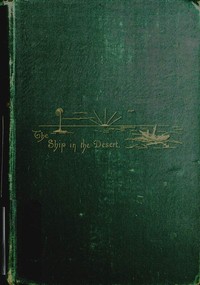
For The Ship in the Desert — Text and Context, the stored edition analysis reports 23,050 words, 1 hr 41 min estimated reading time, and 5 detected text sections.
The text analysis averages about 22.4 words per sentence, while the detected sections provide another way to judge how the source is divided.
Project Gutenberg metadata also associates the work with “American poetry,” connecting these edition facts with the source record’s subject description.
Explore this collection
These alternatives are selected using recorded categories and estimated reading time.
About 77 minutes
Historical Psychological Social Fiction
17,520 recorded words. 24 minutes difference from this book's estimate.
View Gutenberg source #49493About 70 minutes
Historical Psychological Social Fiction
16,083 recorded words. 31 minutes difference from this book's estimate.
View Gutenberg source #36543About 136 minutes
Historical Psychological Social Fiction
31,268 recorded words. 35 minutes difference from this book's estimate.
View Gutenberg source #55178Search stored excerpts and compare books → Choose by your preferences →
Choices use stored catalog measurements. Estimates vary with reading speed. A shared category is a catalog label, not a claim that two books have the same argument or literary quality.
Search reads excerpt text stored with this catalog and links to its associated Gutenberg record. The connection is stored in the site database; this tool does not recheck that every excerpt is word-for-word identical to that external record. Excerpt search does not cover every chapter and does not verify historical publication dates.
Catalog snapshot checked: 2026-09-26. Coverage: 90 public books, 90 available source excerpts.
Calculated from edition completeness, EPUB availability, text structure and catalogue metadata. Not a user rating.
Total of 100 points, scaled to a 2.5-5.0 range. Editions with an empty description or a missing EPUB file are not scored.
Public-domain source text
The source text is kept in the dedicated reader, separate from this catalogue record and its commentary.
Joaquin Miller's The Ship in the Desert opens with a preface that frames the poem as a thread of fiction strung upon scenes from a real overland journey. The speaker recalls a half-year crossing of the continent, describing the Missouri River as 'sullen, strong, and lion-like' and the party's passage through 'parched lands like Syria.' This personal memory quickly gives way to a narrative set in a landscape of 'alkali and ashes,' where a band of men, led by a figure named Morgan, descends into a dead region of black walls and silver sand. The poem's structure alternates between panoramic description and close, almost geological observation, as if the speaker is trying to read the earth's history in its broken surfaces.
The poem's opening movement is a controlled descent. Morgan's men wind down a steep hill 'like some great serpent black and still,' a simile that links the human column to the reptiles that later appear in the ashes. The land is described as 'dead,' 'rent by earthquake's shock,' and 'overthrown'—a place where 'the very devastation gleamed.' Miller emphasizes the materiality of the terrain: 'iron hoofs' sink into ashes, breaking 'old broken idols' and exposing 'old bits of vessels' embedded in stone. The setting is not merely barren but layered with evidence of prior habitation and catastrophe. The narrator notes a 'city older than that gray / And grass-grown tower builded when / Confusion cursed the tongues of men,' situating the desert within a deep, almost biblical chronology. The descent is also a movement backward in time, toward a 'dread and dried-up sea' that once held ships.
Miller populates this dead landscape with a few sparse, carefully chosen creatures. A rattlesnake, 'loathsome, yellow-skinn'd,' lies coiled 'tight as pine-knot' in the sun; when disturbed, it strikes blindly and then 'rattling crept / Flat-bellied down the dusty way.' The narrator comments: ''Twas all the dead land had to say.' Above, two 'pink-eyed hawks, wide-wing'd and gray' scream and circle, then 'Grew dim and died against the sky.' Again: ''Twas all the heavens had to say.' These paired observations create a symmetry between earth and sky, each offering only a single, minimal gesture of life. The snake's mechanical strike and the hawks' fading flight are not symbols so much as evidence of a world reduced to its barest functions. The grasses fail, replaced by 'brown, burnt cactus' and 'stunted sage,' and the last junipers are 'black as shapes of hell' with 'dumb owls' waiting for night. The poem's voice here is flat, almost reportorial, refusing to elaborate beyond what the eye can see.
As the party moves deeper, the landscape becomes increasingly archaeological. A 'savage bluff' lifts 'great walls with characters cut rough / And deep by some long-perish'd race,' and 'strange beasts unnamed, unknown' are 'hewn and limn'd upon the stone.' The poem does not identify these figures; they remain as illegible as the 'old broken idols' underfoot. Miller then introduces a city 'that in her majesty had shamed / The wolf-nursed conqueror of old,' likely a reference to Nineveh or Babylon, but the comparison is left suspended. The bay below is 'a broad bay shrunk to sand and stone, / Where ships had rode and breakers roll'd / When Babylon was yet unnamed.' This telescoping of historical time—from the city's glory to its petrified remains—is achieved through simple juxtaposition rather than explanation. The narrator does not moralize; the ruins simply exist, as inert as the 'cinders' and 'ashes' that cover them. The effect is cumulative: each layer of decay adds to the sense of a world that has outlasted its own meaning.
Despite the title, the ship itself does not appear in the provided excerpts. The poem's focus is on the approach to a 'dried-up sea' called 'Azteckee,' a name that suggests a lost inland ocean. The narrator addresses this sea directly: 'White Azteckee! Dead Azteckee! / Vast sepulchre of buried sea! / What dim ghosts hover on thy rim, / What stately-manner'd shadows swim / Along thy gleaming waste of sands.' The ship, if it exists, remains offstage, a destination or a memory. This absence is structural: the poem builds anticipation through landscape alone, withholding the titular object. The reader, like Morgan's men, moves toward something that can only be inferred from the debris—the 'white arm of a bay,' the 'shoreless limits of dead lands.' The ship may be a literal vessel or a mirage; the text does not decide. What matters is the pull of the empty basin, the way the desert organizes itself around a vanished body of water.
Readers should attend to the poem's handling of scale: Miller moves between the intimate (a snake's rattle, a hawk's scream) and the geological (volcanic plains, dried seas) without transition. The narrative thread is thin—a party crossing a desert—but the descriptive passages are dense with material detail. The preface warns that the story is 'ragged and broken,' and the poem honors that brokenness by refusing to smooth over its gaps. Approach the text as a sequence of vivid, static tableaux rather than a continuous plot.
That rainy afternoon, The Ship in the Desert left me with the strange ache of a dried sea—how ambition turns to ash, yet the marks remain. Later, idly, I picked up A Song of the English — Reading Companion, and found the same patient longing for permanence, softened by tide rather than dust. It felt less like discovery, more like weather turning familiar.
Save your reaction, strongest insight, and memorable passage.