About 530 minutes
The Poetical Works of William Wordsworth — Volume 6 (of 8) — Themes and Context
Historical Psychological Social Fiction
121,700 recorded words. 453 minutes difference from this book's estimate.
View Gutenberg source #47651
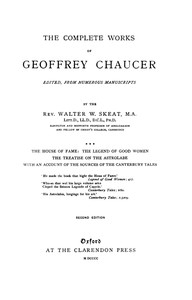
The catalog record for Chaucer's Works, Volume 3 — The House of Fame; The Legend of Good Women; The Treatise on the Astrolabe; The Sources of the Canterbury Tales — Key Ideas to Explore provides practical reading context through 226,032 words, 16 hr 23 min estimated reading time, and 37 detected text sections.
The text analysis averages about 15.8 words per sentence, while the detected sections provide another way to judge how the source is divided.
Project Gutenberg metadata also associates the work with “English poetry -- Middle English, 1100-1500,” connecting these edition facts with the source record’s subject description.
Explore this collection
These alternatives are selected using recorded categories and estimated reading time.
About 530 minutes
Historical Psychological Social Fiction
121,700 recorded words. 453 minutes difference from this book's estimate.
View Gutenberg source #47651About 360 minutes
Historical Psychological Social Fiction
82,610 recorded words. 623 minutes difference from this book's estimate.
View Gutenberg source #43661About 349 minutes
Historical Psychological Social Fiction
80,142 recorded words. 634 minutes difference from this book's estimate.
View Gutenberg source #32459Search stored excerpts and compare books → Choose by your preferences →
Choices use stored catalog measurements. Estimates vary with reading speed. A shared category is a catalog label, not a claim that two books have the same argument or literary quality.
Search reads excerpt text stored with this catalog and links to its associated Gutenberg record. The connection is stored in the site database; this tool does not recheck that every excerpt is word-for-word identical to that external record. Excerpt search does not cover every chapter and does not verify historical publication dates.
Catalog snapshot checked: 2026-09-26. Coverage: 90 public books, 90 available source excerpts.
Calculated from edition completeness, EPUB availability, text structure and catalogue metadata. Not a user rating.
Total of 100 points, scaled to a 2.5-5.0 range. Editions with an empty description or a missing EPUB file are not scored.
Public-domain source text
The source text is kept in the dedicated reader, separate from this catalogue record and its commentary.
Chaucer's House of Fame opens with a dream-vision that immediately signals his interest in the mechanics of poetic authority. The narrator's invocation of the god of sleep and his subsequent encounter with an eagle—who claims to be Jupiter's messenger—establish a framework where divine inspiration and earthly experience collide. Skeat's notes draw attention to the eagle's line, 'Iouis ales,' a direct borrowing from Virgil's Aeneid, showing Chaucer's habit of embedding classical allusions within vernacular verse. This layering of sources is not mere pedantry; it becomes a structural principle, as the poem itself questions how fame distorts truth.
Throughout the volume, Chaucer shifts between high and low diction with deliberate effect. In The House of Fame, the eagle's learned speech—full of astronomical and philosophical terms—contrasts with the narrator's colloquial asides. Skeat notes a crux in line 621, where Chaucer rimes 'lyte' with 'dytees,' requiring the reader to elide the final 'e' for metrical consistency. Such moments reveal a poet acutely aware of the sound of his lines. In The Legend of Good Women, the Prologue's praise of the daisy employs a courtly vocabulary that Skeat traces to French love poetry, yet the narrator's self-deprecating tone undercuts any solemnity. This mixing of registers—learned and plain, formal and familiar—gives Chaucer's verse a conversational intimacy even when discussing abstract ideas.
Chaucer's dialogue often reveals character through rhythm and word choice rather than explicit description. In The House of Fame, the eagle's lengthy explanation of sound's physics (lines 614-640) is a single sentence of 27 lines, mimicking the breathless enthusiasm of a pedant. Skeat's commentary highlights how Chaucer 'describest everything that relates to them,' a phrase that captures the eagle's tendency to over-explain. Conversely, the narrator's responses are terse, marked by interjections that Skeat identifies as colloquial fillers. In The Legend of Good Women, the god of Love's angry speech contrasts with Alcestis's measured pleading; their differing sentence lengths and vocabulary create a dramatic tension that the narrator merely observes. This technique allows Chaucer to imply psychological depth without authorial intrusion.
The Treatise on the Astrolabe, written for 'little Lewis,' shifts Chaucer's descriptive mode from poetic imagery to technical precision. Skeat's edition separates Chaucer's text from later commentary, revealing a prose style that is remarkably clear and methodical. Where the poems use metaphor to describe celestial phenomena—the eagle's flight in The House of Fame is both literal and allegorical—the Astrolabe employs step-by-step instructions. Yet even here, Chaucer's authorial voice emerges: he addresses his son directly, uses analogies from everyday life, and occasionally apologizes for digressions. This juxtaposition of poetic and scientific description within a single volume underscores Chaucer's range. The same poet who invents a dream-eagle also calculates the altitude of the sun.
Both The House of Fame and The Legend of Good Women are incomplete, and Skeat's notes treat this as a feature rather than a flaw. The House of Fame breaks off after the appearance of a 'man of gret auctorite,' leaving the reader in suspense. Skeat observes that Chaucer 'had it in intention' to continue, but the abrupt ending forces attention on the poem's themes of rumor and unfinished knowledge. Similarly, The Legend of Good Women contains only nine of the planned nineteen legends; Skeat's introduction details the manuscript variations, including two versions of the Prologue. These structural gaps invite readers to consider process over product. Chaucer's willingness to leave works open-ended suggests a view of poetry as ongoing experiment rather than fixed monument.
Readers approaching this volume should attend to Skeat's marginalia as much as to Chaucer's lines. The editor's philological rigor—his corrections of meter, his tracing of sources, his identification of scribal errors—illuminates the choices a medieval poet made under constraints of rhyme, manuscript transmission, and audience expectation. Rather than seeking a unified reading, consider how each text enacts a different mode of authorship: the dreamer, the hagiographer, the instructor. The volume's value lies in this multiplicity.
Chaucer’s astrolabe, all brass circles and patient stars, always reminds me of that other fourteenth-century voice, plainer and rougher, crying amidst the furrows. Both men sought a truth beyond the page—one through instruments, one through visions. I often shelve them together, these quiet companions, and fancy their spines leaning toward each other in the dark. The Vision and Creed of Piers Ploughman, Volume 2 — Reading Notes holds that same weary, wondering breath.
Answer a few questions and save a private reflection on this device.