About 360 minutes
The Vision and Creed of Piers Ploughman, Volume 2 — Reading Notes
Historical Psychological Social Fiction
82,610 recorded words. 170 minutes difference from this book's estimate.
View Gutenberg source #43661
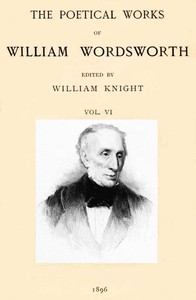
The source record for The Poetical Works of William Wordsworth — Volume 6 (of 8) — Themes and Context measures this digital text at 121,700 words, 8 hr 50 min estimated reading time, and 30 detected text sections.
The text analysis averages about 21.9 words per sentence, while the detected sections provide another way to judge how the source is divided.
Project Gutenberg metadata also associates the work with “English poetry -- 19th century,” connecting these edition facts with the source record’s subject description.
Explore this collection
These alternatives are selected using recorded categories and estimated reading time.
About 360 minutes
Historical Psychological Social Fiction
82,610 recorded words. 170 minutes difference from this book's estimate.
View Gutenberg source #43661About 349 minutes
Historical Psychological Social Fiction
80,142 recorded words. 181 minutes difference from this book's estimate.
View Gutenberg source #32459About 187 minutes
Historical Psychological Social Fiction
42,882 recorded words. 343 minutes difference from this book's estimate.
View Gutenberg source #29879Search stored excerpts and compare books → Choose by your preferences →
Choices use stored catalog measurements. Estimates vary with reading speed. A shared category is a catalog label, not a claim that two books have the same argument or literary quality.
Search reads excerpt text stored with this catalog and links to its associated Gutenberg record. The connection is stored in the site database; this tool does not recheck that every excerpt is word-for-word identical to that external record. Excerpt search does not cover every chapter and does not verify historical publication dates.
Catalog snapshot checked: 2026-09-26. Coverage: 90 public books, 90 available source excerpts.
Calculated from edition completeness, EPUB availability, text structure and catalogue metadata. Not a user rating.
Total of 100 points, scaled to a 2.5-5.0 range. Editions with an empty description or a missing EPUB file are not scored.
Public-domain source text
The source text is kept in the dedicated reader, separate from this catalogue record and its commentary.
Wordsworth's diction in this volume often shifts between plain statement and a more elevated, almost scriptural tone, as seen in the opening of Laodamia where the hero's address to his wife is rendered with formal gravity. The editor, William Knight, supplies variant readings that show Wordsworth repeatedly adjusting single words—substituting 'serving' for 'having served' in the Duddon headnote—to tighten the geographical precision. These small changes reflect a larger authorial habit: the poet treats his own earlier work as material to be refined, not fixed.
Knight's footnotes do more than gloss allusions; they document Wordsworth's compositional process. For instance, a note on the Duddon sonnets quotes Southey's letter about tracing the Derwent from source to sea, linking the poet's fascination with river courses to a known biographical fact. Elsewhere, Knight records that Wordsworth 'delighted in tracing the course of rivers all the way from their source to the sea'—a remark that illuminates the structural logic behind the sonnet sequence. The editor also supplies variant lines from different editions, allowing the reader to see how a phrase like 'and, having served' was later tightened to 'and, serving.' These apparatus entries turn the volume into a workshop record.
The poems of 1816 include several odes written for national thanksgivings and battles—Waterloo, the French retreat from Russia. Yet Wordsworth's voice in these pieces is not uniformly martial. In 'Feelings of a French Royalist,' the diction becomes intimate and elegiac, while the 'Ode. The Morning of the Day appointed for a General Thanksgiving' blends liturgical repetition with landscape description. The contrast between public form and personal inflection is sharpest in the two Waterloo poems: the first uses conventional heroic couplets, the second shifts to a more meditative, irregular stanza. Wordsworth seems to test which register suits historical commemoration.
Several poems anchor emotion in specific locations. 'Composed in one of the Valleys of Westmoreland, on Easter Sunday' ties religious feeling to a named valley, while 'To the River Derwent' addresses the watercourse as a witness to childhood. The Duddon sonnets are introduced by a headnote that traces the river's course through three counties, and the accompanying letter to the Rev. Dr. Wordsworth describes a Christmas minstrel tradition that 'never-failing rite' repeats annually. Wordsworth's method is to layer personal recollection over topographic fact: the river is both a geographical boundary and a thread of memory. The editor's notes reinforce this by supplying the biographical circumstances of each poem's composition.
Wordsworth's revisions often affect rhythm and sound. In the Duddon headnote, the change from 'having served' to 'serving' removes a syllable, quickening the prose. In the poem 'To the Rev. Dr. Wordsworth,' the line 'The Minstrels played their Christmas tune' uses a regular iambic tetrameter that the poet preserves across editions, but the surrounding stanzas show him adjusting line lengths for emphasis. Knight's textual notes record these shifts, making audible the poet's ear for metrical weight. The reader can trace how Wordsworth's later preference for simpler, more direct phrasing sometimes overrides his earlier, more Latinate constructions—a pattern visible across the volume's decade of production.
Because this volume covers a period of intense public and private composition, the reader may find it useful to compare the odes on national events with the more personal lyrics that follow them. Knight's editorial choices—especially his inclusion of variant readings and biographical notes—invite a comparative reading that foregrounds Wordsworth's deliberate craft. The poems reward attention to small verbal adjustments, which often signal larger shifts in tone or intention.
That rain kept tapping the window as I turned Wordsworth’s Duddon sonnets, his river flowing through editorial notes. Somehow, his medieval echoes of doomed love led me to Chaucer’s own legends, where old stories breathe differently. I found Chaucer's Works, Volume 3 — The House of Fame; The Legend of Good Women; The Treatise on the Astrolabe; The Sources of the Canterbury Tales — Key Ideas to Explore waiting quietly, and the afternoon simply continued.
Save your reaction, strongest insight, and memorable passage.