1

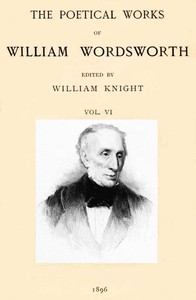
The Poetical Works of William Wordsworth — Volume 6 (of 8) — Themes and Context
(11 User reviews)
2020
Project Gutenberg
2014
Not confirmed
English poetry -- 19th century; English poetry -- 18th century
Readers of public-domain and historical texts
Project Gutenberg digital edition
en
Edition facts
Words
121,700
Reading time
530 min
Text sections
30
The source record for The Poetical Works of William Wordsworth — Volume 6 (of 8) — Themes and Context measures this digital text at 121,700 words, 8 hr 50 min estimated reading time, and 30 detected text sections.
The text analysis averages about 21.9 words per sentence, while the detected sections provide another way to judge how the source is divided.
Project Gutenberg metadata also associates the work with “English poetry -- 19th century,” connecting these edition facts with the source record’s subject description.
Source:
Project Gutenberg record #47651
This volume collects Wordsworth's poems from 1814–1819, including Laodamia, the Duddon sonnets, and odes on public events. Editorial notes by William Knight trace revisions and biographical contexts, revealing Wordsworth's evolving diction and his layering of personal memory onto landscape.
Editorial Edition Score
4.9/5
★★★★★
★★★★★
Calculated from edition completeness, EPUB availability, text structure and catalogue metadata. Not a user rating.
How this score is calculated
- Description quality20 pts
- Title & short description10 pts
- Source metadata20 pts
- Text length15 pts
- Chapters / structure15 pts
- EPUB file integrity20 pts
Total of 100 points, scaled to a 2.5-5.0 range. Editions with an empty description or a missing EPUB file are not scored.
Edition quality
Read the Text
looked upon him and was calmed and cheered; The ghastly colour from his lips had fled; In his deportment, shape, and mien, appeared Elysian beauty, melancholy grace, 95 Brought from a pensive though a happy place.
He spake of love, such love as Spirits feel In worlds whose course is equable and pure; No fears to beat away--no strife to heal-- The past unsighed for, and the future sure; 100 Spake of heroic arts in graver mood Revived, with finer harmony pursued;[8]
Of all that is most beauteous--imaged there In happier beauty; more pellucid streams, An ampler ether, a diviner air, 105 And fields invested with purpureal gleams; Climes which the sun, who sheds the brightest day Earth knows, is all unworthy to survey.
Yet there the Soul shall enter which hath earned That privilege by virtue.--"Ill," said he, 110 "The end of man's existence I discerned, Who from ignoble games and revelry Could draw, when we had parted, vain delight, While tears were thy best pastime, day and night;
"And while my youthful peers before my eyes 115 (Each hero following his peculiar bent) Prepared themselves for glorious enterprise By martial sports,--or, seated in the tent, Chieftains and kings in council were detained; What time the fleet at Aulis lay enchained.[A] 120
"The wished-for wind was given:--I then revolved The oracle, upon the silent sea;[9] And, if no worthier led the way, resolved That, of a thousand vessels, mine should be The foremost prow in pressing to the strand,-- 125 Mine the first blood that tinged the Trojan sand.
"Yet bitter, oft-times bitter, was the pang When of thy loss I thought, belovèd Wife! On thee too fondly did my memory hang, And on the joys we shared in mortal life,-- 130 The paths which we had trod--these fountains, flowers; My new-planned cities, and unfinished towers.
"But should suspense permit the Foe to cry, 'Behold they tremble!--haughty their array, Yet of their number no one dares to die?' 135 In soul I swept the indignity away: Old frailties then recurred:--but lofty thought, In act embodied, my deliverance wrought.
"And Thou, though strong in love, art all too weak In reason, in self-government, too slow; 140 I counsel thee by fortitude to seek Our blest re-union in the shades below. The invisible world with thee hath sympathised; Be thy affections raised and solemnised.
"Learn, by a mortal yearning, to ascend 145 Seeking[10] a higher object. Love was given, Encouraged, sanctioned, chiefly for that[11] end; For this the passion to excess was driven-- That self might be annulled; her bondage prove The fetters of a dream, opposed to love."-- 150
Aloud she shrieked! for Hermes re-appears! Round the dear Shade she would have clung--'tis vain: The hours are past--too brief had they been years; And him no mortal effort can detain: Swift, toward the realms that know not earthly day, 155 He through the portal takes his silent way, And on the palace-floor a lifeless corse She lay.
Thus, all in vain exhorted and reproved, She perished; and, as for a wilful crime, By the just Gods whom no weak pity moved, 160 Was doomed to wear out her appointed time, Apart from happy Ghosts, that gather flowers[12] Of blissful quiet 'mid unfading bowers.
--Yet tears to human suffering are due; And mortal hopes defeated and o'erthrown 165 Are mourned by man, and not by man alone, As fondly he believes.--Upon the side Of Hellespont (such faith was entertained) A knot of spiry trees for ages grew From out the tomb of him for whom she died; 170 And ever, when such stature they had gained That Ilium's walls were subject to their view, The trees' tall summits withered at the sight; A constant interchange of growth and blight![C]
After meeting the Wordsworths at Charles Lamb's, on the 9th May 1815, Henry Crabb Robinson wrote in his _Diary_: "It is the mere power which he is conscious of exerting in which he delights, not the production of a work in which men rejoice on account of the sympathies and sensibilities it excites in them. Hence, he does not much esteem his _Laodamia_, as it belongs to the inferior class of poems founded on the affections." (See _Diary, Reminiscences, and Correspondence_, vol. i. p. 482.)
Wordsworth wrote thus to Walter Savage Landor, from Rydal Mount, on the 21st of January 1824:--
Wordsworth's diction in this volume often shifts between plain statement and a more elevated, almost scriptural tone, as seen in the opening of Laodamia where the hero's address to his wife is rendered with formal gravity. The editor, William Knight, supplies variant readings that show Wordsworth repeatedly adjusting single words—substituting 'serving' for 'having served' in the Duddon headnote—to tighten the geographical precision. These small changes reflect a larger authorial habit: the poet treats his own earlier work as material to be refined, not fixed.
The Editor's Hand in the Margins
Knight's footnotes do more than gloss allusions; they document Wordsworth's compositional process. For instance, a note on the Duddon sonnets quotes Southey's letter about tracing the Derwent from source to sea, linking the poet's fascination with river courses to a known biographical fact. Elsewhere, Knight records that Wordsworth 'delighted in tracing the course of rivers all the way from their source to the sea'—a remark that illuminates the structural logic behind the sonnet sequence. The editor also supplies variant lines from different editions, allowing the reader to see how a phrase like 'and, having served' was later tightened to 'and, serving.' These apparatus entries turn the volume into a workshop record.
Public Occasions and Private Cadences
The poems of 1816 include several odes written for national thanksgivings and battles—Waterloo, the French retreat from Russia. Yet Wordsworth's voice in these pieces is not uniformly martial. In 'Feelings of a French Royalist,' the diction becomes intimate and elegiac, while the 'Ode. The Morning of the Day appointed for a General Thanksgiving' blends liturgical repetition with landscape description. The contrast between public form and personal inflection is sharpest in the two Waterloo poems: the first uses conventional heroic couplets, the second shifts to a more meditative, irregular stanza. Wordsworth seems to test which register suits historical commemoration.
Memory Woven into Place
Several poems anchor emotion in specific locations. 'Composed in one of the Valleys of Westmoreland, on Easter Sunday' ties religious feeling to a named valley, while 'To the River Derwent' addresses the watercourse as a witness to childhood. The Duddon sonnets are introduced by a headnote that traces the river's course through three counties, and the accompanying letter to the Rev. Dr. Wordsworth describes a Christmas minstrel tradition that 'never-failing rite' repeats annually. Wordsworth's method is to layer personal recollection over topographic fact: the river is both a geographical boundary and a thread of memory. The editor's notes reinforce this by supplying the biographical circumstances of each poem's composition.
The Sound of Revision
Wordsworth's revisions often affect rhythm and sound. In the Duddon headnote, the change from 'having served' to 'serving' removes a syllable, quickening the prose. In the poem 'To the Rev. Dr. Wordsworth,' the line 'The Minstrels played their Christmas tune' uses a regular iambic tetrameter that the poet preserves across editions, but the surrounding stanzas show him adjusting line lengths for emphasis. Knight's textual notes record these shifts, making audible the poet's ear for metrical weight. The reader can trace how Wordsworth's later preference for simpler, more direct phrasing sometimes overrides his earlier, more Latinate constructions—a pattern visible across the volume's decade of production.
Because this volume covers a period of intense public and private composition, the reader may find it useful to compare the odes on national events with the more personal lyrics that follow them. Knight's editorial choices—especially his inclusion of variant readings and biographical notes—invite a comparative reading that foregrounds Wordsworth's deliberate craft. The poems reward attention to small verbal adjustments, which often signal larger shifts in tone or intention.
That rain kept tapping the window as I turned Wordsworth’s Duddon sonnets, his river flowing through editorial notes. Somehow, his medieval echoes of doomed love led me to Chaucer’s own legends, where old stories breathe differently. I found Chaucer's Works, Volume 3 — The House of Fame; The Legend of Good Women; The Treatise on the Astrolabe; The Sources of the Canterbury Tales — Key Ideas to Explore waiting quietly, and the afternoon simply continued.
Sofia Hernandez
1 month agoBenjamin Moore
4 weeks agoAvery Roberts
1 month agoJack Baker
1 month agoThere are no comments for this eBook.
Reader reflection
How will you remember this book?
Save your reaction, strongest insight, and memorable passage.
Your progress
0
/
10
2
How much did you enjoy the reading experience?
3
Would you pass this book on to a friend?
4
How much effort did this book require?
5
Did any part of the book feel personally relevant?
6
How valuable was this book for your own interests?
7
How much did the book move you?
8
Did the book meet your expectations?
9
What changed or sharpened your thinking?
10

Daniel Miller
4 weeks ago